Assets, Liabilities & Equity: Small Business Accounting Essentials
Master the accounting equation to understand your business's financial health and make smarter decisions.

Understanding Assets, Liabilities, and Equity
Every successful business owner needs to understand three fundamental financial components: assets, liabilities, and equity. These three elements form the foundation of your company’s financial health and are essential for making informed business decisions, securing loans, and preventing fraud. Whether you’re running a startup or an established small business, mastering these concepts will help you keep your finger on the pulse of your company’s financial situation.
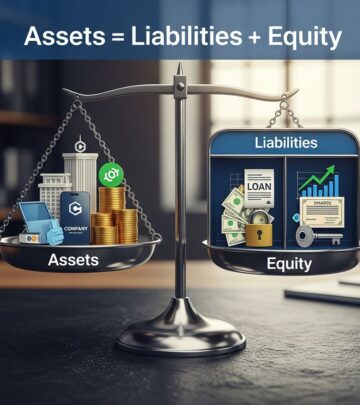
The relationship between these three components is governed by the accounting equation, which states that your business’s assets should always equal the sum of your liabilities and equity. This simple yet powerful formula keeps your books balanced and provides a clear picture of your company’s financial position at any given time.
What Are Assets?
Assets are quantifiable items—tangible or intangible—that add value to your company and contribute to its overall worth. Think of assets as everything your business owns or controls that has economic value. These resources represent the financial strength of your organization and can be converted into cash or used to generate revenue.
Assets fall into several categories:
- Cash and cash equivalents: Money in your business bank accounts and highly liquid investments
- Accounts receivable: Money owed to you by customers for goods or services already provided
- Inventory: Products or materials held for sale or use in production
- Equipment and machinery: Physical resources used in business operations
- Property and real estate: Land and buildings owned by your business
- Intellectual property: Patents, trademarks, copyrights, and proprietary technology
- Goodwill: The value of your business reputation and customer relationships
When calculating total assets, you should list all resources your company controls that have economic value. This comprehensive inventory ensures your balance sheet accurately reflects your company’s true financial position.
Understanding Liabilities
Liabilities represent financial obligations that your company has to external parties. These are debts and commitments your business must fulfill, and they represent claims against your company’s assets by creditors and other entities.
Common types of liabilities include:
- Accounts payable: Money owed to vendors and suppliers for goods or services received
- Short-term loans: Debt obligations due within one year
- Long-term loans: Debt obligations extending beyond one year
- Credit card debt: Outstanding balances on business credit cards
- Taxes owed: Income taxes, payroll taxes, and other tax obligations
- Wages payable: Salaries and wages owed to employees
- Bonds payable: Debt securities issued by the company
- Contingent liabilities: Potential obligations like product warranties or pending lawsuits
Contingent liabilities deserve special attention because they represent potential future obligations. These might include the cost of honoring product warranties, potential legal settlements, or environmental cleanup costs. While these liabilities may not be certain, accounting principles require you to include them in your calculations if they’re reasonably possible.
Defining Equity
Equity, also known as owner’s equity or net worth, represents the owner’s or shareholders’ stake in the company. It’s the residual value that belongs to the business owners after all liabilities have been paid. Equity reflects what would remain if the company liquidated all its assets and paid off all its debts today.
There are two main types of equity structures:
Owner’s equity: In small businesses and sole proprietorships, owner’s equity reflects the direct stake of the business owner. This equity changes as profits are reinvested into the business or as the owner withdraws money for personal use.
Shareholder equity: In corporations and publicly traded companies, equity is distributed among multiple shareholders. This equity can grow when new shares are issued or when company profits are reinvested into business operations.
The Accounting Equation
The foundation of all accounting and financial reporting is the accounting equation: Assets = Liabilities + Equity. This equation must always balance, forming the basis of the double-entry accounting system where every business transaction results in entries on both sides of the equation.
To understand how this works in practice, consider a simple example: Your company generates $20 in cash. This $20 is an asset for your business. However, this asset must be funded by either a liability or equity. If Bank Y lent you that $20, it’s also a liability you must repay. You would enter this transaction as both an asset (cash) and a liability (loan payable), keeping your books perfectly balanced.
This balancing principle ensures that your financial statements accurately reflect your company’s financial position. If your accounting doesn’t balance, it signals that an error exists somewhere in your records that needs to be identified and corrected.
Calculating Owner’s Equity
To calculate your company’s owner’s equity, you need to use the owner’s equity formula:
Equity = Assets – Liabilities
Let’s work through a practical example: Suppose your company with five equal-share owners has $1.2 million in total assets. Your company owes $485,000 on a term loan and $120,000 for a financed semi-truck, bringing total liabilities to $605,000.
Using the formula: $1,200,000 – $605,000 = $595,000 in total equity. Since there are five equal owners, each owner’s equity would be $595,000 ÷ 5 = $119,000 per owner.
It’s important to note that owner’s equity calculated this way usually differs slightly from the market value of your company. In fact, it’s typically lower because market valuations often factor in intangible aspects like intellectual property value, brand strength, and expected future returns that don’t appear in the straightforward owner’s equity calculation.
Understanding Net Change Formulas
Assets, liabilities, and equity are rarely fixed values. Your company’s financial position changes constantly as you conduct business operations, acquire new assets, pay off debts, and generate profits or losses. To keep your financial records accurate, you need to periodically adjust your calculations to reflect current values and debts.
When your financial position changes, use the net change formula to update your accounting equation:
Current Period Value – Previous Period Value = Net Change
For example, suppose your company had $7,000 in inventory last quarter but now has only $5,000 in inventory. The net change would be calculated as: $5,000 – $7,000 = -$2,000. This means you should reduce your total assets by $2,000.
Taking out a new loan illustrates another important principle: adding liabilities reduces owner’s equity. If you borrow $50,000, your liabilities increase by $50,000 (and your assets increase by $50,000 from the cash received), but your equity remains unchanged initially. However, as you service the debt with interest payments, your equity may decrease.
Why These Concepts Matter for Small Business Loans
Understanding assets, liabilities, and equity becomes critically important when you need to secure financing. Before approving a business loan or line of credit, lenders meticulously examine your balance sheet to assess your ability to repay the debt.
Lenders pay particular attention to several factors:
- Your current ratio (current assets divided by current liabilities) to determine if you can meet short-term obligations
- Your debt-to-equity ratio (total liabilities divided by total equity) to assess how much you’re leveraging borrowed capital versus owner investment
- The quality and liquidity of your assets to determine collateral value
- Your historical ability to generate profits and maintain positive cash flow
A company with many existing liabilities may struggle to convince lenders of its ability to take on additional debt payments. Similarly, a business with very few quality assets to provide as collateral is viewed as a higher lending risk because the lender has less recourse if you default on the loan.
Sample Balance Sheet Example
To see how assets, liabilities, and equity fit together in practice, consider this simplified balance sheet for a fictional SaaS startup:
| StartUp Co. Balance Sheet (as of December 31) | |
| Assets | |
| Cash | $50,000 |
| Accounts Receivable | $20,000 |
| Equipment | $15,000 |
| Total Assets | $85,000 |
| Liabilities | |
| Credit Card Debt | $5,000 |
| Accounts Payable | $10,000 |
| Bank Loan | $20,000 |
| Total Liabilities | $35,000 |
| Equity | |
| Founder’s Investment | $30,000 |
| Retained Earnings | $20,000 |
| Total Equity | $50,000 |
| Total Liabilities + Equity | $85,000 |
Notice how the accounting equation balances perfectly: Assets ($85,000) = Liabilities ($35,000) + Equity ($50,000). The company’s $85,000 in assets is financed partly by what it owes ($35,000 in liabilities) and partly by what belongs to the founder ($50,000 in equity).
Key Financial Ratios to Monitor
Once you understand your assets, liabilities, and equity, you can calculate important financial ratios that reveal your company’s health:
| Ratio | Formula | What It Measures |
|---|---|---|
| Current Ratio | Current Assets ÷ Current Liabilities | Ability to pay current debts with current assets |
| Quick Ratio | (Cash + Accounts Receivable) ÷ Current Liabilities | Ability to pay debts with most liquid assets |
| Cash Ratio | Cash ÷ Current Liabilities | Ability to pay current debts with cash only |
| Debt-to-Equity Ratio | Total Liabilities ÷ Total Equity | Proportion of debt vs. owner capital financing |
Frequently Asked Questions
Q: Why must my balance sheet always balance?
A: The balance sheet must always balance because it reflects the accounting equation: Assets = Liabilities + Equity. This fundamental principle ensures your financial records are accurate and helps identify errors in your bookkeeping.
Q: What’s the difference between current and long-term liabilities?
A: Current liabilities are debts due within one year, such as accounts payable and short-term loans. Long-term liabilities extend beyond one year, including long-term loans and bonds payable.
Q: How often should I update my balance sheet?
A: Most small businesses should prepare balance sheets quarterly, though many also create monthly statements for better financial management. At minimum, you should review your balance sheet annually.
Q: Can equity be negative?
A: Yes, equity can be negative if liabilities exceed assets. This situation, called negative equity or insolvency, indicates the business is in financial distress and may require intervention.
Q: How does profit affect equity?
A: When your business generates profit, it increases retained earnings, which is part of owner’s equity. Conversely, losses decrease equity. This is why profitable companies typically show growing equity over time.
Bottom Line
Assets, liabilities, and equity are the three pillars of your business’s financial foundation. Understanding how these components interact and maintaining a balanced balance sheet is essential for business success. Whether you’re managing daily operations, planning for growth, or seeking financing, a clear grasp of these concepts enables you to make smarter financial decisions and maintain the health of your business. Before applying for a small business loan or line of credit, ensure your balance sheet is in order because lenders will carefully examine it to determine whether you can repay any borrowed funds.
References
- What Are Assets, Liabilities and Equity? — Bankrate. 2025. https://www.bankrate.com/loans/small-business/assets-liabilities-equity/
- Assets vs liabilities vs. equity: balance sheet basics for founders — Mercury. 2025. https://mercury.com/blog/assets-vs-liabilities-vs-equity
- What Are Assets? — Bankrate. 2025. https://www.bankrate.com/investing/what-are-assets/
- 4 types of financial statements for a small business — Bankrate. 2025. https://www.bankrate.com/small-business/types-of-financial-statements-small-business/
- Balance Sheets for Small Businesses: A Simple Guide — Vintti. 2025. https://www.vintti.com/blog/balance-sheets-sample-a-comprehensive-guide-for-small-businesses
- Small Business Guide: Assets, Liabilities & Equity — OnPay. 2025. https://onpay.com/insights/assets-liabilities-equity-guide/
Similar Articles








Read full bio of medha deb