Asset Impairment in Accounting: Definition and Examples
Understanding asset impairment: How companies assess and adjust asset values on financial statements.
Understanding Asset Impairment in Accounting
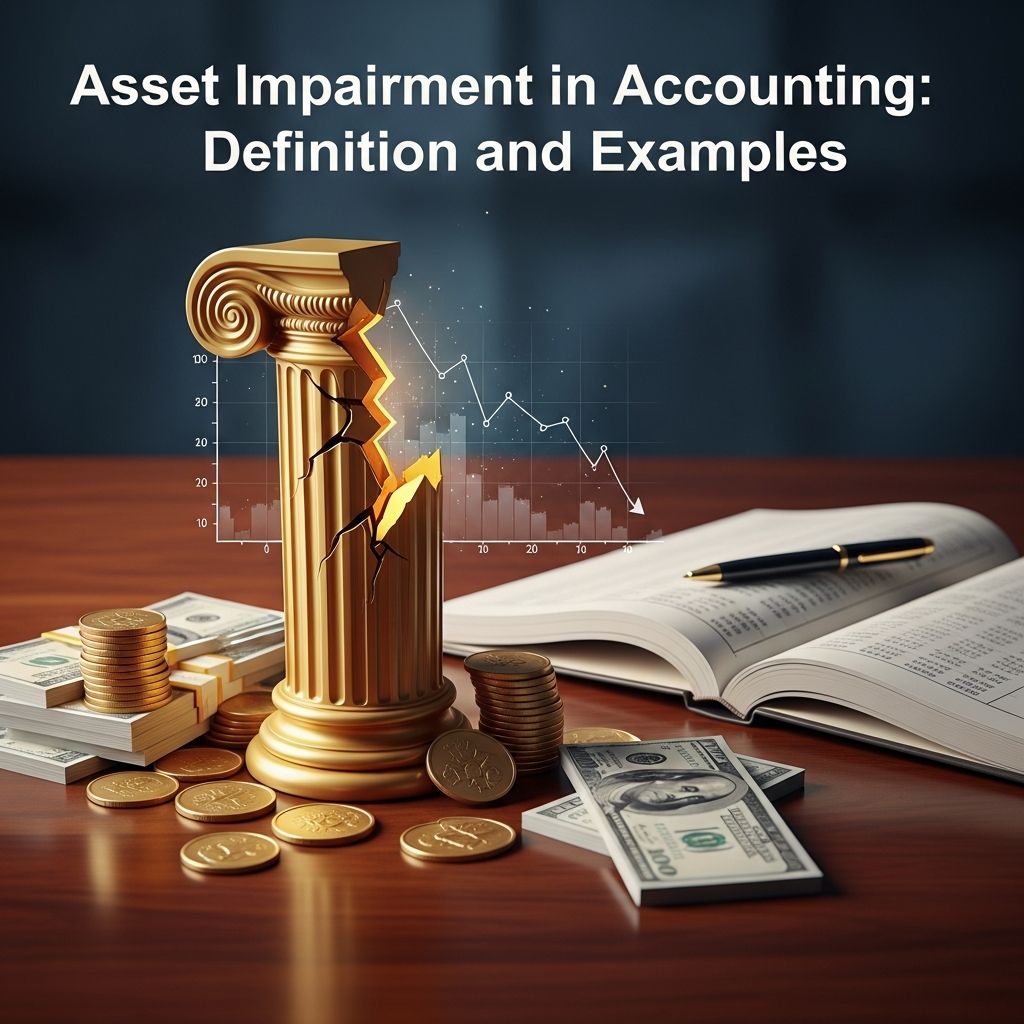
Asset impairment is a critical accounting concept that reflects the true economic value of a company’s assets on its financial statements. In accounting, impairment refers to a permanent reduction in the value of an asset below its carrying amount on the balance sheet. This occurs when the recoverable amount of an asset falls below what the company originally recorded as its value. Understanding impairment is essential for investors, analysts, and business professionals who need to assess the financial health and asset quality of organizations.
The process of identifying and recording impairment ensures that financial statements accurately represent the current worth of company assets. When assets lose value due to unexpected events, market changes, or technological obsolescence, companies must adjust their balance sheets accordingly. This adjustment protects stakeholders by ensuring they have access to truthful financial information.
What is Carrying Value and Recoverable Amount?
To understand impairment, one must first grasp two fundamental concepts: carrying value and recoverable amount. The carrying value, also known as book value, is the original cost of an asset minus accumulated depreciation or amortization. This is the amount shown on the balance sheet and represents what the company initially paid for the asset adjusted for its use over time.
The recoverable amount is the higher of two values: the asset’s fair value less costs to sell, or its value in use. Fair value represents what the asset could sell for in the current market, while value in use reflects the present value of cash flows the asset is expected to generate in the future. When the recoverable amount falls below the carrying value, an impairment loss occurs.
How Asset Impairment Testing Works
Companies must regularly test assets for impairment to ensure they are reporting their true economic value on the balance sheet. This testing process involves comparing the carrying value of assets to their recoverable amount. If the carrying amount exceeds the recoverable amount, the asset is considered impaired.
When impairment is identified, companies must recognize an impairment loss on the income statement as a separate line item. Simultaneously, the carrying amount of the impaired asset is reduced on the balance sheet to reflect the recoverable amount. This dual adjustment ensures that both the income statement and balance sheet reflect the asset’s true current value.
Types of Assets Subject to Impairment
Impairment applies to both tangible and intangible assets. Understanding which assets may be impaired helps companies conduct thorough assessments of their asset portfolios.
Tangible Assets
Tangible assets are physical assets that can be touched and seen. These include:
- Property, plant, and equipment (buildings, machinery, equipment)
- Land holdings
- Inventory intended for sale
- Furniture and fixtures
For tangible assets, the carrying amount is calculated as the original cost less accumulated depreciation. Impairment testing for these assets focuses on whether physical damage, obsolescence, or market changes have reduced their fair value below their carrying amount.
Intangible Assets
Intangible assets lack physical substance but hold significant value for companies. These include:
- Goodwill from acquisitions
- Patents and copyrights
- Trademarks and brand names
- Licenses and permits
- Customer relationships
For intangible assets, the carrying amount is calculated as the original cost less accumulated amortization. Intangible assets are particularly susceptible to impairment when business conditions change, technology becomes obsolete, or acquired companies underperform.
Key Indicators of Asset Impairment
Companies should monitor several external and internal factors that may signal potential impairment:
- Physical damage to assets or deterioration
- Changes in laws or regulations that negatively affect asset value
- Technological obsolescence making assets outdated
- Increased competition reducing profitability
- Significant decline in market demand
- Poor management decisions affecting asset productivity
- Macroeconomic downturns or industry-specific challenges
- Natural disasters or unexpected accidents
- Significant underperformance against expectations
Impairment vs. Depreciation: Key Differences
While both impairment and depreciation involve reductions in asset value, they operate under different circumstances and principles. Understanding these differences is crucial for proper financial reporting.
| Aspect | Depreciation | Impairment |
|---|---|---|
| Nature of Decline | Gradual reduction from normal wear and tear | Sudden and significant value reduction |
| Reversibility | Non-reversible | May be reversed if conditions improve |
| Application | Tangible assets only | Both tangible and intangible assets |
| Triggers | Systematic based on useful life | Specific events or market conditions |
| Cause | Expected normal usage | Unexpected events or permanent changes |
Real-World Example of Asset Impairment
Consider a practical example to illustrate how impairment works. A company acquires a piece of machinery for $100,000 with an estimated useful life of 20 years. Using straight-line depreciation, the company records annual depreciation of $5,000. After five years, the accumulated depreciation totals $25,000, and the carrying value is $75,000.
However, due to technological advancements and market changes, the machinery’s current fair value drops to $70,000. Since the recoverable amount of $70,000 is less than the carrying value of $75,000, the company must recognize an impairment loss of $5,000. The company records this loss on the income statement and reduces the asset’s value on the balance sheet to $70,000, its true economic value.
The Tata Steel Acquisition: A Major Impairment Case Study
One of the most notable real-world examples of asset impairment involves Tata Steel’s 2006 acquisition of Anglo-Dutch steelmaker Corus Group. Tata Steel, one of India’s largest steel companies, made an initial bid of $13 billion to acquire Corus, which was the second-largest steel company in Europe at the time. The acquisition aimed to provide Tata Steel with access to the European market and valuable technology benefits.
However, market reaction to the acquisition was negative. Tata Steel’s share price fell 11% on announcement day and declined more than 20% within a month. Industry experts believed the acquisition price was overly optimistic. When the European steel market weakened significantly, with steel demand falling approximately 8% in 2013, Tata Steel was forced to confront the reality of its investment.
In 2013, Tata Steel recognized the extent of its overvaluation and chose to impair the acquired assets by $3 billion. The company impaired both goodwill and other tangible assets, citing a weaker macroeconomic and market environment in Europe where demand was expected to remain depressed for the medium term. This significant impairment forced Tata Steel to revise downward its expectations for cash flows from the European operations.
The Tata Steel case was not unique. In 2012, ArcelorMittal, the world’s largest steelmaker, wrote down its European business assets by $4.3 billion following the eurozone debt crisis. Similarly, companies like Nippon Steel and Sumitomo recorded impairments for their Japanese operations during the same period.
Accounting Standards for Impairment
International Financial Reporting Standards (IFRS) and Generally Accepted Accounting Principles (GAAP) provide frameworks for asset impairment testing and reporting. IAS 36, the primary international standard for impairment of assets, applies to all assets except those specifically addressed by other standards. These accounting standards ensure consistent treatment of impairment across companies and industries, making financial statements more comparable and transparent.
Recording Impairment on Financial Statements
When impairment is identified, companies must make specific adjustments to their financial statements. An impairment loss is recognized on the income statement as a separate line item, clearly showing the impact on profitability. This transparency helps stakeholders understand the reasons behind earnings changes. Simultaneously, the asset’s value on the balance sheet is written down to its recoverable amount, presenting an accurate picture of the company’s asset base.
Frequently Asked Questions
Q: What triggers an impairment test for assets?
A: Impairment tests are typically triggered by significant changes in circumstances such as technological obsolescence, regulatory changes, market downturns, physical damage, poor management decisions, or underperformance relative to expectations. Companies should assess their external environment regularly to identify these indicators.
Q: Can impairment losses be reversed?
A: Yes, unlike depreciation, impairment losses can potentially be reversed if the conditions that caused the impairment improve. However, reversals are subject to strict accounting standards and cannot exceed the original carrying value before the impairment was recorded.
Q: How often should companies test assets for impairment?
A: While annual testing is common for intangible assets and goodwill, companies should conduct impairment testing whenever indicators suggest assets may be impaired. This ensures financial statements always reflect the true economic value of assets.
Q: Does all depreciation reduce asset value permanently?
A: Yes, depreciation is a non-reversible reduction in asset value. It systematically allocates the asset’s cost over its useful life and cannot be reversed even if market conditions improve or the asset becomes more valuable.
Q: Why is goodwill particularly susceptible to impairment?
A: Goodwill represents the premium paid for an acquisition beyond the fair value of identified assets. When acquired companies underperform expectations or market conditions deteriorate, goodwill becomes overvalued and requires impairment, as demonstrated by the Tata Steel example.
References
- Impairment in Accounting: Definition & Examples — Study.com. 2024. https://study.com/academy/lesson/impairment-in-accounting-definition-examples.html
- Impairment: Accounting Definition, Factors, Pros, Cons — Corporate Finance Institute. 2024. https://corporatefinanceinstitute.com/resources/accounting/impairment/
- International Accounting Standard 36: Impairment of Assets — IFRS Foundation. https://www.ifrs.org/
Similar Articles








Read full bio of medha deb