Assessed Value vs. Market Value Explained
Discover the key differences between assessed and market values, how they're calculated, and their impact on taxes, sales, and loans.
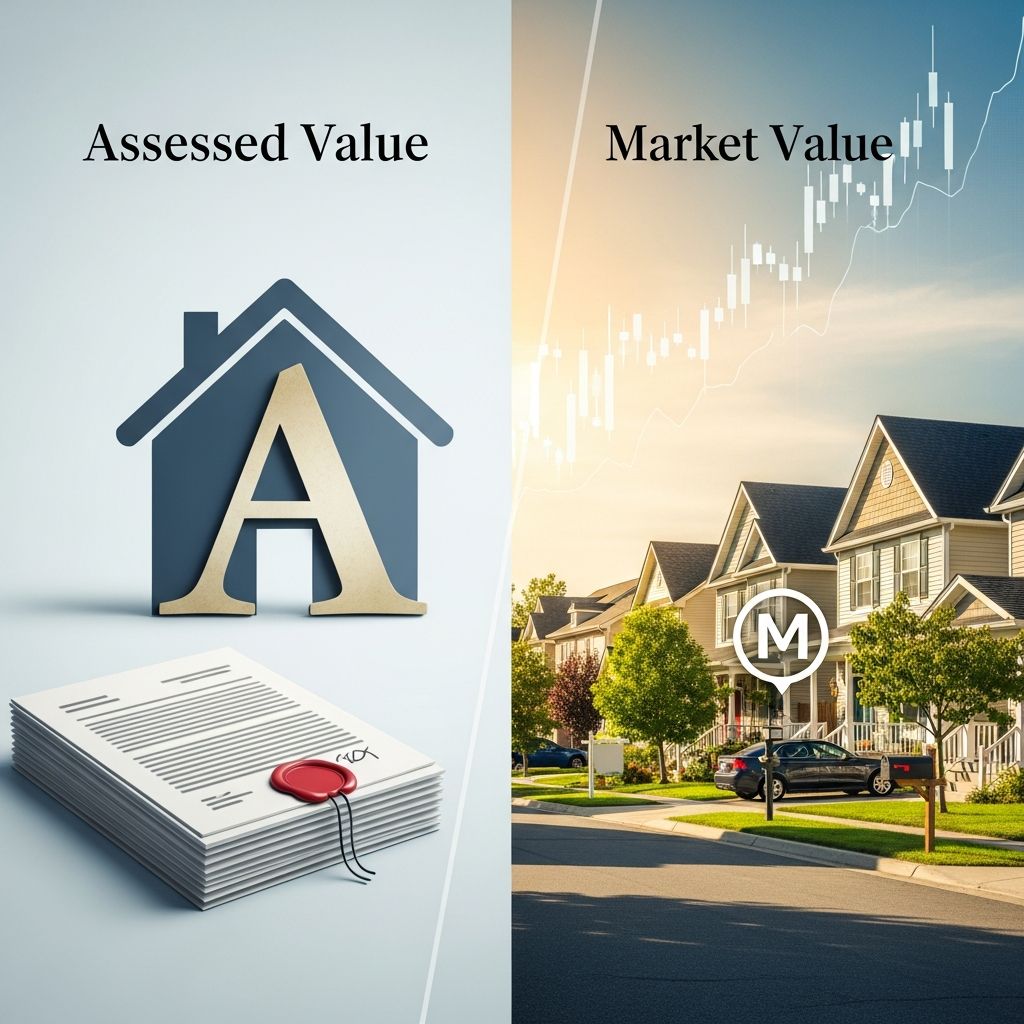
Property valuations play a crucial role in homeownership, influencing everything from tax bills to sale prices. Assessed value is set by local governments primarily for taxation, while market value reflects what a property might fetch in today’s competitive real estate landscape. Understanding these distinctions helps homeowners navigate taxes, refinancing, and sales effectively.
Defining the Core Concepts
At its heart, assessed value represents the figure local authorities use to compute property taxes. Tax assessors evaluate properties using standardized methods, often applying a specific ratio to the estimated full value. For instance, some areas use an 80% assessment rate on a $400,000 home, resulting in a $320,000 assessed value for tax purposes. This approach ensures taxes are based on a portion of the property’s worth, potentially lowering the annual burden.
In contrast, market value is the estimated amount a willing buyer would pay a willing seller in an open market. It’s dynamic, shaped by current economic conditions, buyer demand, and property specifics. Professional appraisers determine this for lenders during mortgage processes, focusing on recent comparable sales rather than fixed formulas.
How Assessed Value is Determined
Local tax assessors calculate assessed values through mass appraisal techniques, reviewing large numbers of properties periodically—typically every 1 to 5 years. They consider factors like location, size, and condition but prioritize uniformity for fair taxation.
- Cost approach: Estimates rebuilding costs minus depreciation.
- Income approach: Relevant for rental properties, based on potential earnings.
- Sales comparison: Draws from recent sales of similar homes.
Many jurisdictions apply an assessment ratio, such as 70% or 100%, to the market estimate. In South Dakota, for example, it’s 50% of market value, turning a $300,000 home into a $150,000 assessed value. These values appear on tax notices and can lag behind rapid market shifts.
Factors Shaping Market Value
Market value evolves continuously, responding to real-time data. Appraisers and real estate agents analyze:
- Comparable sales (comps): Recent transactions of similar properties in size, age, and location.
- Property condition: Updates, maintenance, and repairs boost value.
- Location perks: Proximity to schools, shops, and safe neighborhoods.
- Economic trends: Interest rates, job growth, and inventory levels.
A comparative market analysis (CMA) helps sellers price accurately, ensuring competitiveness without undervaluing the home.
Key Differences at a Glance
| Aspect | Assessed Value | Market Value |
|---|---|---|
| Purpose | Property tax calculation | Sales, loans, insurance |
| Determined By | Government assessors | Appraisers, buyers/sellers |
| Frequency | Every 1-5 years | Real-time, per transaction |
| Influences | Formulas, ratios | Comps, condition, market |
| Typical Relation | Often lower (due to ratios) | Higher in hot markets |
This table highlights why assessed values frequently trail market values, especially in booming areas.
Real-World Examples and Calculations
Suppose a home’s market value is $500,000 in a county with an 80% assessment ratio. The assessed value becomes $400,000, forming the tax base. If the local tax rate is 1.5%, the annual bill is $6,000—versus $7,500 on full market value.
In rising markets, market value might climb to $550,000 due to new comps, but assessed value stays put until the next cycle. Homeowners benefit from lower taxes but must use market value for equity loans, where lenders ignore assessments.
Another scenario: A renovated kitchen adds $30,000 to market value via comps, but assessors might not adjust until their review, delaying tax hikes.
Implications for Property Taxes
Assessed value directly dictates tax liability. Lower assessments mean savings, but appeals are possible if discrepancies arise. Check public records or tools comparing your value to neighbors. Successful appeals can reduce bills significantly.
Market value indirectly affects taxes over time, as assessments trend toward it. In stable areas, they align closely; in volatile ones, gaps widen.
Role in Buying, Selling, and Refinancing
For buyers, market value guides offers and negotiations. Sellers rely on it for pricing to attract bids. During sales, appraisals confirm market value to satisfy lenders.
Refinancing hinges on market value for loan-to-value ratios. A $420,000 market value enables more borrowing than a $320,000 assessment, even if taxes use the latter. Home equity lines also prioritize it.
When Values Diverge: What to Do
If assessed value exceeds market—rare but possible in declining markets—appeal promptly with comps. Conversely, undervalued assessments are a tax win, though they signal potential equity.
Track both via county sites, Zestimates, or professional CMAs. In Wisconsin, fair market estimates derive from assessed values divided by ratios, aiding levy distribution.
Appraised Value: A Related Concept
Don’t confuse with appraised value, a professional estimate mirroring market value for lenders. It’s detailed, site-specific, and transaction-tied, unlike periodic assessments.
| Valuation Type | Definition | Used By |
|---|---|---|
| Assessed | Tax base | Governments |
| Appraised | Lender estimate | Banks |
| Market | Sale price potential | Buyers/Sellers |
Frequently Asked Questions
Is assessed value usually lower than market value?
Yes, often due to assessment ratios below 100%, though it depends on location. In 100% ratio areas, they match.
How often are properties reassessed?
Typically every 1-5 years, varying by state or county.
Can I appeal my assessed value?
Absolutely—submit comps and evidence to your assessor within deadlines.
Does market value affect my taxes?
Indirectly, as assessments aim to reflect it over time.
Who sets market value?
Buyers and sellers via negotiation, confirmed by appraisers.
Strategies for Homeowners
Monitor both values annually. Invest in upgrades boosting market value, like energy-efficient features. When selling, highlight comps. For taxes, stay informed on reassessment cycles.
In 2026, with fluctuating rates, understanding these empowers better decisions.
References
- Understanding assessed vs. market value — Rocket Mortgage. 2023. https://www.rocketmortgage.com/learn/assessed-vs-market-value
- Assessed value vs market value: Key differences — Better Mortgage. 2023. https://better.com/content/assessed-value-vs-market-value
- Assessed Value vs. Market Value: What’s the Difference? — Experian. 2023. https://www.experian.com/blogs/ask-experian/assessed-value-vs-market-value/
- Home Assessed Value vs. Market Value — Zillow. 2023. https://www.zillow.com/learn/assessed-value-vs-market-value/
- Tax-Assessed Value vs. Market Value: What’s the Difference? — Realtor.com. 2023. https://www.realtor.com/advice/sell/assessed-value-vs-market-value-difference/
- Assessed vs Market Values — City of Superior, WI (Official Website). 2023. https://www.superiorwi.gov/67/Assessed-vs-Market-Values
Similar Articles








Read full bio of Sneha Tete