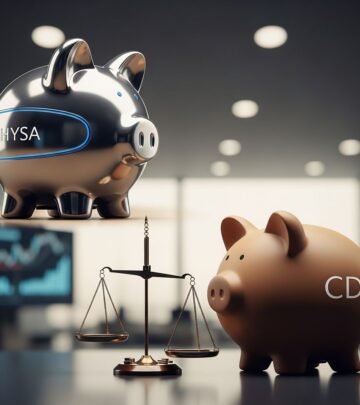
Are High-Yield Savings Accounts Safe?
Discover why high-yield savings accounts offer top-tier security with FDIC protection and superior returns for your emergency funds.

High-yield savings accounts (HYSAs) stand out as one of the safest options for parking cash, backed by federal insurance and offering competitive returns without exposure to market volatility.
Understanding the Core Safety Features of HYSAs
At their foundation, HYSAs function like standard savings accounts but deliver significantly higher annual percentage yields (APYs). Unlike investments tied to stocks or bonds, your principal remains intact, protected by government-backed insurance. The Federal Deposit Insurance Corporation (FDIC) covers deposits up to $250,000 per depositor, per ownership category, per insured institution for banks. Similarly, the National Credit Union Administration (NCUA) provides equivalent protection for credit unions.
This insurance means that even if the financial institution fails—a rare occurrence—your funds are secure. For instance, during recent banking stresses, FDIC swiftly reimbursed depositors, demonstrating the system’s reliability.
How FDIC and NCUA Insurance Works in Practice
FDIC insurance applies to deposit accounts including savings, checking, money market accounts, and CDs. Coverage is calculated per depositor across categories like single, joint, or trust accounts. To illustrate:
| Ownership Category | Example | Coverage Limit |
|---|---|---|
| Single | Individual account in your name only | $250,000 |
| Joint | Shared with spouse or partner | $500,000 ($250K per owner) |
| Trust | Payable-on-death (POD) beneficiary | $250,000 per beneficiary |
| IRA | Individual Retirement Account | $250,000 |
Spreading funds across multiple institutions or categories can extend protection beyond $250,000. Always verify insurance status via the FDIC’s BankFind tool or NCUA’s Research a Credit Union database.
Comparing HYSAs to Traditional Savings and Investments
Traditional savings accounts average a mere 0.42% APY, while HYSAs often exceed 4-5% as of mid-2025, allowing faster growth. Here’s a comparison:
| Account Type | Typical APY | Insurance | Liquidity | Risk Level |
|---|---|---|---|---|
| HYSA | 4.00%-5.00% | FDIC/NCUA up to $250K | High (6+ withdrawals/year) | Very Low |
| Traditional Savings | 0.40% | FDIC/NCUA up to $250K | High | Very Low |
| Stock Investments | 7-10% historical avg | None | Low | High |
| CDs | 4.50%-5.50% | FDIC/NCUA up to $250K | Low (penalties for early withdrawal) | Low |
HYSAs excel for short-term needs due to easy access and no principal risk, unlike stocks where losses are possible.
Potential Drawbacks and Hidden Risks
While principal loss is impossible within limits, other factors warrant attention. APYs are variable, fluctuating with the federal funds rate set by the Federal Reserve. If rates drop, earnings decrease—though they remain superior to traditional accounts.
- Rate Volatility: Current top rates near 5% could fall with economic shifts.
- Fees: Rare but possible minimum balance penalties; online HYSAs often waive these due to low overhead.
- Liquidity Limits: Federal Regulation D caps withdrawals/transfers at six per month, though many banks relaxed this post-2020.
- Inflation Erosion: If inflation outpaces APY, purchasing power declines over time—ideal for 3-12 month horizons, not decades.
Ideal Uses for High-Yield Savings Accounts
HYSAs shine for:
- Emergency Funds: 3-6 months’ expenses, instantly accessible.
- Short-Term Goals: Vacations, down payments (under 5 years).
- Cash Parking: Temporary holds before investing longer-term.
Avoid over-allocating; beyond emergency needs, stocks or bonds historically outperform for long horizons.
Steps to Select a Secure HYSA Provider
- Confirm Insurance: Ensure FDIC/NCUA membership.
- Check APY and Fees: Compare via deposit rate trackers.
- Evaluate Accessibility: Mobile apps, ATM access, transfer speeds.
- Security Features: Multi-factor authentication, SSL encryption, fraud monitoring.
- Minimums: Prefer no/low requirements.
Online-only banks like those from Santander or Amex often lead in rates due to efficiency.
Real-World Earnings Example
Deposit $10,000 in a HYSA at 4.25% APY vs. 0.41% traditional:
- HYSA Year 1: ~$425 interest.
- Traditional: ~$41 interest.
Over five years, compounding pushes HYSA to over $2,300 total interest vs. $205. Use FDIC’s deposit calculator for personalized projections.
Frequently Asked Questions (FAQs)
Can I lose my money in a HYSA?
No, if FDIC/NCUA-insured and under $250,000 limits. Principal is guaranteed.
Are online HYSAs as safe as brick-and-mortar?
Yes, if insured; often safer with advanced digital security.
How often do HYSA rates change?
Variable; banks adjust monthly or with Fed announcements.
What’s better for long-term savings: HYSA or investments?
HYSAs for short-term; investments for 5+ years despite risks.
Can I have multiple HYSAs for more insurance?
Yes, per institution/category up to $250,000 each.
Maximizing Protection and Returns in 2026
With rates potentially stabilizing post-2025 Fed adjustments, ladder HYSAs with CDs for locked yields. Monitor via official tools and diversify institutions. HYSAs remain a cornerstone for financial stability, blending safety with growth.
References
- Are High-Yield Savings Accounts Safe? — Experian. 2025-06-01. https://www.experian.com/blogs/ask-experian/are-high-yield-savings-accounts-safe/
- HYSA: Safe Pick in Volatile Markets — Openbank by Santander. 2024-01-01. https://www.openbank.us/resources/high-yield-savings/are-high-yield-savings-accounts-safe
- Pros and Cons of a High-Yield Savings Account — Hancock Whitney. 2024-12-01. https://www.hancockwhitney.com/insights/pros-cons-high-yield-savings
- What is a High-Yield Savings Account? Why Should I Have One? — First Bank. 2024-12-01. https://www.first.bank/Resources/Learn/Financial-Education-Center/December-2024/What-is-a-High-Yield-Savings-Account-Why-Should-I
- The Basics of High Yield Savings Accounts — American Express. 2025-01-01. https://www.americanexpress.com/en-us/banking/online-savings/articles/all-about-high-yield-savings/
Similar Articles








Read full bio of Sneha Tete