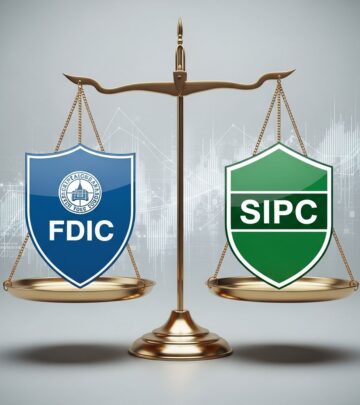
Are Brokerage Investments Protected?
Discover how SIPC safeguards your brokerage assets unlike FDIC bank insurance, with key limits and exclusions explained.

Investments in brokerage accounts receive protection through the Securities Investor Protection Corporation (SIPC), not the Federal Deposit Insurance Corporation (FDIC) that covers bank deposits. This safeguard activates if a brokerage firm fails, helping return cash and securities up to specified limits, though it excludes market losses.
Understanding the Core Protections for Your Investments
Brokerage accounts hold a variety of assets like stocks, bonds, and mutual funds, exposing them to different risks than traditional bank savings. While FDIC guarantees deposits up to $250,000 per depositor per bank against bank failure, SIPC steps in for brokerages. Established by Congress in 1970, SIPC is a nonprofit that maintains a fund to reimburse customers when member firms cannot return their holdings due to insolvency or bankruptcy.
The protection applies only to SIPC-member firms, which include nearly all registered U.S. broker-dealers. It covers missing securities and cash but not declines in value from market fluctuations, poor investment choices, or bad advice. This distinction is crucial: SIPC restores your account to its state before the firm’s failure, not compensating for unrealized gains or losses.
What Assets Fall Under SIPC Coverage?
SIPC protects a defined set of holdings in qualifying accounts. Eligible items include:
- Cash awaiting investment
- Stocks and equity shares
- Bonds, including corporate and municipal
- U.S. Treasury securities
- Mutual funds
- Money market mutual funds
- Certificates of deposit held in brokerage
Exclusions apply to commodities, futures contracts, fixed annuity contracts, and investments in currency or non-U.S. securities issued by foreign entities. Protection extends to accounts in separate capacities, such as individual, joint, IRA, or trust, each potentially qualifying for full coverage.
Coverage Limits and How They Apply
SIPC provides up to $500,000 per customer per member firm, with a sub-limit of $250,000 for cash claims. This means if your account holds $400,000 in securities and $150,000 in cash, full recovery is likely. Excess cash beyond $250,000 might receive partial or no coverage unless additional protections exist.
For multiple accounts at one firm, coverage is aggregated per customer across capacities only if they share ownership. Spouses with joint and individual accounts may access higher totals. Brokerages often purchase excess SIPC insurance from private insurers, potentially extending protection to tens of millions per account—check your firm’s disclosures.
| Feature | SIPC Protection | FDIC Insurance |
|---|---|---|
| Purpose | Brokerage firm failure | Bank failure |
| Assets Covered | Cash, stocks, bonds, funds | Deposits in checking, savings, CDs |
| Limit | $500K total ($250K cash) | $250K per depositor per bank |
| Market Losses | Not covered | Not applicable |
| Action Required | File claim if needed | Automatic |
This table highlights key contrasts, aiding quick comparison.
How SIPC Protection Activates in Practice
When a brokerage faces distress, a court-appointed trustee takes over, inventories assets, and reconciles customer accounts. SIPC advances funds to expedite transfers to a healthy firm or direct payouts. Most cases resolve without loss, as brokerages segregate client assets from their own operations under SEC rules.
Historical examples include the 2008 Lehman Brothers collapse, where SIPC facilitated smooth asset transfers. In rare full liquidations, customers file claims via forms provided by the trustee. Delays can occur, but SIPC has handled over $3 billion in claims since inception with minimal uncovered losses.
Enhancing Security Beyond Basic SIPC
While SIPC offers solid baseline protection, proactive steps maximize safety:
- Verify SIPC Membership: Confirm via SIPC’s directory or firm statements.
- Diversify Firms: Spread assets across multiple SIPC members for multiplied $500K coverage.
- Seek Excess Coverage: Choose firms with private insurance topping SIPC limits.
- Monitor Cash Balances: Invest idle cash to stay under $250K uninvested.
- Review Account Agreements: Understand segregation and custody practices.
Many major firms like Fidelity and Vanguard provide excess policies covering up to $150 million in securities and $1.9 million in cash per client, far exceeding standard limits.
Common Myths About Brokerage Protections
Misconceptions abound. SIPC does not insure against investment performance— a stock crash leaves you exposed. It’s not government-backed like FDIC; SIPC funds come from member assessments. Nor does it cover theft by advisors unless tied to firm failure. Unauthorized trading may qualify if proven, but advisor misconduct often requires separate arbitration.
Another myth: all brokerages offer identical protection. While SIPC is mandatory, excess coverage varies. Always scrutinize Form ADV or customer agreements for details.
Brokerage Accounts vs. Bank-Linked Options
Some brokerages offer FDIC-insured cash sweeps into partner banks, protecting uninvested funds up to $250K per bank. This hybrid shields cash while allowing investment flexibility. However, securities remain under SIPC. Understand allocation: cash in sweeps gets FDIC, swept-out holdings get SIPC.
Navigating Risks in a Changing Financial Landscape
Brokerage failures are exceedingly rare due to rigorous SEC oversight and capital requirements. Yet, vigilance matters amid economic shifts. Recent regulatory enhancements post-2008 ensure better asset segregation. Investors should annually review protections, especially with growing robo-advisors and crypto offerings—many latter lack SIPC.
For retirement accounts like IRAs, SIPC applies identically, safeguarding long-term savings against firm-specific risks.
Frequently Asked Questions
Does SIPC cover cryptocurrency holdings?
No, SIPC excludes cryptocurrencies, commodities, and futures. Use regulated custodians for digital assets with separate protections.
Is my brokerage automatically SIPC-protected?
Yes, if it’s a registered U.S. broker-dealer—virtually all are members. Confirm via SIPC.org.
What if my account exceeds $500K?
Use multiple firms or opt for excess insurance. Many platforms offer this automatically.
Does SIPC protect against hacking or theft?
Not directly; it covers firm custody failure. Firms often have separate cyber insurance.
Can joint accounts get double coverage?
Joint accounts qualify separately from individual ones, potentially doubling protection.
These FAQs address top concerns for informed investing.
Steps to Verify and Strengthen Your Protections
1. Log into your brokerage portal and search for ‘SIPC’ or ‘protection’ disclosures.
2. Contact customer service for excess coverage details.
3. Use SIPC’s investor tools to check firm status.
4. Diversify across institutions.
5. Keep records of holdings and transactions.
By following these, you minimize rare but possible risks.
References
- Are Brokerage Funds Insured? — Experian. 2023. https://www.experian.com/blogs/ask-experian/are-brokerage-funds-insured/
- Are Brokerage Accounts FDIC Insured? — Chase. 2024-01-15. https://www.chase.com/personal/investments/learning-and-insights/article/are-brokerage-accounts-fdic-insured
- What is SIPC coverage and how does it work? — Fidelity Investments. 2025-02-20. https://www.fidelity.com/learning-center/smart-money/sipc
- SIPC insurance: What it covers and how it protects investors — Bankrate. 2024-11-10. https://www.bankrate.com/investing/sipc-insurance/
- What Is FDIC Insurance and How Does It Work? — Vanguard. 2024-03-05. https://investor.vanguard.com/investor-resources-education/article/how-does-fdic-insurance-work
- Understanding FDIC and SIPC Insurance — Charles Schwab. 2023-09-12. https://www.schwabmoneywise.com/essentials/understanding-fdic-and-sipc-insurance
- For Investors – What is SIPC? — SIPC. 2025. https://www.sipc.org/for-investors/introduction
Similar Articles








Read full bio of medha deb