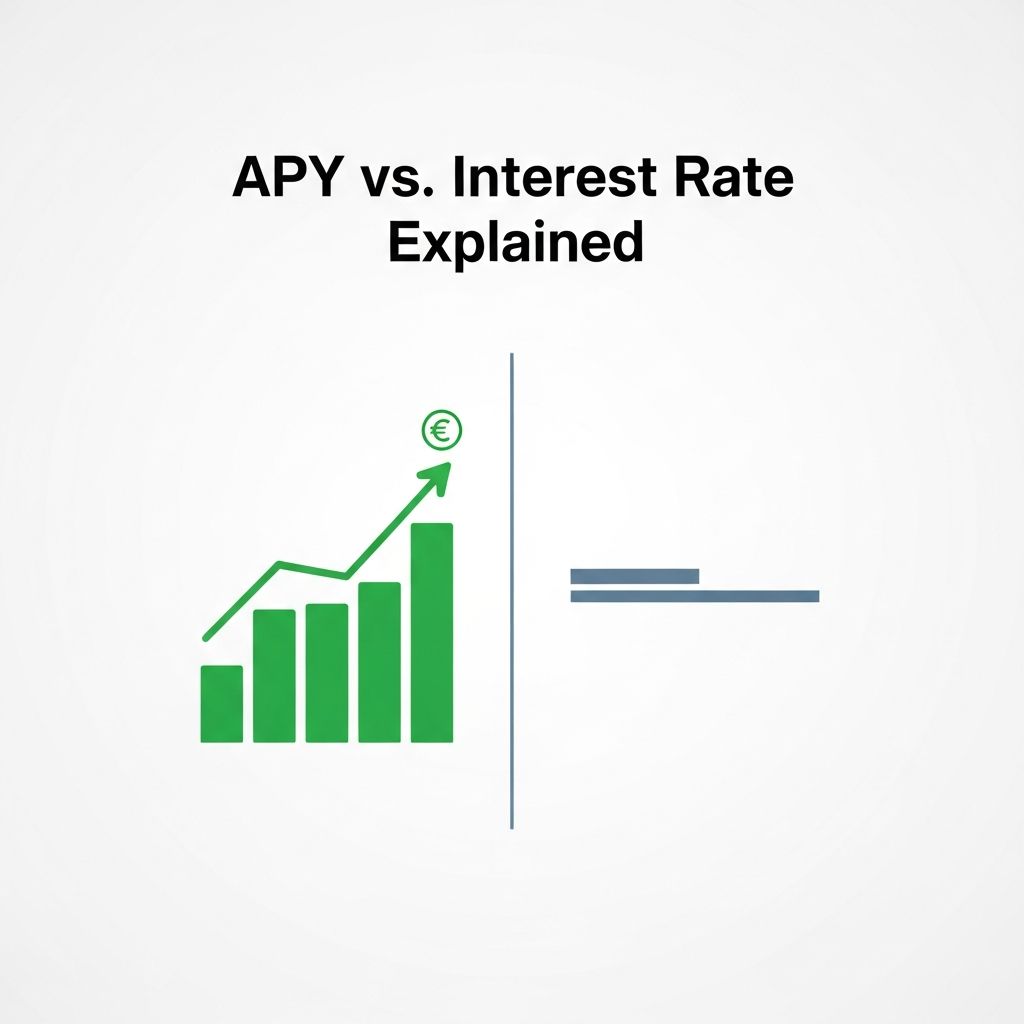
APY vs. Interest Rate Explained
Unlock the real earning power of your savings: Master APY versus interest rate to maximize returns and make smarter banking choices.
The
annual percentage yield (APY)
andinterest rate
are fundamental concepts in banking that determine how much your money grows in savings accounts or CDs. While often confused, APY provides a more complete picture by incorporating compounding effects, leading to higher effective returns over time.Defining the Basics: Interest Rate Fundamentals
The interest rate represents the raw percentage that a bank or credit union pays on your deposited funds over a year, without considering how often interest is added to the principal. It serves as the foundation for calculating earnings on savings products like high-yield savings accounts or certificates of deposit (CDs).
For instance, a 4% interest rate on a $10,000 deposit means the bank promises to pay 4% of that amount annually. If calculated as simple interest, you’d earn exactly $400 after one year. This rate is quoted prominently by financial institutions to attract depositors but doesn’t reveal the full story.
Interest rates are influenced by broader economic factors, including the Federal Reserve’s federal funds rate. When the Fed raises rates to combat inflation, banks typically increase their offerings to stay competitive.
Understanding APY: The Power of Compounding
**APY**, or annual percentage yield, measures the total return on your money over 365 days, factoring in both the interest rate and the frequency of compounding. Compounding occurs when interest earned is added to the principal, allowing future interest to be calculated on a larger balance.
This creates a snowball effect: the more frequently interest compounds—daily, monthly, or quarterly—the more your savings grow. APY standardizes comparisons across accounts, making it the superior metric for savers seeking true profitability.
By federal regulation under the Truth in Savings Act, banks must disclose APY for deposit accounts, ensuring transparency. Unlike interest rates, APY always reflects compounding, revealing why a 5% rate compounded daily outperforms the same rate compounded annually.
Key Distinctions: A Side-by-Side Comparison
| Aspect | Interest Rate | APY |
|---|---|---|
| Definition | Base annual percentage paid on principal | Total yield including compounding over a year |
| Compounding | Not included | Fully accounted for |
| Value Comparison | Typically lower | Always higher or equal |
| Best Use | Initial screening | Account selection and comparison |
This table highlights why APY trumps interest rate for decision-making. For example, two accounts both advertising 4% might yield differently: one compounding monthly at 4.07% APY, the other annually at exactly 4%.
Compounding in Action: Real-World Examples
Consider depositing $5,000 in two accounts, both with a 3% interest rate, but differing compounding schedules.
- Annual compounding: Interest added once yearly yields $150, for a total of $5,150 (APY = 3.00%).
- Monthly compounding: Interest compounds 12 times, earning about $152.08, total $5,152.08 (APY ≈ 3.04%).
- Daily compounding: With 365 periods, you earn roughly $152.25, total $5,152.25 (APY ≈ 3.05%).
Over five years, these differences compound dramatically: annual yields $5,833; daily reaches $5,859—a $26 gap from frequency alone.
The Formula Behind APY Calculations
Financial experts use this standard formula to compute APY: APY = (1 + r/n)^n - 1, where r is the nominal interest rate (as a decimal) and n is compounding periods per year.
For a 4.5% rate compounded quarterly (n=4): APY = (1 + 0.045/4)^4 – 1 ≈ 4.59%. Tools like online calculators from the FDIC or bank websites simplify this for consumers.
Understanding this empowers you to verify advertised rates and spot misleading promotions where high interest rates mask infrequent compounding.
APY and Interest Rates in Savings Products
High-yield savings accounts and CDs often boast APYs from 4-5% in competitive markets, far above traditional savings at 0.01-0.45%. Online banks like Ally or SoFi lead due to lower overhead.
Money market accounts blend checking features with competitive APYs, while CDs lock funds for fixed terms with guaranteed rates. Variable-rate accounts tie APY to market changes, requiring monitoring.
Loans and Credit: Interest Rate Dominance with APR Context
On the borrowing side, interest rate is the core cost of loans, mortgages, or credit cards—e.g., 6% on a $20,000 auto loan adds $1,200 yearly. Unlike deposits, loan interest rates rarely compound in consumer products.
However,
APR
(annual percentage rate) provides a fuller view by including fees. A 6% rate with 2% fees becomes 8% APR, better approximating total cost. APY applies mainly to earning products, not borrowing.Strategies to Maximize Your Earnings
To optimize returns:
- Compare
APYs
, not rates, across FDIC-insured institutions. - Prioritize daily compounding for marginal gains.
- Laddering CDs balances liquidity and rates.
- Automate transfers to high-APY accounts.
- Monitor Fed announcements for rate shifts.
Experts recommend shopping annually, as top APYs can exceed inflation, preserving purchasing power.
Navigating Taxes and Inflation Impacts
Interest and APY earnings are taxable as ordinary income, reported on Form 1099-INT. High earners may face state taxes too. Inflation erodes real returns; aim for APYs above CPI (e.g., 5% APY vs. 3% inflation nets 2% growth).
Common Pitfalls and How to Avoid Them
Savers often overlook:
- Introductory rates: Teaser APYs drop post-promotion.
- Minimum balances: Falling below triggers rate cuts.
- Fees: Maintenance charges negate gains.
- Rate variability: Non-CD accounts fluctuate.
Read fine print and use tools like Bankrate’s comparison charts.
Future Trends in Banking Rates
As of 2026, persistent inflation and Fed policies keep APYs elevated around 4-5% for top accounts. Digital banks continue disrupting with superior yields, while fintech apps enable seamless switching.
Frequently Asked Questions
What is the difference between APY and interest rate?
APY includes compounding effects for total yearly yield; interest rate is the base percentage without it.
Why is APY always higher than the interest rate?
Compounding generates interest on interest, boosting the effective rate.
Is APY or interest rate more important for savings?
APY, as it reflects true growth potential.
Does APY apply to checking accounts?
Some high-yield checkings offer APY, but most earn little to none.
How does compounding frequency affect APY?
More frequent compounding (e.g., daily) yields higher APY.
Take Control of Your Finances Today
Armed with APY knowledge, transfer funds to competitive accounts and watch wealth compound. Consistency in high-yield saving builds financial security over time.
References
- Difference Between APY vs Interest Rate — SoFi. 2025-06-15. https://www.sofi.com/learn/content/apy-vs-interest-rate/
- APY vs Interest Rate: What’s the Difference? — NerdWallet. 2025-08-22. https://www.nerdwallet.com/banking/learn/apy-vs-interest-rate
- APY Vs. Interest Rate: What’s The Difference? — Bankrate. 2025-11-10. https://www.bankrate.com/banking/savings/apy-vs-interest-rate/
- APR vs APY: Understanding the Key Differences — Ally Bank. 2025-04-05. https://www.ally.com/stories/save/apy-vs-apr-what-is-apr-what-is-apy/
Similar Articles








Read full bio of medha deb