APR vs. Interest Rate: What’s The Difference?
Understand the key differences between APR and interest rate to make informed mortgage decisions.
Understanding APR vs. Interest Rate: What’s The Difference?
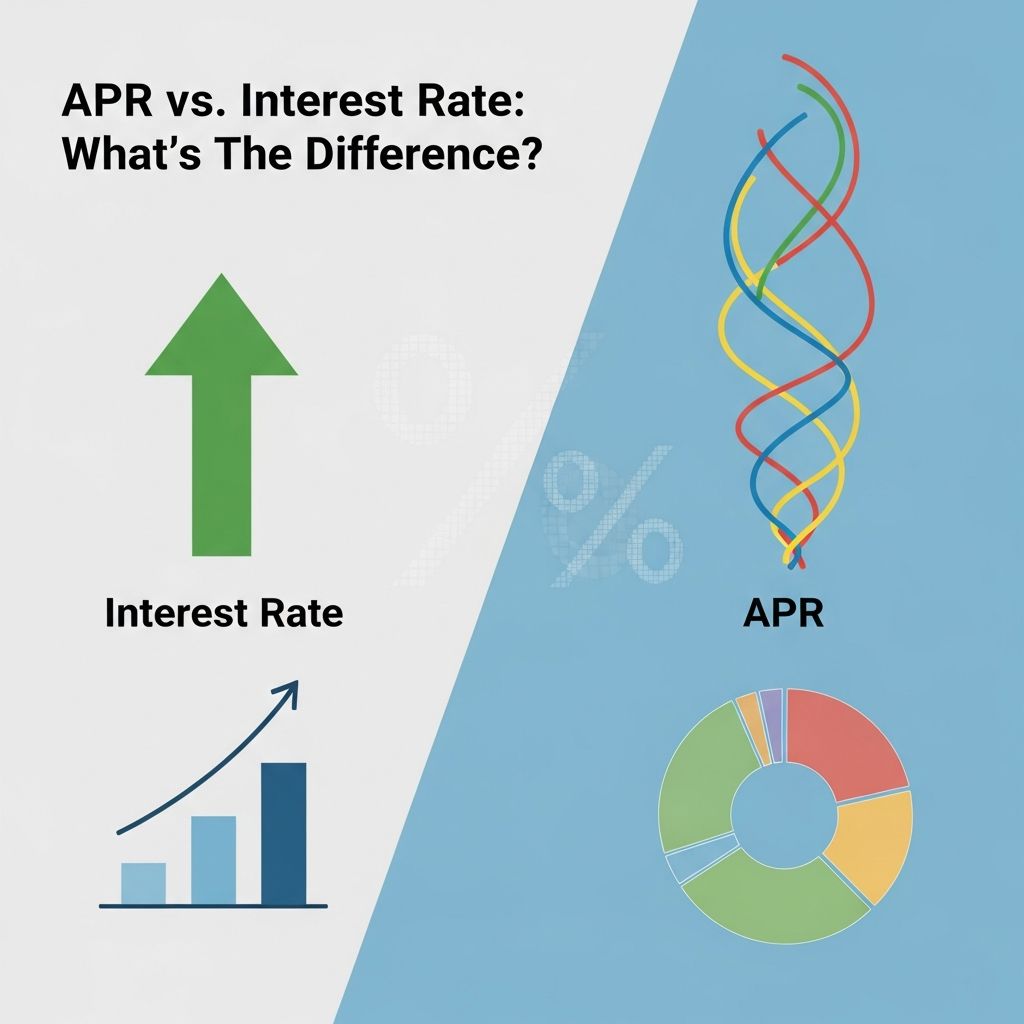
When shopping for a mortgage, you’ll encounter two important terms that are often confused: annual percentage rate (APR) and interest rate. While these terms are sometimes used interchangeably, they represent distinctly different aspects of your loan. Understanding the difference between APR and interest rate is crucial for making informed decisions about your mortgage and ensuring you’re getting the best deal possible.
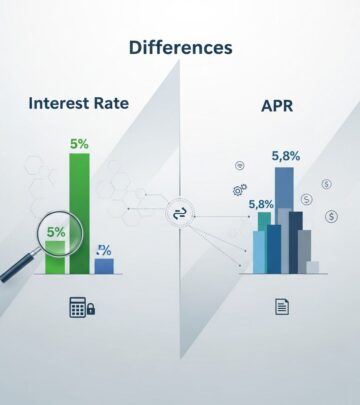
The interest rate on a mortgage represents the cost you’ll pay each year to borrow money, expressed as a percentage of the loan principal. It does not include fees, closing costs, or any other charges associated with the loan. In contrast, the APR reflects the total yearly cost of your loan, encompassing the interest rate plus additional fees such as origination fees, closing costs, mortgage points, and broker fees. Because the APR includes these extra costs, it is always higher than the interest rate.
The Key Differences Between APR and Interest Rate
Interest Rate Defined
The interest rate is the percentage of your loan principal that you pay annually as the cost of borrowing. If you take out a $300,000 mortgage with a 6.5% interest rate, you’ll pay $19,500 in interest during the first year (though this amount decreases over time as you pay down the principal). The interest rate is determined by several factors beyond your control, including inflation, the broader economic conditions, and the Federal Reserve’s fund rate policies. Your specific interest rate also depends on personal factors such as your credit score, debt-to-income ratio, down payment size, and overall financial profile.
APR Defined
The APR, or annual percentage rate, provides a more comprehensive view of what your mortgage will cost. It takes your interest rate and adds the costs associated with obtaining the loan. These additional costs typically include:
- Origination fees charged by the lender
- Closing costs
- Mortgage points (also called discount points)
- Mortgage broker fees, if applicable
By including these fees, the APR gives you a more accurate picture of your true borrowing cost. For example, if a lender offers a 6.5% interest rate but charges $3,100 in origination fees and $3,100 in mortgage points on a $310,000 loan, your actual APR would be 6.596%—noticeably higher than the advertised interest rate.
Why APR Matters More for Comparison
When comparing mortgage offers from different lenders, looking at APR rather than interest rate gives you a clearer, more complete picture of the total cost. Some lenders may advertise attractive interest rates but compensate by charging higher fees. Without considering APR, you might select a loan that appears cheaper upfront but actually costs more over time.
Consider this scenario: Bank A offers a 6.375% interest rate with an APR of 6.652%, while Bank B offers a 6.250% interest rate with an APR of 6.389%. At first glance, Bank B appears to offer a better deal with a lower rate. However, when you compare the APRs, Bank B is actually the more affordable option because its total cost is lower. This demonstrates why comparing APRs—not just interest rates—is essential for making smart financial decisions.
How Interest Rates Are Calculated
Interest rates fluctuate constantly based on macroeconomic factors and lender-specific considerations. The Federal Reserve’s monetary policy has a significant influence on mortgage rates, as does the overall state of the economy and inflation levels. When the Federal Reserve raises its fund rate, mortgage rates typically increase; conversely, when it lowers rates, mortgage rates generally fall.
Your individual mortgage rate depends on personal factors including:
- Your credit score and credit history
- Your debt-to-income ratio
- The size of your down payment
- Your employment history
- The type of mortgage you’re seeking
Generally, the higher your credit score and the larger your down payment, the lower your interest rate will be. Lenders view borrowers with strong credit profiles as lower-risk, so they reward them with better rates.
How APR Is Calculated
Calculating APR involves combining three key figures: your interest rate, the fees you’ll pay, and any mortgage points you choose to purchase upfront. Mortgage lenders are required to calculate your APR for you, but understanding the process can help you verify their calculations and understand how different fees impact your total cost.
The basic steps for calculating APR are:
- Add up all interest and fees on your loan
- Divide that total by your loan principal
- Divide that result by the number of years in your loan term
- Multiply that answer by 365
- Multiply by 100 to convert to a percentage
To illustrate how points and fees affect APR, consider a $300,000 mortgage at different scenarios:
| Interest Rate | Origination Fee | Discount Points | Points and Fees | APR | Monthly Payment | Total Interest |
|---|---|---|---|---|---|---|
| 6.8% | 1% ($3,000) | 2 ($6,000) | $9,000 | 7.092% | $1,956 | $404,075 |
| 6.95% | 1% ($3,000) | 1 ($3,000) | $6,000 | 7.147% | $1,986 | $414,907 |
| 7% | 1% ($3,000) | 0 | $3,000 | 7.099% | $1,996 | $418,524 |
This table demonstrates how buying down your interest rate with points can affect your APR and monthly payment. While paying points increases your upfront costs, it can lower your monthly payments and total interest paid over the life of the loan.
What Costs Are Included in APR?
Understanding exactly what components make up your APR is important for accurate comparison. The APR includes your interest rate plus several types of fees:
- Origination Fees: Lenders charge these fees for processing and underwriting your loan, typically ranging from 0.5% to 1% of the loan amount
- Closing Costs: These include title insurance, appraisal fees, attorney fees, and recording fees
- Mortgage Points: Also called discount points, one point equals 1% of the loan amount and can be purchased to lower your interest rate
- Broker Fees: If you work with a mortgage broker, their fees are included in the APR
Monthly Payment vs. Overall Cost
An important distinction exists between what the interest rate calculates and what the APR calculates. The interest rate determines your actual monthly payment for principal and interest. If you have a $300,000 mortgage at 6% interest over 30 years, your monthly principal and interest payment will be approximately $1,799, regardless of your APR.
However, the APR calculates the total cost of the loan. By comparing APRs, you’re comparing the true all-in cost of borrowing. This is why APR is the better metric for choosing between different loan offers. Two lenders might offer the same interest rate but different APRs based on their fee structures, and the APR tells you which lender’s total offer is actually cheaper.
Current Mortgage Rates and APRs
As of November 2025, mortgage rates have fluctuated based on economic conditions and Federal Reserve policy. Current market data shows the following average rates for various mortgage products:
| Product | Interest Rate | APR |
|---|---|---|
| 30-Year Fixed Rate | 6.25% | 6.31% |
| 20-Year Fixed Rate | 5.99% | 6.08% |
| 15-Year Fixed Rate | 5.60% | 5.69% |
| 10-Year Fixed Rate | 5.63% | 5.74% |
Notice how the APR is consistently higher than the interest rate across all product types, confirming that fees are factored into every mortgage offer.
Special Considerations: Adjustable-Rate Mortgages
When comparing fixed-rate mortgages and adjustable-rate mortgages (ARMs), extra caution is necessary. The interest rate quoted for an ARM is typically an introductory rate that remains fixed only for a specified period—often 3, 5, 7, or 10 years. After that initial period, the rate adjusts periodically based on market conditions, which means both your interest rate and your monthly payment can increase significantly.
This adjustment has important implications for APR comparison. The APR on an ARM is calculated using the initial introductory rate and doesn’t reflect the maximum interest rate your loan could reach. If rates increase substantially after the introductory period ends, your actual costs could be much higher than the quoted APR suggests. When comparing an ARM to a fixed-rate mortgage, make sure you understand the rate caps and potential payment adjustments to accurately assess the long-term cost.
Tips for Comparing Mortgage Offers
To ensure you’re making the best decision when comparing mortgage offers:
- Always compare APR to APR and interest rate to interest rate—never mix the two
- Request Loan Estimates from multiple lenders, which are required to clearly show both the interest rate and APR
- Look beyond the advertised interest rate; some lenders use low rates to attract customers but compensate with high fees
- Consider the total cost of the loan over its full term, not just the monthly payment
- Ask lenders to explain every fee included in the APR calculation
- For ARMs, understand the rate adjustment schedule and maximum rate caps
Frequently Asked Questions
Q: Is APR the same as the interest rate?
A: No. The interest rate is only the cost of borrowing the principal, while APR includes the interest rate plus all associated fees and charges. APR is always higher than the interest rate.
Q: Why is my APR higher than my interest rate?
A: Your APR is higher because it includes your interest rate plus origination fees, closing costs, mortgage points, and any broker fees. These additional costs are factored into the APR calculation to show your true borrowing cost.
Q: Which should I use to compare mortgages—APR or interest rate?
A: You should compare APRs when evaluating different loan offers. APR provides a more accurate picture of the total cost because it includes all fees, making it easier to compare offers fairly between lenders.
Q: Can I lower my APR?
A: Yes, you can lower your APR by paying discount points upfront, which buys down your interest rate. You can also shop around with different lenders, improve your credit score, or increase your down payment to secure a lower APR.
Q: Does the APR on an ARM include potential rate increases?
A: No. The APR on an ARM is calculated using only the introductory rate and doesn’t account for potential increases after the initial fixed period ends. You should review the rate adjustment terms separately to understand your maximum exposure.
Q: How often do I need to compare mortgage rates?
A: Compare rates when you’re preparing to buy a home, before closing day, and whenever you’re considering refinancing. Market conditions change frequently, so comparing rates at these key moments helps you find the best available terms.
References
- What Is The APR On A Mortgage? — Bankrate. 2025. https://www.bankrate.com/mortgages/what-is-mortgage-apr/
- APR Vs. Interest Rate: What’s The Difference? — Bankrate. 2025. https://www.bankrate.com/mortgages/apr-and-interest-rate/
- Interest Rate vs. APR: What’s the Difference? — FNBO. 2025. https://www.fnbo.com/insights/mortgage/interest-rate-vs-apr-whats-the-difference
- What is mortgage interest and how does it work? — Bankrate. 2025. https://www.bankrate.com/mortgages/what-is-a-mortgage-interest-rate/
- Consumer Financial Protection Bureau – Interest Rates — U.S. Consumer Financial Protection Bureau. 2025. https://www.consumerfinance.gov/
- How does the Federal Reserve affect mortgages? — Bankrate. 2025. https://www.bankrate.com/mortgages/federal-reserve-and-mortgage-rates/
Similar Articles








Read full bio of Sneha Tete