APR Vs Interest Rate: 5 Smart Strategies For Car Loans
Unlock the difference between APR and interest rate to secure smarter car financing and minimize hidden costs.
Understanding the distinction between
APR
andinterest rate
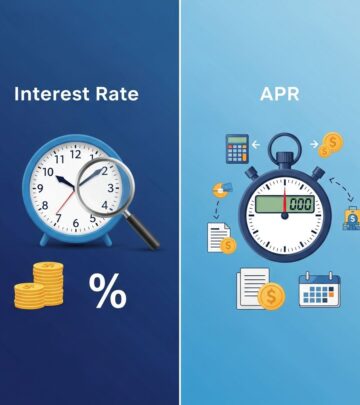
is essential for anyone financing a vehicle. The interest rate represents the basic cost of borrowing the principal, while APR provides a fuller picture by incorporating additional fees, offering a more accurate measure of total expenses.Core Elements of Car Loan Costs
Every car loan breaks down into fundamental components that determine your overall repayment burden. The
principal
is the base amount borrowed, typically the vehicle’s purchase price minus any down payment or trade-in value. For instance, a $30,000 car with a $5,000 down payment results in a $25,000 principal.**Interest** serves as the lender’s profit margin, calculated as a percentage of the outstanding principal. Car loans use simple interest, applied daily to the remaining balance without compounding, unlike some other debts. This means interest accrues on the principal only, making payments more predictable over time.
Amortization structures these payments so early installments primarily cover interest, with principal reduction accelerating later. This front-loaded approach ensures lenders recover costs quickly while borrowers build equity gradually.
Defining Interest Rate in Depth
The
interest rate
, often called the note rate, is the percentage applied solely to the principal balance. It dictates how much extra you pay for the privilege of borrowing. For a $25,000 loan at 5% interest over 60 months, monthly payments might total around $472, with interest comprising a significant portion early on.Lenders determine rates based on factors like credit score, loan term, and vehicle value. Higher scores unlock lower rates, reducing borrowing costs substantially. Shorter terms often yield lower rates but elevate monthly payments.
- Credit score: Excellent (720+) typically secures rates under 5%; subprime scores exceed 10%.
- Loan-to-value (LTV) ratio: Loans below 100% LTV (loan amount vs. car value) attract better rates.
- Term length: 36-48 months often cheaper than 72+ months.
Unpacking the Annual Percentage Rate (APR)
**APR** expands beyond interest by including all financing costs annualized as a percentage. Mandated by the federal Truth-in-Lending Act (TILA), it ensures transparency, allowing apples-to-apples comparisons across lenders.
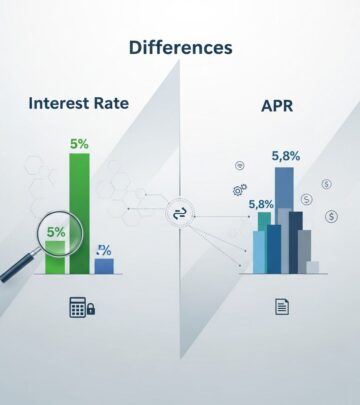
APR factors in origination fees, documentation charges, and sometimes taxes or add-ons like extended warranties rolled into the loan. If a $25,000 loan carries a 5% interest rate plus $500 in fees, the APR might rise to 5.8%, reflecting the true yearly cost.
APR is typically higher than the interest rate due to these extras, though rare promotions (e.g., rebates) can invert this. Always prioritize APR when evaluating offers, as it reveals the holistic expense.
Interest Rate vs. APR: Side-by-Side Analysis
To clarify differences, consider this comparison:
| Aspect | Interest Rate | APR |
|---|---|---|
| Calculation Base | Principal balance only | Principal + interest + fees |
| Scope | Borrowing cost | Total loan cost |
| Typical Value | Lower (e.g., 5%) | Higher (e.g., 5.8%) |
| Best Use | Understanding core interest | Comparing lenders |
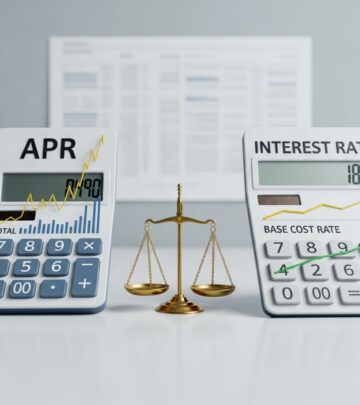
This table highlights why focusing solely on interest rate can mislead; fees inflate the effective cost via APR.
Real-World Impact on Monthly Payments
Both rates influence payments identically in structure but differ in transparency. Using the loan formula: Monthly Payment = [P × r × (1+r)^n] / [(1+r)^n – 1], where P is principal, r monthly rate, n payments.
For a $25,000 loan at 5% interest (APR 5.5% with fees):
- 60-month term: ~$471/month; total interest ~$3,140; total fees add ~$365.
- Extending to 72 months drops to ~$405/month but adds ~$1,000 in interest.
Shorter terms save on interest despite higher payments, emphasizing the value of APR in long-term planning.
Factors Driving Rate Variations
Several variables shape both rates:
- Prepaid Finance Charges: Upfront fees like origination boost APR but not the base rate.
- Loan Term: Longer terms increase total interest, often hiking APR.
- LTV Ratio: High LTV (over 100%) signals risk, raising rates.
- Credit Profile: FICO scores dictate eligibility; improvements yield savings.
- Market Conditions: Economic shifts affect baseline rates across lenders.
Shopping multiple quotes reveals variances; even 0.5% differences save hundreds over the loan life.
Strategies to Secure Favorable Terms
Minimize costs by proactive steps:
- Boost Credit: Pay down debt; scores above 740 unlock prime rates.
- Large Down Payment: 20% reduces principal and LTV, lowering rates.
- Shorten Term: Opt for 48-60 months to cut interest.
- Pre-Qualify: Get rates from banks, credit unions, online lenders without credit hits.
- Negotiate Fees: Challenge add-ons to keep APR low.
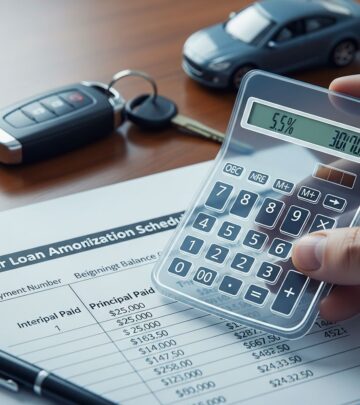
Tools like auto loan calculators simulate scenarios, projecting total costs based on inputs.
Common Pitfalls in Loan Shopping
Borrowers often overlook:
- Fee Overlooks: Shiny low rates hide high APRs from fees.
- Upside-Down Loans: Owing more than car value via high LTV or long terms.
- Dealer Markups: Captive financing inflates rates; compare independently.
- Ignoring Amortization: Early prepayments target interest best.
Review Truth-in-Lending disclosures meticulously for all figures.
Advanced Calculation Insights
Estimating rates manually: For year-one interest, divide total interest by average balance. A $15,000 loan at 6% yields ~$900 first-year interest on ~$14,000 average balance.
APR adjusts for prepaid charges: Solve iteratively in amortization formulas, yielding higher effective rates. Use spreadsheets for precision:
PMT = principal * (monthly_rate * (1 + monthly_rate)^terms) / ((1 + monthly_rate)^terms - 1)These computations underscore APR’s superiority for holistic evaluation.
Frequently Asked Questions
Why is APR higher than interest rate?
APR incorporates fees, taxes, and charges absent from the base interest rate, providing the complete annual cost.
Does a lower interest rate always mean a better deal?
No; compare APRs, as high fees can make a lower rate costlier overall.
How does loan term affect APR?
Longer terms spread costs but accrue more interest, potentially elevating APR.
Can APR be lower than interest rate?
Rarely, via incentives like rebates reducing effective costs.
Is APR regulated?
Yes, TILA mandates clear disclosure for comparison shopping.
Final Thoughts on Smart Borrowing
Mastering APR versus interest rate empowers better decisions, saving thousands on auto loans. Prioritize comprehensive quotes, strong credit, and fee scrutiny for optimal financing.
References
- Understanding Interest Rates vs. APR for Car Loans — RateGenius. 2023. https://www.rategenius.com/car-loan-interest-rate-vs-apr
- Understanding APR vs. interest rate for auto loans — Santander Consumer USA. 2024. https://santanderconsumerusa.com/blog/apr-vs-interest-rate-auto-loan
- APR vs. Interest Rate For Car Loans — Tresl Auto Finance. 2023. https://mytresl.com/blog/apr-vs-interest-rate-for-car-loans/
- Apr vs Interest Rate on a Car Loan — State Farm. 2024. https://www.statefarm.com/simple-insights/financial/apr-vs-interest-rate-car-loan
- How Do Car Loans Work? — Bank of America. 2025. https://www.bankofamerica.com/auto-loans/how-car-loans-work/
- How Is Interest Calculated on a Car Loan? — Credit Union of America. 2024. https://www.cuofamerica.com/News/How-Is-Interest-Calculated-on-a-Car-Loan
Similar Articles








Read full bio of Sneha Tete