Annual Percentage Yield (APY): 2025 Guide For Savers
Understanding APY: How compound interest affects your savings and investments.
What Is Annual Percentage Yield (APY)?
Annual Percentage Yield (APY) is a standardized measure of the interest rate earned on a deposit account or investment over the course of a year, taking into account the effects of compound interest. Unlike simple interest, APY reflects the actual return you will receive when interest is compounded at regular intervals throughout the year. This metric is crucial for comparing financial products and understanding how your money grows over time.
Financial institutions are required by law to disclose APY when advertising deposit accounts, making it an essential tool for consumers to evaluate savings opportunities. The higher the APY, the more interest your money will earn, all else being equal. Understanding APY helps you make informed decisions about where to place your money to maximize returns.
How APY Works
APY incorporates compound interest, which is the process where earned interest is added back to the principal, and then earns interest itself in subsequent periods. This creates an exponential growth effect over time. The frequency of compounding—whether daily, monthly, quarterly, or annually—significantly impacts the final APY.
For example, if you deposit $10,000 in a savings account with a 4% APY compounded daily, your money will grow faster than with the same 4% rate compounded annually. The daily compounding means interest is calculated and added to your balance every single day, allowing each day’s interest to earn interest on subsequent days.
The relationship between frequency of compounding and APY can be illustrated as follows:
- Daily Compounding: Interest is calculated and added to your account every day, maximizing growth potential.
- Monthly Compounding: Interest is calculated and added once per month, resulting in moderate growth.
- Quarterly Compounding: Interest is calculated and added four times per year, resulting in slower growth than daily or monthly.
- Annual Compounding: Interest is calculated and added once per year, resulting in the slowest growth rate.
APY vs. APR: Key Differences
APY and Annual Percentage Rate (APR) are two commonly confused financial terms that represent different concepts and serve different purposes in financial products.
Annual Percentage Rate (APR)
APR is the annual rate of interest charged on borrowed money, without accounting for compound interest. It represents the cost of borrowing expressed as a yearly percentage. APR is commonly used for loans, mortgages, and credit cards. The APR does not include the effects of compounding, providing a simpler but less complete picture of the true cost of borrowing.
Key Distinctions
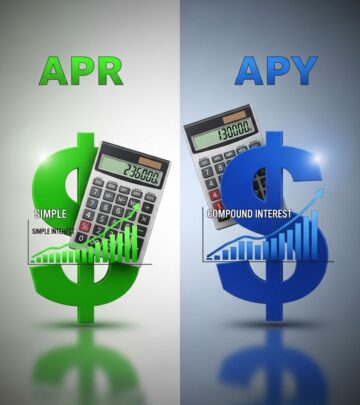
- Compounding: APY includes compound interest; APR does not.
- Account Type: APY is used for savings and investments; APR is used for loans and credit products.
- Actual Return/Cost: APY shows what you actually earn; APR shows the stated annual cost before compounding effects.
- Comparison Ease: APY provides a more accurate basis for comparing savings products; APR provides a standardized comparison for borrowing costs.
Comparative Example
Consider a savings account with an APY of 4.5% versus a loan with an APR of 4.5%. On a $10,000 deposit in the savings account, you might earn approximately $450 in the first year (assuming simple calculation). However, with daily compounding, you would actually earn slightly more due to compound interest. Conversely, on a $10,000 loan at 4.5% APR, the interest owed would be approximately $450, but the actual cost could vary depending on how interest is calculated and the loan term.
How to Calculate APY
The APY formula accounts for the principal amount, the interest rate, and the frequency of compounding. The mathematical formula for APY is:
APY = (1 + r/n)^n – 1
Where:
- r = The annual interest rate (as a decimal)
- n = The number of compounding periods per year
Calculation Example
If you have a savings account with a nominal interest rate of 2% compounded monthly:
- r = 0.02
- n = 12 (monthly compounding)
- APY = (1 + 0.02/12)^12 – 1
- APY = (1.001667)^12 – 1
- APY ≈ 0.02020 or 2.020%
This shows that a 2% nominal rate with monthly compounding yields an effective annual return of approximately 2.02%—a difference of 0.02 percentage points due to compounding.
Why APY Matters for Savers and Investors
APY is particularly important for individuals who are evaluating savings accounts, money market accounts, certificates of deposit (CDs), and other deposit products. A higher APY means your money grows faster, which is especially significant over longer time periods.
Long-Term Impact of APY Differences
Even small differences in APY can result in substantial differences in accumulated wealth over time due to compound interest. For instance:
- A difference of 0.5% APY on a $50,000 deposit over 10 years can result in thousands of dollars in additional earnings.
- Comparing APY across different financial institutions helps identify the best savings opportunities.
- Choosing accounts with higher APY maximizes returns without taking on additional risk (assuming FDIC insurance applies).
Types of Accounts and Their Typical APY Rates
Different financial products offer varying APY rates based on their terms, liquidity, and market conditions:
Savings Accounts
Traditional savings accounts typically offer modest APY rates, often ranging from 0.01% to 0.50% at major banks. Online savings accounts frequently provide higher rates due to lower overhead costs.
Money Market Accounts
Money market accounts usually offer APY rates slightly higher than savings accounts, typically between 0.25% and 1.50%, depending on the institution and current market conditions.
Certificates of Deposit (CDs)
CDs typically offer higher APY rates than savings accounts because you agree to keep your money deposited for a fixed period. Rates vary based on the term length, with longer-term CDs often offering higher APY.
High-Yield Savings Accounts
High-yield savings accounts, primarily offered by online banks, provide significantly higher APY rates, often ranging from 2% to 5%, depending on market conditions and competition among financial institutions.
Factors Affecting APY
Several factors influence the APY rates offered by financial institutions:
Federal Reserve Rates
The Federal Reserve’s interest rate decisions directly impact the APY rates offered by banks. When the Fed raises rates, banks typically increase the APY on deposit accounts to attract and retain customers.
Competition Among Banks
Banks compete for deposits by offering attractive APY rates. Online banks often lead in offering higher rates due to their lower operating costs compared to traditional brick-and-mortar institutions.
Account Type and Terms
Different account types and terms affect APY. Longer-term CDs typically offer higher rates than shorter-term options, and money market accounts may offer tiered rates based on your balance.
Economic Conditions
During periods of economic growth and inflation, APY rates tend to increase. Conversely, during economic downturns or deflationary periods, rates typically decline.
Maximizing Returns with APY
To maximize your earnings through APY, consider the following strategies:
- Compare Multiple Institutions: Shop around and compare APY rates from different banks and financial institutions to find the best opportunities.
- Consider Account Features: Evaluate not only the APY but also fees, withdrawal restrictions, and minimum balance requirements.
- Choose Appropriate Account Types: Match account types to your financial goals. CDs are ideal for funds you won’t need immediately, while savings accounts offer more liquidity.
- Monitor Rate Changes: Stay informed about interest rate trends and move your money to higher-yielding accounts when opportunities arise.
- Leverage Compounding: Choose accounts with more frequent compounding (daily is best) to maximize the benefits of compound interest.
Frequently Asked Questions (FAQs)
Q: What is the difference between APY and interest rate?
A: The interest rate is the percentage charged or earned per period, while APY is the annualized rate that includes the effects of compound interest over a full year. APY provides a more accurate picture of actual earnings or costs.
Q: How often is APY compounded?
A: Compounding frequency varies by account. Common compounding periods include daily, monthly, quarterly, and annually. Daily compounding typically results in the highest APY, while annual compounding results in the lowest.
Q: Can APY change after I open an account?
A: Yes, APY rates can change, particularly for savings accounts and money market accounts. CD rates are typically fixed for the term of the CD, but rates may change when the CD matures and you consider renewing.
Q: Is APY guaranteed?
A: APY rates are not guaranteed in perpetuity. Banks can change rates on savings and money market accounts at any time. However, rates on fixed-term CDs are locked in for the duration of the CD term.
Q: How does APY affect taxes?
A: Interest earned through APY is considered taxable income. You must report all interest earned on your tax return. The financial institution will typically issue a Form 1099-INT if you earn $10 or more in interest during the tax year.
Q: Which account type typically offers the highest APY?
A: High-yield savings accounts and CDs with longer terms typically offer the highest APY rates. Online banks often provide better rates than traditional banks due to lower operating costs.
References
- Annual Percentage Yield Definition and Disclosure — Federal Reserve System. YYYY-MM-DD. https://www.federalreserve.gov/
- Truth in Savings Act Regulation DD — Consumer Financial Protection Bureau. 2024. https://www.consumerfinance.gov/
- Compound Interest and Investment Returns — U.S. Securities and Exchange Commission. 2024. https://www.sec.gov/
- Understanding Interest Rates and APY — Office of the Comptroller of the Currency. 2024. https://www.occ.treas.gov/
- Savings Account and CD Rate Trends — Federal Deposit Insurance Corporation. 2025. https://www.fdic.gov/
Similar Articles








Read full bio of medha deb