Annual Business Revenue: Essential Guide To Calculating It
Master the essentials of annual business revenue: definitions, calculations, tracking tools, and its role in growth and valuation.
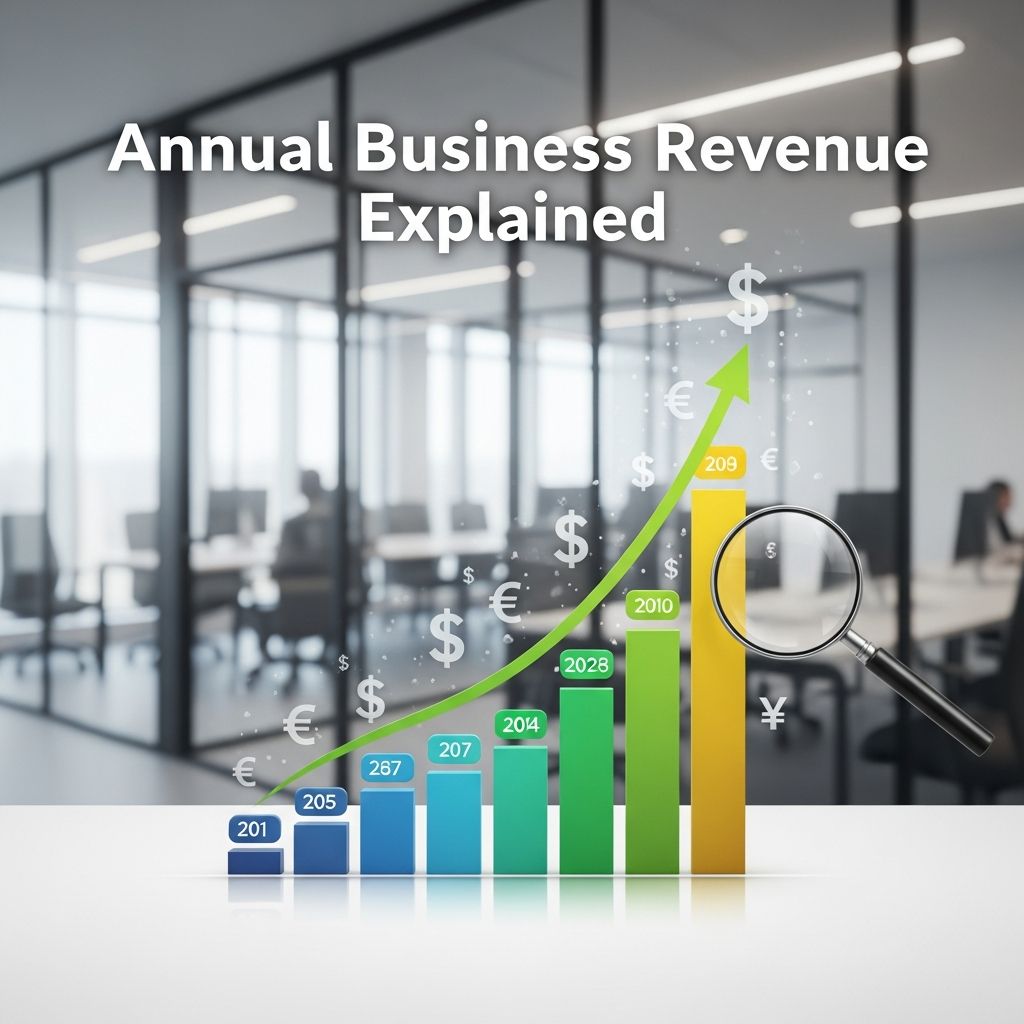
Annual business revenue represents the total income generated by a company over a full 12-month period from its primary operations, excluding any deductions for costs or expenses. This key financial metric serves as a foundational indicator of business scale and performance, influencing everything from loan applications to investment pitches.
Understanding the Core Concept of Business Revenue
At its essence, business revenue captures all money flowing into the company from sales of products, services, or other core activities before accounting for outflows. It appears as the top line on an income statement, providing a clear snapshot of operational success without the noise of expenses. Distinguishing revenue from profit is crucial: while revenue tracks gross inflows, profit reflects what’s left after subtracting costs, taxes, and other deductions.
Revenue can be categorized into operating revenue, derived from everyday business functions like product sales or service fees, and non-operating revenue, such as interest earned or gains from asset disposals. For most analyses, especially annual figures, the focus remains on operating revenue as it best reflects sustainable business health.
Fundamental Formulas for Revenue Computation
The simplest way to compute revenue uses the formula: Revenue = Quantity Sold × Selling Price. This approach works universally across business models. For instance, a retailer selling 1,000 units at $50 each generates $50,000 in revenue.
Total revenue sums all income streams, while gross sales precede adjustments for returns or discounts. Net sales, then, equal gross sales minus these reductions. A business with $5,000 in gross sales and $500 in discounts reports $4,500 in net sales.
Tailored Revenue Calculations by Business Model
Different industries require adapted methods to ensure accuracy.
Product-Based Enterprises
For manufacturers or retailers, revenue stems directly from inventory movement. Calculate per product line: Revenue = Units Sold × Price per Unit, then aggregate. A store moving 200 hammers at $25 ($5,000) and 150 drills at $80 ($12,000) totals $17,000.
- Track variants like bulk discounts or bundles separately to avoid underreporting.
- Seasonal peaks, such as holiday sales, demand monthly breakdowns for annual summation.
Service-Oriented Companies
Service providers bill by time, projects, or subscriptions. Hourly models multiply billable hours by rates; project fees recognize income at milestones. Recurring models shine here: a $5,000 monthly retainer yields $60,000 annually per client.
- SaaS firms prioritize Monthly Recurring Revenue (MRR): MRR × 12 = Annual Recurring Revenue (ARR).
- Freelancers aggregate invoiced amounts, excluding unbilled work.
Deriving Annual Revenue from Periodic Data
Annual revenue aggregates 12 months of figures, ideally from January to December for calendar-year businesses. Sum monthly totals directly if records exist. Mid-year estimates multiply average monthly revenue by 12, but seasonal businesses must adjust using historical patterns.
Quarterly data annualizes via multiplication by 4, suitable for stable operations. Formula: Annual Revenue = (Q1 + Q2 + Q3 + Q4) or projected equivalents. Fluctuations, like retail holiday surges, require weighting recent strong periods higher.
| Period | Revenue Example | Annualization Method |
|---|---|---|
| Monthly | $10,000 avg. | ×12 = $120,000 |
| Quarterly | $30,000 | ×4 = $120,000 |
| Seasonal Adjusted | $15,000 peak mo. | Historical avg. ×12 |
Advanced Tracking and Automation Tools
Manual spreadsheets falter with volume; modern tools automate precision. Cloud accounting platforms like QuickBooks, Xero, or FreshBooks link to banks and processors for real-time inflows.
- Invoicing Platforms: Wave or Zoho track receivables, generating reports on outstanding and collected funds.
- CRM Systems: Salesforce or HubSpot monitor sales pipelines, forecasting revenue from leads.
- POS for Retail: Square or Lightspeed capture point-of-sale data instantly.
- Revenue Recognition Software: RevPro handles complex subscriptions and contracts per standards.
Enterprise solutions like NetSuite offer segmentation by channel or region, revealing insights like top-performing products.
Revenue’s Strategic Role in Business Decisions
Beyond tracking, annual revenue fuels growth strategies. It benchmarks performance, guides pricing tweaks, and informs marketing budgets. Stable revenue signals scalability to partners.
Boosting Revenue Streams
- Diversify products or enter new markets.
- Optimize pricing based on elasticity analysis.
- Enhance retention via loyalty programs.
Financial Health Indicators
Pair revenue with margins: Gross Profit Margin = (Revenue – COGS) / Revenue × 100. Stable ratios indicate pricing power; declines signal cost pressures.
Leveraging Revenue for Valuation and Funding
Buyers and investors scrutinize annual revenue for worth estimates. The revenue multiple method multiplies figures by industry benchmarks: Value = Annual Revenue × Multiple.
SaaS firms might use 3.5x on $3M revenue for $10.5M valuation, though profitability adjusts this. Research multiples via M&A data; growth trumps margins for startups.
For loans, banks favor consistent revenue trajectories, often requiring 12-24 months of statements.
| Industry | Typical Multiple | Example Valuation ($1M Revenue) |
|---|---|---|
| SaaS | 3-10x | $3M-$10M |
| Retail | 0.5-2x | $500K-$2M |
| Services | 1-3x | $1M-$3M |
Common Pitfalls in Revenue Reporting
Inaccurate categorization inflates or deflates figures. Exclude one-offs like asset sales from operating revenue. Seasonal distortions mislead if not averaged properly. Always reconcile with bank statements.
Tax bodies demand precise annual revenue for filings; underreporting risks audits.
Future-Proofing Revenue Management
Integrate AI-driven tools for predictive analytics, forecasting based on trends. As e-commerce grows, blend online/offline tracking seamlessly. Sustainability reporting may tie revenue to ESG metrics soon.
Frequently Asked Questions
What counts as annual business revenue?
Total core operation income over 12 months, pre-expenses. Operating sales dominate; non-operating adds marginally.
How do I calculate annual revenue mid-year?
Average monthly ×12, adjusted for seasonality via historical data.
What’s the difference between revenue and profit?
Revenue is inflows; profit subtracts all costs.
Which tools best track revenue?
QuickBooks, Xero for accounting; Salesforce for pipelines; Square for POS.
How is revenue used in business sales?
Multiplied by industry factors for valuation estimates.
References
- Business Revenue: Definition, Formula & Examples — Ramp. 2023. https://ramp.com/blog/how-to-calculate-and-report-annual-business-revenue
- Best Tools to Calculate Revenue for Your Business — Paperturn. 2023. https://www.paperturn.com/blog/business/best-tools-to-calculate-revenue-for-your-business
- Valuing a Business Based on Revenue: A Comprehensive Guide — Website Closers. 2023. https://www.websiteclosers.com/resources/valuing-a-business-based-on-revenue/
- What Multiple Of Revenue Is A Business Worth? — Raincatcher. 2023. https://raincatcher.com/how-many-times-revenue-is-a-business-worth/
- Defining Revenue: Key Concepts, Calculations & Examples — PNC. 2024-01-15. https://www.pnc.com/insights/small-business/manage-business-finances/defining-revenue-key-concepts-calculations-examples.html
- How to Calculate and Track Annual Revenue — Rho. 2023. https://www.rho.co/blog/annual-revenue-meaning
- How to Measure Business Profitability — U.S. Chamber of Commerce. 2023. https://www.uschamber.com/co/run/finance/how-to-measure-business-profitability
Similar Articles








Read full bio of Sneha Tete