Amortization vs Depreciation: Key Differences
Discover how amortization and depreciation allocate asset costs, their unique applications, and impacts on financial statements for smarter business decisions.
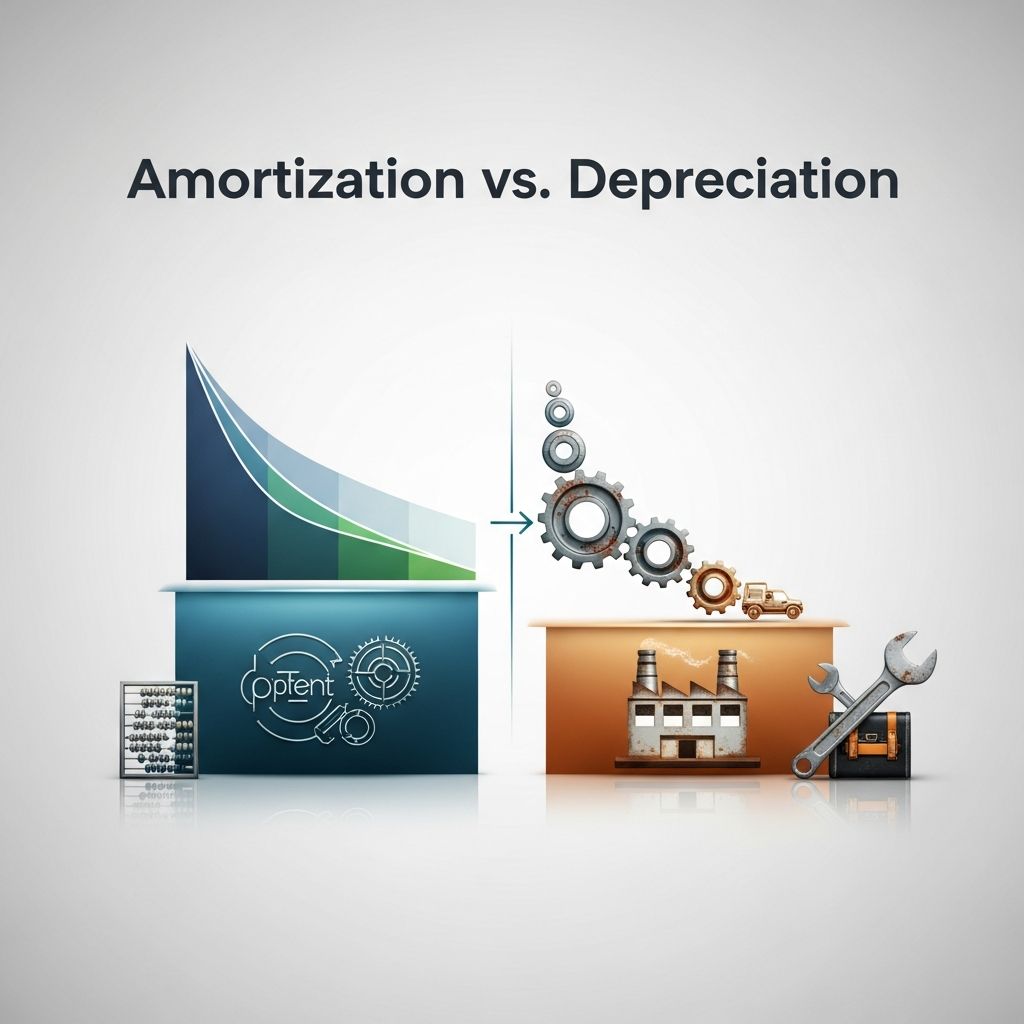
Amortization and depreciation serve as fundamental accounting tools that enable businesses to distribute the cost of assets across their productive periods, ensuring financial statements accurately reflect economic reality. While both methods systematically reduce asset values over time, they target distinct asset categories and employ varied approaches.
Core Concepts of Asset Cost Allocation
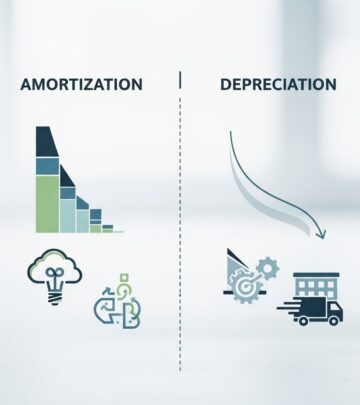
Businesses acquire assets to generate revenue, but these assets’ value diminishes as they are used. Accounting standards require matching this cost decline with the periods benefiting from the asset, a principle known as expense matching. Depreciation handles tangible assets like machinery or vehicles, while amortization addresses intangibles such as patents or software.
This allocation prevents large one-time expenses, smoothing income statements and providing a clearer picture of profitability. Both are non-cash expenses, meaning they do not involve actual cash outflows but are added back in cash flow analyses.
Defining Depreciation in Detail
Depreciation systematically allocates the cost of a physical, tangible asset over its estimated useful life. Tangible assets include items with physical substance, such as buildings, equipment, vehicles, and furniture, which wear out through usage, time, or obsolescence.
The process begins by determining the asset’s initial cost, including purchase price and setup expenses. From this, subtract the salvage value—the expected resale amount at the end of its life. Divide the net amount by the useful life in years or units of production to derive annual depreciation.
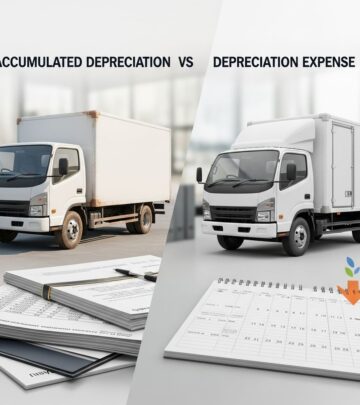
For instance, a company buys a delivery truck for $50,000 with a 5-year useful life and $5,000 salvage value. The depreciable base is $45,000, leading to $9,000 annual straight-line depreciation.
Common Depreciation Methods
- Straight-Line Method: Evenly spreads cost over time, ideal for assets with consistent usage. Formula: (Cost – Salvage) / Useful Life.
- Declining Balance (Accelerated): Higher expenses early on, suiting assets losing value quickly, like technology. Often doubles the straight-line rate.
- Units of Production: Bases expense on output, perfect for machinery tied to production volume.
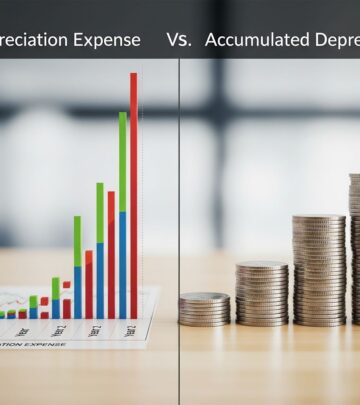
Accumulated depreciation appears as a contra-asset on the balance sheet, reducing the asset’s book value without affecting cash.
Understanding Amortization Thoroughly
Amortization mirrors depreciation but applies exclusively to intangible assets—non-physical items providing long-term benefits, like patents, trademarks, copyrights, goodwill, or software licenses. These assets derive value from legal rights or competitive edges rather than physical form.
Unlike tangibles, intangibles rarely have salvage value, as their worth typically expires (e.g., patent terms end). Amortization uses the straight-line method almost universally, dividing the cost evenly over the legal or economic life, often 15 years for tax purposes under U.S. rules.
Consider a $100,000 patent with a 10-year life: annual amortization is $10,000, gradually zeroing the balance sheet value.
Special Cases in Amortization
- Goodwill: From business acquisitions, often not amortized if indefinite-lived but tested annually for impairment.
- Loan Amortization: Separate context for debt repayment, reducing principal alongside interest, distinct from asset amortization.
Accumulated amortization functions like its depreciation counterpart, contra to intangible assets on the balance sheet.
Side-by-Side Comparison
The table below highlights critical distinctions for quick reference:
| Aspect | Depreciation | Amortization |
|---|---|---|
| Asset Type | Tangible (physical) | Intangible (non-physical) |
| Examples | Machinery, buildings, vehicles | Patents, software, trademarks |
| Methods | Straight-line, accelerated, units-of-production | Straight-line primarily |
| Salvage Value | Often considered | Usually zero |
| Useful Life | Shorter, asset-specific | Legal term or 15 years (tax) |
| Financial Impact | Reduces PP&E on balance sheet | Reduces intangibles on balance sheet |
This comparison underscores how depreciation accommodates physical wear patterns, while amortization fits finite legal durations.
Financial Statement Implications
Both appear as operating expenses on the income statement, lowering taxable income and thus tax liability. They do not impact cash flows directly but are reversed in the cash flow statement’s reconciliation.
On the balance sheet, they decrease net asset values via contra accounts, preserving historical cost while showing consumed portions. This aids in ratio analysis, like return on assets, by reflecting true economic value.
For example, high depreciation in capital-intensive industries like manufacturing depresses net income initially under accelerated methods but stabilizes later.
Tax Considerations and Compliance
U.S. tax code (IRC Section 168) mandates depreciation for tangibles via Modified Accelerated Cost Recovery System (MACRS), allowing faster write-offs than financial straight-line. Intangibles under Section 197 amortize over 15 years straight-line.
Businesses must align book and tax treatments, often using deferred tax liabilities for timing differences. Accurate classification avoids IRS penalties.
Practical Examples Across Industries
Manufacturing Scenario
A factory purchases $200,000 equipment with 10-year life and $20,000 salvage. Straight-line depreciation: $18,000/year. This matches costs to production output.
Tech Firm Example
A software company develops proprietary code for $300,000, useful for 5 years. Annual amortization: $60,000, reflecting development expense spread over revenue generation.
Common Misconceptions Clarified
- Myth: They are interchangeable. No—asset type dictates the method; misclassification distorts statements.
- Myth: Only large firms use them. Small businesses with any fixed/intangible assets must apply them.
- Myth: No tax benefits. Both reduce taxable income significantly.
Frequently Asked Questions (FAQs)
What is the main difference between amortization and depreciation?
Depreciation applies to tangible assets, using various methods including salvage value, while amortization is for intangibles, typically straight-line with no salvage.
Do amortization and depreciation affect cash flow?
No, they are non-cash expenses added back in cash flow statements.
Can you accelerate amortization like depreciation?
Rarely; straight-line dominates for intangibles due to their nature.
How does salvage value factor in?
Only in depreciation for tangibles expected to resell; intangibles assume zero.
Are they the same on income statements?
Yes, both recorded as expenses, though separately labeled.
Strategic Applications for Businesses
Understanding these methods aids capital budgeting, investment decisions, and performance evaluation. Managers forecast cash needs considering tax shields from deductions. Investors scrutinize D&A policies for earnings quality—aggressive methods may inflate short-term profits.
In mergers, amortization of acquired intangibles impacts post-deal profitability. For auto financing contexts, vehicle depreciation influences lease residuals and loan terms, helping buyers anticipate equity loss.
Advanced Topics: Impairment and Revaluation
Beyond scheduled allocation, assets undergo impairment tests if value drops suddenly (e.g., obsolete tech). Depreciation/amortization pauses during impairment write-downs.
Some standards allow revaluation upward for tangibles, but U.S. GAAP generally prohibits this, sticking to historical cost minus accumulations.
References
- Depreciation and Amortization (D&A) | Definition + Examples — Wall Street Prep. 2023. https://www.wallstreetprep.com/knowledge/depreciation-vs-amortization/
- Key Differences of Amortization vs Depreciation — HighRadius. 2024-01-15. https://www.highradius.com/resources/Blog/amortization-vs-depreciation/
- Amortization vs. depreciation: What are the differences? — Thomson Reuters Tax. 2024-05-20. https://tax.thomsonreuters.com/blog/amortization-vs-depreciation-what-are-the-differences/
- Depreciation vs. Amortization: What’s the Difference? — Indeed. 2023-11-10. https://www.indeed.com/career-advice/career-development/depreciation-vs-amortization
Similar Articles








Read full bio of Sneha Tete