Amortization: Definition, Examples, and How It Works
Master amortization: Understand loan payments, schedules, and financial planning strategies.

Amortization is a fundamental financial concept that plays a crucial role in personal finance and business accounting. Whether you’re taking out a mortgage, car loan, or managing a business asset, understanding amortization can help you make informed financial decisions and better manage your finances. This comprehensive guide explores amortization, how it works, and why it matters in both personal and business contexts.
What Is Amortization?
Amortization refers to the process of paying off a debt over time through regular payments. Each payment includes both principal and interest components. The term comes from the Latin word “amortis,” meaning “to deaden” or “to kill,” reflecting the gradual elimination of the debt. In accounting, amortization also refers to the process of spreading the cost of an intangible asset over its useful life.
There are two primary uses of amortization in financial contexts:
- Loan Amortization: The gradual repayment of a loan through periodic payments over a specified period, typically ranging from a few years to several decades.
- Asset Amortization: The systematic allocation of the cost of an intangible asset to expense over its estimated useful life for accounting purposes.
How Amortization Works
When you take out an amortizing loan, such as a mortgage or auto loan, you commit to making regular payments until the debt is fully repaid. Each payment covers both the interest accrued and a portion of the principal balance. The key characteristic of amortization is that the proportion of principal and interest changes with each payment.
In the early stages of loan repayment, a larger portion of each payment goes toward interest, while a smaller portion reduces the principal. As time passes and the remaining balance decreases, more of each payment applies to the principal, with less going toward interest. This pattern continues until the loan is completely paid off.
The amortization process is governed by the following factors:
- Loan Amount (Principal): The initial sum borrowed.
- Interest Rate: The annual percentage rate (APR) charged on the outstanding balance.
- Loan Term: The total period over which the loan will be repaid, typically expressed in months or years.
- Payment Frequency: How often payments are made (monthly, quarterly, annually, etc.).
Amortization Schedule Explained
An amortization schedule is a detailed table that outlines each payment on an amortizing loan. This schedule shows how each payment is allocated between principal and interest, the remaining balance after each payment, and the cumulative interest paid over the life of the loan. Amortization schedules are invaluable tools for understanding the true cost of borrowing and planning your financial obligations.
A typical amortization schedule includes the following columns:
- Payment Number: Sequential numbering of each payment.
- Payment Date: The date when payment is due.
- Payment Amount: The fixed periodic payment amount (for fixed-rate loans).
- Principal Payment: The portion of the payment reducing the loan balance.
- Interest Payment: The portion of the payment covering interest charges.
- Remaining Balance: The outstanding principal after each payment.
Consider a simple example: A borrower takes a $200,000 mortgage at 4% annual interest over 30 years. The monthly payment would be approximately $955. In the first month, roughly $667 goes toward interest and $288 toward principal. By the final payment, nearly the entire $955 goes toward principal, with minimal interest.
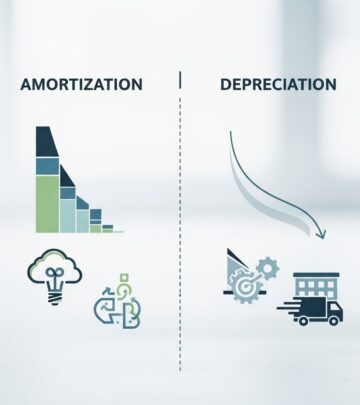
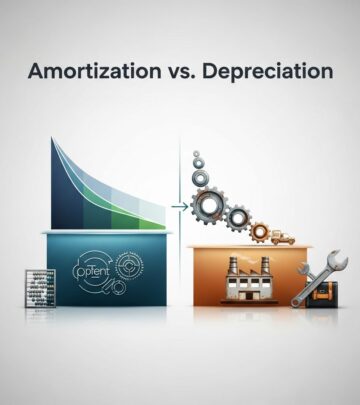
Amortization vs. Depreciation
Although the terms are sometimes confused, amortization and depreciation serve different purposes in accounting and finance. Understanding the distinction is essential for accurate financial reporting and analysis.
Amortization refers to the systematic allocation of the cost of an intangible asset over its useful life. Intangible assets include:
- Patents and copyrights
- Trademarks and brand names
- Goodwill
- Intellectual property
- Software licenses
Depreciation applies to tangible assets—physical property that can be seen and touched, such as buildings, machinery, vehicles, and equipment. Both methods reduce the book value of assets on financial statements, but they apply to different asset classes.
Key differences include:
- Amortization applies to intangible assets; depreciation applies to tangible assets.
- Amortization is often calculated on a straight-line basis over the asset’s legal or contractual life.
- Depreciation can use various methods, including straight-line, declining balance, and units of production.
- Amortization schedules for loans track debt repayment; asset amortization tracks expense recognition.
Types of Amortization
Different types of loans and assets employ amortization in various ways:
Mortgage Amortization
Mortgages are among the most common amortizing loans. Borrowers typically repay home loans over 15 or 30 years through fixed monthly payments. Mortgage amortization schedules help homeowners understand how much equity they’re building and how much they’ll pay in total interest over the loan’s life.
Auto Loan Amortization
Vehicle financing typically involves amortization periods of 3 to 7 years. Auto loan amortization schedules show the rapid equity buildup early in the loan term, which is why vehicles often become underwater (owing more than they’re worth) when interest-heavy early payments dominate.
Personal Loan Amortization
Personal loans are often amortized over 2 to 7 years. These unsecured loans generally carry higher interest rates than mortgages or auto loans, making amortization schedules particularly useful for understanding total borrowing costs.
Student Loan Amortization
Federal and private student loans use amortization for repayment. Some federal student loans offer income-driven repayment plans that modify standard amortization schedules based on borrower income.
Intangible Asset Amortization
Businesses amortize intangible assets like patents, copyrights, and goodwill acquired during mergers and acquisitions. This allocation of costs is required for accurate financial reporting under Generally Accepted Accounting Principles (GAAP).
Calculating Amortization Payments
The formula for calculating monthly amortization payments is:
M = P × [r(1 + r)^n] / [(1 + r)^n – 1]
Where:
- M = Monthly payment
- P = Principal loan amount
- r = Monthly interest rate (annual rate divided by 12)
- n = Total number of payments
This formula ensures that the borrower pays a consistent amount each period while fully retiring the debt by the loan’s maturity date. Financial calculators and amortization software automate this calculation, making it easy for borrowers to determine their payment obligations.
Benefits of Amortization
Amortization offers several advantages for both lenders and borrowers:
- Predictable Payments: Borrowers know exactly how much they’ll pay each period, making budgeting easier.
- Debt Reduction: Each payment reduces the principal, ensuring the loan is eventually eliminated.
- Transparent Costs: Amortization schedules clearly show total interest costs and how payments are allocated.
- Lender Security: Regular principal reduction protects lenders by continuously lowering their risk exposure.
- Tax Benefits: For mortgages, borrowers can deduct mortgage interest on their tax returns.
- Equity Building: Homeowners and business owners steadily build equity through principal payments.
Amortization in Business Accounting
In business accounting, amortization of intangible assets is a critical concept for financial reporting. When a company acquires another business, the purchase price often includes a premium for intangible assets like brand value, customer relationships, and proprietary technology. This premium, known as goodwill, must be amortized over time for accounting purposes.
Companies must comply with GAAP or International Financial Reporting Standards (IFRS) when amortizing intangible assets. The straight-line amortization method is most common, spreading costs evenly over the asset’s estimated useful life. This practice ensures that financial statements accurately reflect the company’s resources and expenses.
Special Amortization Considerations
Biweekly Payments
Some borrowers make biweekly mortgage payments instead of monthly payments. This strategy can significantly reduce the total interest paid and shorten the loan term, as it results in one extra monthly payment per year.
Extra Principal Payments
Borrowers who make extra principal payments reduce their outstanding balance faster, resulting in less total interest and a shorter loan term. This strategy requires careful tracking but can yield substantial savings.
Balloon Payments
Some loans feature balloon payments, where the amortization schedule is calculated over a longer period than the actual loan term, resulting in a large final payment. While this reduces monthly payments, it requires careful financial planning.
Variable-Rate Amortization
Adjustable-rate mortgages (ARMs) use amortization schedules that recalculate when interest rates change, potentially altering monthly payments and extending the loan term.
Frequently Asked Questions
Q: What is the main purpose of amortization?
A: Amortization serves two main purposes: it provides a systematic way to repay loans through regular payments combining principal and interest, and it allocates the cost of intangible business assets over their useful lives for accounting purposes.
Q: How long does it take to amortize a loan?
A: Amortization periods vary widely depending on the loan type. Mortgages typically span 15-30 years, auto loans 3-7 years, personal loans 2-7 years, and student loans can extend 10-25 years or more with income-driven repayment plans.
Q: Can I pay off an amortized loan early?
A: Yes, most amortized loans allow early payoff without penalty. Making extra principal payments reduces the loan term and total interest paid, though some loans may include prepayment penalties.
Q: What’s the difference between amortization and depreciation?
A: Amortization applies to intangible assets and loan repayment, while depreciation applies to tangible physical assets. Both reduce asset values over time but serve different accounting purposes.
Q: How do amortization schedules help in financial planning?
A: Amortization schedules provide detailed breakdowns of each payment’s principal and interest components, showing remaining balances and total costs. This information helps borrowers understand their debt obligations and plan finances accordingly.
Q: Is mortgage interest tax-deductible?
A: Yes, homeowners can deduct mortgage interest on their tax returns, though the mortgage must secure a primary or secondary residence, and the loan amount cannot exceed certain limits set by tax authorities.
Conclusion
Amortization is a fundamental financial concept that impacts millions of people through mortgages, auto loans, and personal debt. Understanding how amortization works, coupled with the ability to read and interpret amortization schedules, empowers individuals to make better borrowing decisions and optimize their financial strategies. Similarly, businesses must understand asset amortization to comply with accounting standards and accurately represent their financial positions. Whether you’re a borrower seeking to understand loan costs or a business owner managing assets, amortization knowledge is essential for achieving financial success.
References
- Amortization and the Amortization Schedule — U.S. Securities and Exchange Commission (SEC). https://www.sec.gov
- Generally Accepted Accounting Principles (GAAP) — Financial Accounting Standards Board (FASB). 2024. https://www.fasb.org
- Mortgage Amortization and Loan Terms — Federal Reserve Board. 2024. https://www.federalreserve.gov
- Intangible Asset Amortization Guidelines — Internal Revenue Service (IRS). 2024. https://www.irs.gov
- Student Loan Repayment Plans and Amortization — U.S. Department of Education. 2024. https://www.ed.gov
Similar Articles








Read full bio of Sneha Tete