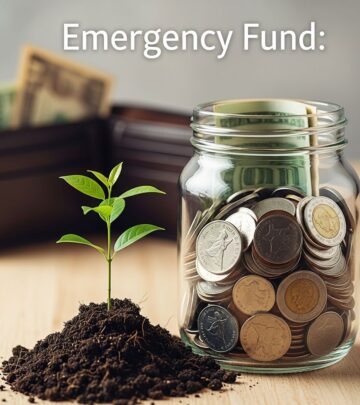
Americans Need $19K in Savings: Reality Check
Most Americans fall short of the $19,800 emergency savings goal, with median balances revealing a stark gap in financial preparedness.
The benchmark for emergency savings stands at approximately $19,800 for the typical American household, calculated from average monthly expenses of around $6,600. Yet, median transaction account balances linger at just $8,000, exposing a widespread vulnerability to unexpected financial shocks.
Understanding the Emergency Savings Imperative
Financial experts emphasize the necessity of an emergency fund equivalent to three to six months of living expenses. This buffer protects against job loss, medical emergencies, or major repairs. With U.S. household expenditures averaging $6,600 monthly, the lower target hits $19,800, while the upper reaches $39,600.
Life’s unpredictability underscores this need. Surveys indicate only 46% of adults possess sufficient funds for three months’ expenses, leaving over half at risk of debt reliance during crises.
Current State of American Savings Accounts
Federal Reserve data from the Survey of Consumer Finances reveals a median of $8,000 across transaction accounts, including savings, checking, and money market funds. The mean balance skews higher at $62,410, inflated by high-net-worth outliers.
This disparity highlights that while a wealthy minority bolsters averages, most households operate with modest reserves. Income levels drive the strongest variance: the lowest earners hold medians near $900, versus $111,600 for top brackets.
Age Breakdown: Savings Trajectories Over Time
Savings accumulation varies sharply by age group, reflecting career stages and life demands.
- Under 35: Average $20,540, as early careers build foundations amid student debt and entry-level pay.
- 35-44: Balances climb, supporting family growth and homeownership.
- 45-54: Peak earning years boost medians, though college and elder care strain resources.
- 55-64: Pre-retirement focus intensifies reserves.
- 65-74: Highest at $100,250 average, drawing on decades of compounding.
Younger cohorts lag due to high living costs and stagnant wages relative to inflation.
Why Savings Fall Short: Key Barriers
Several forces erode saving capacity. Stagnant real wages fail to match inflation, squeezing disposable income. Housing, healthcare, and education costs have surged, consuming larger budget shares.
The personal saving rate hovers at 4.5% as of January 2026, per Federal Reserve Economic Data, signaling low prioritization amid immediate pressures.
| Factor | Impact on Savings | Data Insight |
|---|---|---|
| Rising Costs | Monthly expenses average $6,080-$6,600 | Consumer Expenditure Survey |
| Low Wages | Median worker savings minimal | Income-savings correlation |
| Debt Burden | Student loans, credit cards divert funds | Widespread among under-40s |
| Inflation | Erodes purchasing power | Persistent post-2020s |
Retirement Savings: An Even Wider Chasm
Beyond emergencies, long-term retirement gaps loom larger. Median defined contribution plan balance for workers 21-64 stands at $955, including zeros; $40,000 for those with accounts.
Average retirement savings reach $87,000 overall, median $65,000, per 2024 Federal Reserve figures, but fall short of Fidelity guidelines: 1x income by 30, 3x by 40, up to 10x by 67.
Only 18% of savers meet age-based targets, with racial disparities: Asian (23%) and White (20%) workers ahead of Black and Hispanic (11%) groups.
- 40-45% of near-retirees have under $100,000.
- 1 in 4 working adults: zero retirement savings.
Strategies to Build Your Emergency Fund
Bridging the gap demands deliberate action. Start by tracking expenses to identify cuts—subscriptions, dining out yield quick wins.
- Automate Transfers: Post-paycheck shifts to high-yield savings (currently 4-5% APY).
- High-Yield Accounts: Shift from 0.01% traditional savings.
- Side Income: Gig work adds $500+/month for many.
- Windfalls: Tax refunds, bonuses direct to savings.
- Debt Paydown First: Tackle high-interest obligations.
Aim for $1,000 starter fund, then scale to full target. Consistency trumps speed.
Investment Options for Growing Savings
Once emergencies are covered, allocate excess to growth vehicles.
| Option | Risk Level | Potential Return | Best For |
|---|---|---|---|
| High-Yield Savings | Low | 4-5% | Emergencies |
| CDs | Low | 4.5-5.5% | Short-term goals |
| Index Funds | Medium | 7-10% historical | Retirement |
| 401(k) Match | Medium | Employer boost | Long-term |
Employer matches provide free money—maximize contributions.
Overcoming Common Saving Hurdles
Lifestyle inflation tempts spending raises. Counter with fixed-percentage savings rules (20% ideal).
Behavioral nudges help: apps rounding purchases or gamifying goals. Community accountability via financial peers boosts adherence.
For low earners, public programs like LIHEAP or SNAP free budget room.
Future Outlook: Savings in 2026 and Beyond
With saving rates at 4.5%, economic headwinds persist. Yet, fintech innovations—robo-advisors, micro-savings—democratize access.
Policy shifts, like expanded child tax credits, could aid families. Personal agency remains key: disciplined habits yield security.
Frequently Asked Questions
How much emergency savings do I really need?
Target 3-6 months of essential expenses, around $19,800-$39,600 for average households.
What’s the difference between average and median savings?
Average ($62,410) skewed by wealthy; median ($8,000) better reflects typical.
Should I prioritize emergency fund or retirement?
Build $1,000-$3,000 emergency first, then parallel track both.
Where to park emergency savings?
High-yield savings or money market for liquidity and yield.
Can I catch up on retirement savings in my 40s?
Yes, via max contributions, catch-up provisions post-50.
References
- The Average Savings Account Balance In The U.S. — Bankrate. 2022. https://www.bankrate.com/banking/savings/savings-account-average-balance/
- American workers fall short of retirement savings targets, study shows — Fox Business. 2023. https://www.foxbusiness.com/lifestyle/typical-american-worker-has-just-955-saved-retirement-study-shows
- Shocking Financial Stats About the Typical American — Erin Talks Money (YouTube). 2026. https://www.youtube.com/watch?v=WnRQCDBL_sA
- Personal Saving Rate (PSAVERT) — FRED, St. Louis Fed. 2026-01-01. https://fred.stlouisfed.org/series/PSAVERT
- Average Retirement Savings by Age 2026 — SafeMoney.com (citing Federal Reserve). 2024. https://safemoney.com/retirement-statistics/average-retirement-savings/
Similar Articles








Read full bio of medha deb