Alpha vs. Beta In Investing: Key Differences Explained
Understand the critical differences between alpha and beta to make smarter investment decisions.
Alpha vs. Beta in Investing: What’s the Difference?
Alpha and beta are two fundamental concepts in investing that often confuse newcomers to the market. These Greek letters represent measurable aspects of investment performance and risk, yet many investors use them interchangeably or misunderstand their distinct purposes. Understanding the difference between alpha and beta is crucial for developing a sound investment strategy and evaluating whether your investments are truly working for you. While they sound complicated at first glance, these concepts are actually straightforward once you break them down into their core components.
Key Takeaways
- Alpha measures excess returns above what would be expected for a given level of risk
- Beta measures an asset’s volatility relative to the overall market
- A higher alpha indicates better outperformance by a fund manager or strategy
- Beta values above 1.0 indicate higher volatility than the market benchmark
- Combining low beta with positive alpha can provide downside protection and growth potential
What is Alpha in Investing?
Alpha represents the return on an investment above what would be expected based on its level of risk. It serves as a measure of whether an asset or portfolio outperformed an appropriate benchmark, typically the S&P 500 or another major index. In simpler terms, alpha is the excess return that a fund manager or investment strategy generates beyond what the benchmark itself delivered.
To illustrate this concept, consider a practical example: if a stock fund returned 12 percent while the S&P 500 returned only 10 percent, the alpha would be 2 percent. However, this simple calculation doesn’t account for risk. To properly measure alpha, analysts must first determine what return should be expected given the investment’s level of risk. This is where beta becomes important in the calculation.
How Alpha Relates to Risk
The true measure of alpha requires adjusting for the risk undertaken. If a fund manager outperformed an index, it may have been because the fund assumed more risk than that of the index itself. For example, if a stock has a beta of 1.2, meaning it’s 20 percent riskier than the benchmark, investors should expect a higher return to compensate for that additional risk. If the index returned 10 percent and the stock returned 12 percent, that 2 percent difference would be considered alpha, as it represents true outperformance adjusted for risk.
Alpha is sometimes casually referred to as a measure of outperformance, but financial professionals emphasize that it should be used to measure return in excess of what would be expected for a given level of risk. This distinction is important because it separates lucky performance from genuine skill in investment management.
The Value of Consistent Alpha
A fund manager can generate alpha over any time horizon, but it’s most valuable when generated consistently over long periods. One legendary example is Warren Buffett’s Berkshire Hathaway, which has outperformed the S&P 500 by nearly 10 percent annually since 1965. This impressive alpha generation has created extraordinary wealth for investors—a $1,000 investment in the S&P 500 at the beginning of 1965 would have been worth about $391,540 at the end of 2024, whereas the same investment in Berkshire would have been worth approximately $55 million.
What is Beta in Investing?
Beta, also known as the beta coefficient, measures volatility relative to the market and serves as a risk measure. By definition, the stock market as a whole always has a beta of 1.0, making this the baseline for comparison. This means that betas above 1.0 indicate greater volatility than the overall market, while betas below 1.0 suggest lower volatility.
Understanding Beta Values
The term beta is simply a measure of a stock’s sensitivity to the movement of the overall stock market. For individual stocks, beta is calculated based on how they perform in relation to the index’s benchmark. A stock with a beta of 1.0 indicates that it moves in tandem with the S&P 500. If a stock’s performance has historically been more volatile than the market as a whole, its beta will be higher than 1.0. For example, a stock with a beta of 1.2 is 20 percent more volatile than the market.
Beta Works Both Ways
It’s important to understand that beta works in both directions. So if the S&P 500 rises 10 percent, a stock with a beta of 1.2 is expected to rise by 12 percent. Conversely, if the S&P 500 falls 10 percent, a stock with a beta of 1.2 is expected to fall by 12 percent as well. Generally, the higher a stock’s beta, the more volatile it is.
However, while a stock’s beta measures its volatility, it does not necessarily predict direction. A stock that performs 50 percent worse than the S&P 500 in a down market and a stock that performs 50 percent better than the S&P 500 in an up market will each have a high beta. Therefore, beta is best used for finding companies that tend to track the movements of the S&P 500—specifically, those with betas closer to 1.0.
Differences Between Alpha and Beta
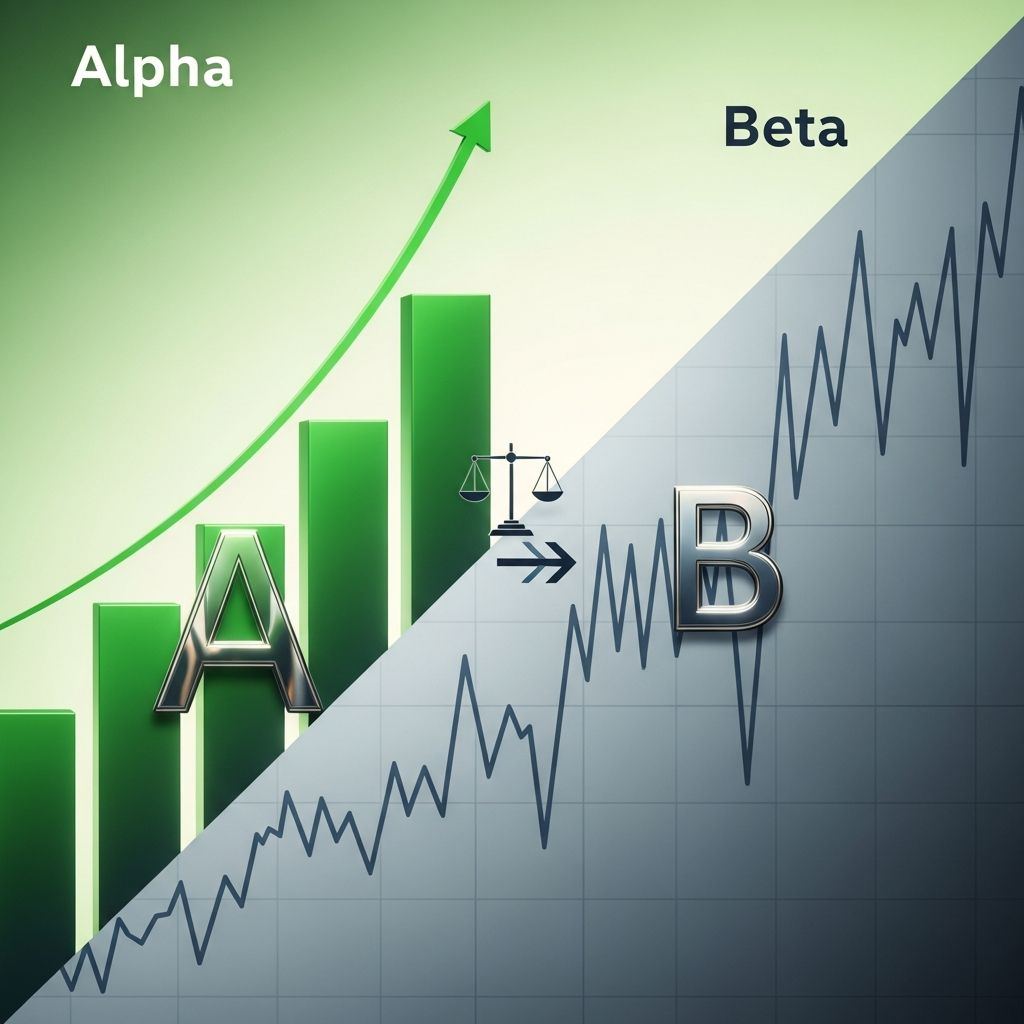
Though they’re both Greek letters, alpha and beta are quite different from each other and serve distinct purposes in investment analysis. The fundamental difference is that alpha measures excess return, while beta measures volatility or risk of an asset.
| Characteristic | Alpha | Beta |
|---|---|---|
| Definition | Excess return above expected based on risk | Volatility relative to the market |
| Purpose | Measures outperformance and manager skill | Measures risk and market sensitivity |
| Baseline | Zero indicates performance in line with benchmark | 1.0 represents the overall market |
| Value Range | Can be positive or negative | Greater than 1.0 (volatile) or less than 1.0 (stable) |
| Interpretation | Positive alpha = outperformance; Negative alpha = underperformance | Higher beta = more risk; Lower beta = less risk |
Key Distinctions
Beta might also be referred to as the return you can earn by passively owning the market. You cannot earn alpha by investing in a benchmark index fund such as an S&P 500 index fund, which is the definition of beta. This is because index funds simply track the market performance without attempting to outperform it. Any outperformance above the index return would represent alpha, which typically comes from active management decisions.
Choosing Your Investment Strategy Based on Beta
Understanding beta helps investors align their investment choices with their personal risk tolerance and investment goals. If you’re the type of investor easily rattled by market volatility, you may want to seek out investments with a lower beta. These investments will experience smaller price swings and may provide a smoother ride through market cycles.
Conversely, if you are seeking potentially higher returns in exchange for higher risk, higher beta stocks might generally be a good match for your portfolio. These more volatile investments have the potential to deliver greater gains during bull markets, but they also carry the risk of steeper losses during market downturns.
Smart Beta: A Middle Ground Approach
Smart beta strategies offer an alternative approach that differs fundamentally from both traditional passive indexing and active management. Unlike beta, which simply measures volatility, alpha measures a portfolio manager’s ability to outperform a market index. Smart beta strategies seek to outperform, or have less risk than, traditional capitalization-weighted benchmarks but typically have lower expenses than a traditional actively managed fund.
Smart beta strategies seek to enhance returns, improve diversification, and reduce risk by investing in customized indexes or ETFs based on one or more predetermined “factors.” They aim to outperform a benchmark index, in this sense differing fundamentally from a traditional passive indexing strategy.
Factor-Based Investing
Smart beta strategies identify and invest in factors that have historically driven superior returns. For example, stocks of companies that generate superior profits, strong balance sheets, and stable cash flows are considered high quality and tend to outperform the market over time. Similarly, small-cap stocks have historically outperformed large-cap stocks, although leadership can shift over shorter periods.
Most factors are not highly correlated with one another, and different factors may perform well at different times. This means that a diversified smart beta approach can adapt to changing market conditions more effectively than a static traditional index fund.
Combining Alpha and Beta for Better Results
While alpha measures the “value added” by a fund manager or strategy, beta reflects how sensitive an asset is to overall market movements. During periods of market declines, a low-beta asset (with a beta of less than 1) tends to show downside outperformance because it is less volatile than the broader market.
Low-beta stocks or funds tend to hold up better during market sell-offs because they do not swing as dramatically in response to market movements. These assets are less likely to experience steep declines, making them attractive for investors seeking protection during periods of high market uncertainty. For example, a stock with a beta of 0.5 would typically decline only half as much as the market during a downturn, meaning it is less exposed to the downside risk.
The Ideal Portfolio Combination
Ideally, investors look for a combination of both positive alpha and low beta to achieve downside outperformance. A strategy that consistently generates excess returns (alpha) without being overly sensitive to market declines (low beta) is highly valuable, particularly in volatile or bear markets. By reducing exposure to sectors showing weakness and maintaining resilient allocations, such strategies help limit drawdowns and contribute to overall alpha.
Frequently Asked Questions
What does an alpha of zero mean?
An alpha of zero indicates that an investment performed exactly in line with its benchmark index, neither outperforming nor underperforming. This is the baseline measure for alpha.
Can I earn alpha with an index fund?
No, you cannot earn alpha by investing in a benchmark index fund because index funds are designed to track market performance exactly. By definition, index funds deliver beta returns only.
How is beta calculated?
Beta is calculated by comparing a stock or fund’s price movements to those of a market benchmark. A beta of 1.0 means the investment moves with the market, above 1.0 means it’s more volatile, and below 1.0 means it’s less volatile than the market.
Which is more important: alpha or beta?
Both are important for different reasons. Beta helps you assess and manage risk, while alpha helps you evaluate whether a manager or strategy is adding genuine value through outperformance. The ideal investment combines positive alpha with an appropriate beta for your risk tolerance.
How does smart beta differ from traditional active management?
Smart beta strategies use systematic approaches based on predetermined factors to seek outperformance, typically with lower costs than actively managed funds. Traditional active management relies on a manager’s individual stock selection decisions.
References
- Alpha, Beta, and Smart Beta — Fidelity Investments. 2025. https://www.fidelity.com/learning-center/investment-products/etf/smart-beta
- Alpha Vs. Beta In Investing: What’s The Difference? — Bankrate. 2025. https://www.bankrate.com/investing/alpha-vs-beta-stocks/
- Understanding Alpha and Beta in the Context of Downside Outperformance — Beacon Investing. 2025. https://beaconinvesting.com/understanding-alpha-and-beta-in-the-context-of-downside-outperformance/
- Alpha, Beta and Smart Beta — State Street Global Advisors. 2025. https://www.ssga.com/au/en_gb/intermediary/insights/education/alpha-beta-and-smart-beta
Similar Articles








Read full bio of medha deb