Advanced Internal Rating-Based (AIRB): Definition and Framework
Understanding AIRB: A comprehensive guide to credit risk measurement in modern banking.
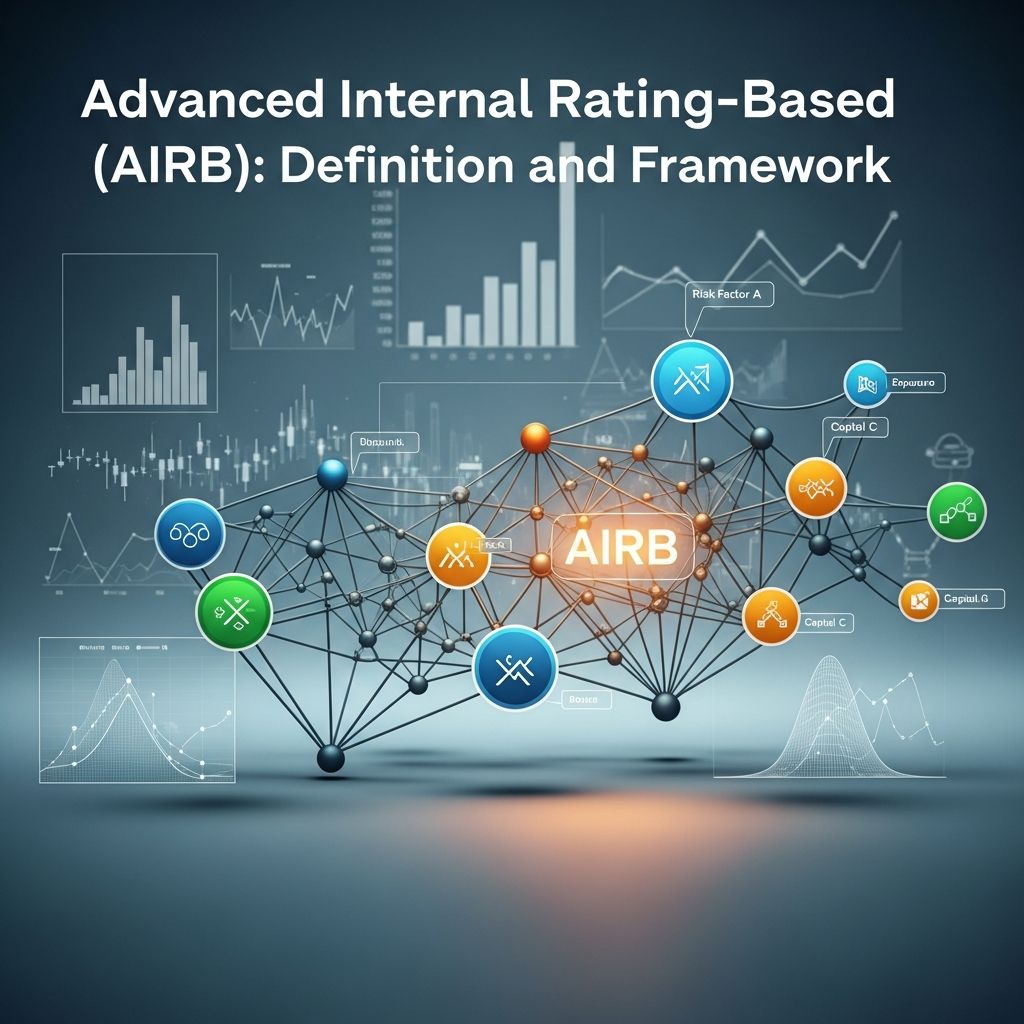
The Advanced Internal Rating-Based (AIRB) approach represents a sophisticated methodology for measuring credit risk within banking and financial institutions operating under global regulatory frameworks. As a risk measurement tool sanctioned under the Basel II Capital Rules, AIRB enables financial institutions to develop customized models that assess the probability of borrower default and calculate appropriate capital reserves. This approach has become fundamental to modern risk management practices in the banking sector.
What is AIRB?
The Advanced Internal Rating-Based approach is a credit risk measurement methodology that allows financial institutions to use their own internal models to assess credit risk rather than relying solely on external credit ratings. Under AIRB, banks develop sophisticated algorithms and models that analyze borrower characteristics, financial metrics, and historical default data to assign internal risk ratings to clients and counterparties.
Unlike the Foundation Internal Rating-Based (IRB) approach, AIRB grants institutions greater flexibility in determining multiple components of credit risk calculation, including loss given default (LGD) and exposure at default (EAD). This enhanced flexibility allows larger, more sophisticated financial institutions to tailor their risk assessments to their specific portfolio characteristics and operational environments.
Historical Context and Development
The AIRB framework emerged as part of the Basel II accord, which was introduced in 2004 as an international regulatory standard for banking supervision. Basel II represented a significant evolution from its predecessor, Basel I, by incorporating more nuanced approaches to measuring and managing credit risk. The accord aimed to promote stronger banking practices by aligning capital requirements more closely with actual risk exposure.
However, the implementation timeline proved challenging. The 2008 Global Financial Crisis intervened before Basel II could be fully implemented across global banking systems. This crisis exposed significant weaknesses in pre-crisis risk measurement approaches, including limitations in the AIRB framework itself. Many financial institutions had underestimated systemic risk and long-term lending exposure, leading regulators and risk managers to reconsider and refine the AIRB methodology.
Key Components of AIRB
The AIRB framework relies on several critical components to calculate risk-weighted assets (RWA) and determine capital requirements:
Probability of Default (PD)
The Probability of Default represents the likelihood that a borrower will default on its obligations within a specified time horizon, typically one year. Banks estimate PD through statistical analysis of historical default rates, considering factors such as borrower credit history, financial condition, industry dynamics, and macroeconomic conditions. More sophisticated institutions incorporate forward-looking indicators and scenario analysis into their PD calculations.
Loss Given Default (LGD)
Loss Given Default measures the economic loss incurred by the bank if a borrower defaults, expressed as a percentage of the exposure at default. LGD considers collateral value, recovery rates, and seniority of claims. Under AIRB, larger institutions estimate LGD based on their own historical recovery experience, adjusted for different economic conditions and collateral types.
Exposure at Default (EAD)
Exposure at Default represents the total value at risk at the time of default. For term loans, EAD typically equals the outstanding balance. For revolving facilities like credit lines, EAD includes both drawn amounts and estimates of future utilization based on historical drawdown patterns.
Maturity (M)
The maturity adjustment factor reflects the time remaining until the facility matures. Longer-dated exposures generally require higher capital due to increased uncertainty and risk over extended periods. AIRB models incorporate maturity adjustments based on contractual terms and estimated prepayment probabilities.
Applications Across Banking Sectors
The Advanced Internal Rating-Based approach finds application across diverse banking domains and credit products. Financial institutions utilize AIRB models for corporate lending, where they assess the credit quality of business borrowers across industries. Commercial real estate lending represents another significant application area, with specialized models addressing property-specific risks and market dynamics.
Banks also deploy AIRB methodologies in consumer lending portfolios, where statistical models analyze borrower characteristics and payment behavior patterns. Retail credit exposure models typically incorporate demographic factors, credit history, and income verification. Additionally, financial institutions apply AIRB frameworks to exposures in emerging markets, structured finance products, and specialized lending arrangements, each requiring customized model components.
Benefits of AIRB Implementation
Enhanced Risk Sensitivity
AIRB models enable financial institutions to capture credit risk more accurately and granularly than standardized approaches. By developing institution-specific models based on actual portfolio experience, banks can better identify and price risk, leading to more accurate pricing of credit products and improved profitability.
Capital Optimization
For well-managed institutions with strong historical performance and low default rates, AIRB can result in lower risk-weighted asset calculations compared to standardized approaches. This capital efficiency allows well-managed banks to deploy capital more productively and enhance return on equity ratios.
Operational Discipline
Implementing AIRB requires significant investment in data infrastructure, model development, validation, and governance. This process drives operational excellence and better organizational understanding of credit risk drivers across different portfolios and counterparties.
Challenges and Limitations
Model Risk and Accuracy
AIRB models rely on historical data to predict future default probabilities. During periods of structural economic change or unprecedented credit events, historical relationships may break down, causing models to misestimate risk. The 2008 financial crisis demonstrated that sophisticated models can underestimate tail risks and systemic vulnerabilities that emerge during severe stress scenarios.
Data Quality Requirements
Implementing AIRB demands extensive, accurate historical data on defaults, recoveries, and counterparty characteristics. Smaller institutions or those operating in emerging markets may lack sufficient data depth to develop robust models, requiring them to rely on simpler approaches or external assumptions.
Systemic Risk Blind Spots
AIRB models assess idiosyncratic credit risk at the borrower or facility level but may inadequately capture systemic risks arising from correlated defaults during macroeconomic stress. The financial crisis revealed that interconnectedness among financial institutions created contagion risks that point-in-time PD and LGD models failed to anticipate.
Stress Testing Coordination
Regulatory stress testing can override components of AIRB models, requiring banks to apply severely adverse scenarios that may conflict with historical model assumptions. Balancing AIRB model outputs with stress testing requirements demands careful governance to ensure consistency and credibility of capital planning.
Regulatory Framework and Compliance
AIRB implementation operates within the Basel II framework, which establishes minimum standards for capital adequacy and supervisory review. Banks must obtain explicit regulatory approval before implementing AIRB, demonstrating robust governance, data infrastructure, and model validation processes. Regulatory authorities conduct ongoing supervision and backtesting to ensure models remain accurate and that banks maintain appropriate capital buffers.
The Basel III reforms, introduced following the 2008 crisis, further refined AIRB requirements by introducing additional stress testing requirements, higher risk-weighted asset floors, and enhanced regulatory scrutiny. These enhancements aim to strengthen the resilience of the AIRB framework and reduce the likelihood of capital miscalculation.
AIRB vs. Foundation IRB Approach
| Feature | Advanced IRB (AIRB) | Foundation IRB |
|---|---|---|
| Component Calculation | Bank estimates all four components (PD, LGD, EAD, M) | Bank estimates only PD; regulator supplies LGD, EAD, M |
| Institutional Requirements | Reserved for larger, more sophisticated institutions | Available to mid-sized institutions with adequate capability |
| Capital Efficiency | Potentially lower RWA for strong portfolios | Less flexibility; higher RWA typically result |
| Model Complexity | Highly complex with extensive data requirements | Moderately complex with regulatory parameters |
| Regulatory Burden | Stringent validation, governance, and backtesting requirements | Less demanding approval and supervision processes |
Best Practices for AIRB Implementation
Financial institutions implementing or maintaining AIRB frameworks should prioritize several critical practices. First, invest in robust data governance to ensure consistent, accurate collection and validation of credit data used in model development and ongoing monitoring. Second, establish independent model validation functions separate from model development teams to provide objective assessment of model performance and limitation identification.
Third, develop comprehensive governance frameworks that clearly define roles and responsibilities for model oversight, approval, and challenge. Fourth, maintain regular backtesting programs that compare model predictions against actual outcomes, with documented analysis of prediction errors and model improvements. Fifth, conduct periodic model reviews to assess continued relevance and accuracy as portfolio composition and market conditions evolve.
Sixth, maintain robust documentation of model methodologies, key assumptions, limitations, and validation results to ensure institutional knowledge transfer and regulatory transparency. Seventh, integrate AIRB outputs with stress testing, capital planning, and pricing frameworks to ensure consistent risk management across the institution.
Frequently Asked Questions (FAQs)
Q: What is the primary purpose of AIRB?
A: The primary purpose of AIRB is to enable financial institutions to measure credit risk more accurately and calculate risk-weighted assets based on their own internal models, allowing for better alignment of capital requirements with actual risk exposure in their portfolios.
Q: Which banks can implement AIRB?
A: AIRB is typically available only to larger, globally active financial institutions that demonstrate sufficient sophistication in data infrastructure, quantitative capabilities, governance frameworks, and risk management practices. Regulatory authorities must explicitly approve AIRB implementation.
Q: How does AIRB differ from standardized approaches?
A: AIRB uses bank-specific internal models to estimate credit risk parameters, while standardized approaches use regulatory-prescribed risk weights. AIRB can result in lower capital requirements for well-managed institutions but requires significantly greater data and modeling resources.
Q: What are the main risks of AIRB models?
A: Key risks include model specification error, inadequate historical data during unprecedented events, underestimation of systemic risks, procyclicality concerns, and the possibility that internal assumptions diverge significantly from actual outcomes during stress periods.
Q: How do banks validate AIRB models?
A: Banks validate AIRB models through backtesting (comparing predictions versus outcomes), sensitivity analysis (testing model robustness to assumption changes), stress testing (assessing performance under severe scenarios), and independent model reviews by risk management functions.
Q: Has AIRB been updated since the 2008 financial crisis?
A: Yes, post-crisis reforms including Basel III introduced enhanced stress testing requirements, risk-weighted asset floors, countercyclical capital buffers, and more stringent regulatory oversight to address AIRB limitations revealed during the financial crisis.
References
- Advanced Internal Rating-Based (AIRB) – Definition, Risks — Corporate Finance Institute. Accessed 2025-11-29. https://corporatefinanceinstitute.com/resources/career-map/sell-side/risk-management/advanced-internal-rating-based-airb/
- Basel II Framework and Implementation — Basel Committee on Banking Supervision, Bank for International Settlements. 2004. https://www.bis.org/publ/bcbs107.htm
- Basel III: International Regulatory Framework for Banks — Basel Committee on Banking Supervision, Bank for International Settlements. 2010. https://www.bis.org/bcbs/basel3.htm
- Credit Risk Measurement and Management — International Monetary Fund. 2009. https://www.imf.org/external/pubs/ft/wp/2009/wp09226.pdf
Similar Articles








Read full bio of Sneha Tete