Adjustable-Rate Mortgage Calculator Guide
Estimate your ARM payments and understand how rates adjust over time.
Understanding Adjustable-Rate Mortgage Calculators
An adjustable-rate mortgage (ARM) offers homebuyers an attractive entry point into homeownership with lower initial interest rates compared to fixed-rate mortgages. However, unlike fixed-rate loans where your payment remains constant throughout the loan term, ARM payments can fluctuate after the initial fixed-rate period expires. This unpredictability makes it essential for borrowers to understand how their payments might change over time. An adjustable-rate mortgage calculator is a powerful tool that helps you approximate your possible adjustable mortgage payments and visualize how rate adjustments will impact your monthly obligations.
How Adjustable-Rate Mortgages Work
An ARM typically follows a two-phase structure. During the first phase, known as the introductory or fixed-rate period, your interest rate remains fixed for a predetermined duration—commonly three, five, seven, or ten years. This period is represented by the first number in ARM terminology, such as the “5” in a “5/1 ARM.” During this time, your monthly payment remains consistent and predictable.
Once the fixed-rate period concludes, the loan enters its adjustable phase. During this period, your interest rate is recalculated at specific intervals based on a benchmark index plus a margin set by your lender. The frequency of these adjustments—typically every six months or annually—is indicated by the second number in the ARM designation. For example, a 5/1 ARM means your rate is fixed for five years, then adjusts annually thereafter.
Key Features of ARM Calculators
What the Calculator Measures
A comprehensive adjustable-rate mortgage calculator helps you estimate several critical aspects of your ARM loan:
- Your initial monthly payment during the fixed-rate period
- How your payment changes after the initial rate adjustment
- The progression of payments throughout multiple adjustment cycles
- The impact of rate caps on your maximum possible payment
- Your cumulative interest paid over the loan term
- Remaining principal balance at different points in time
Input Parameters
To use an ARM calculator effectively, you’ll need to provide several key pieces of information. First, enter your loan amount—the total principal you’re borrowing. Next, specify your loan term, typically 30 years for most mortgages. Enter your initial fixed interest rate, which is the rate locked in during the first phase of your ARM. You’ll also need to input your adjustment intervals, which indicate how frequently your rate can change—whether annually, semi-annually, or at other specified periods.
Additionally, provide information about rate caps, including the initial adjustment cap (the maximum increase at your first adjustment), the periodic adjustment cap (the maximum change at each subsequent adjustment), and the lifetime cap (the maximum total increase over the loan’s life). Finally, enter an assumption about how the index rate might change, which helps the calculator project realistic future rate scenarios.
Understanding ARM Rate Adjustments
The Index and Margin
ARM rates are determined through a straightforward formula: lenders take a benchmark index rate and add a stated number of percentage points called the margin. Most new ARMs now use the Secured Overnight Financing Rate (SOFR) as their index. The index rate fluctuates based on market conditions, but your margin remains fixed throughout the loan term. For example, if the current index is 4.25 percent and your margin is 3 percentage points, your interest rate would be 7.25 percent. If the index rises to 4.5 percent the following year, your rate would increase to 7.5 percent, reflecting only the index change.
Rate Caps Explained
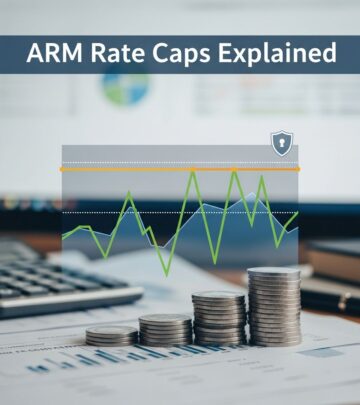
ARMs include protective mechanisms called rate caps that limit how much your interest rate can increase. Understanding these caps is crucial for predicting your maximum potential payments. The initial adjustment cap restricts the maximum increase at your first rate adjustment—often 2 or 5 percentage points higher than your initial rate. The periodic adjustment cap (or subsequent adjustment cap) limits how much your rate can rise at each subsequent adjustment, typically 1 to 2 percentage points per adjustment. The lifetime adjustment cap sets an absolute ceiling on how much higher your rate can go compared to your initial rate over the entire loan term, often 5 to 6 percentage points above your starting rate.
Consider a practical example: if you have a 5/1 ARM with a 6.7 percent initial rate and a 2/2/5 cap structure, your rate could rise to a maximum of 8.7 percent at the first adjustment (2 percent initial cap), then by up to 2 percent at each subsequent adjustment, with an absolute maximum of 11.7 percent (your initial 6.7 percent plus the 5 percent lifetime cap).
Common ARM Types and Their Characteristics
Short-Term Fixed Periods
3/1 and 3/6 ARMs offer introductory rates for only three years, followed by adjustments either annually (3/1) or semi-annually (3/6). These loans typically feature the lowest introductory rates available but are best suited for borrowers who plan to remain in their home only temporarily or expect significant income increases within a few years.
Mid-Range Fixed Periods
5/1 and 5/6 ARMs provide five-year fixed-rate periods, making them among the most popular ARM options. The 5/1 ARM adjusts annually after the initial period, while the 5/6 ARM adjusts semi-annually. These options appeal to borrowers who expect to relocate or refinance within five to seven years or who want a balance between lower initial rates and relative payment stability.
Extended Fixed Periods
10/1 ARMs offer the longest introductory fixed-rate period, lasting a full decade. This extended period provides substantial payment certainty for homeowners who plan to stay in their properties long-term but still want to benefit from initially lower rates compared to 30-year fixed mortgages. After ten years, rates adjust annually for the remaining 20 years of the loan term.
Using Your Calculator Results
Scenario Planning
A quality ARM calculator allows you to model multiple scenarios. You can adjust assumptions about future index rates to see conservative, moderate, and aggressive rate increase scenarios. This helps you determine whether you could comfortably afford your maximum potential payment if rates rise significantly. For instance, you might model a scenario where rates remain stable, another where they increase gradually, and a third where they rise more rapidly to test the limits of your budget.
Payment Progression Visualization
Most calculators provide detailed breakdowns showing exactly how your payments evolve year by year. If you closed on a 5/1 ARM in January 2025 at 6.7 percent, your payment would remain fixed through January 2030. At that first adjustment, suppose your rate increases to 6.95 percent. Your new monthly payment for that year would rise to approximately $2,641 (assuming a $400,000 loan). The following year, if rates increase another 0.25 percent to 7.2 percent, your payment would increase further, continuing this pattern until the loan term ends or rates level off.
Amortization Reports
Advanced ARM calculators generate comprehensive amortization reports showing your loan balance, interest paid, and principal paid for each period—whether monthly or annually. These reports help you understand how much of your payment goes toward interest versus principal at different stages of your loan, illustrating how this ratio shifts as your interest rate changes.
Comparing ARMs with Other Mortgage Options
While ARM calculators focus specifically on adjustable-rate mortgages, many financial institutions offer comparison calculators that evaluate ARMs alongside fixed-rate mortgages and interest-only ARM options. These comparative tools allow you to see side-by-side how your payments and loan balance would change under different mortgage structures, helping you make a fully informed decision about which product best suits your financial situation and risk tolerance.
Important Considerations Before Choosing an ARM
Who Should Consider ARMs
ARMs may be suitable for homebuyers who expect interest rates to decline in the future, those planning to sell or refinance before the adjustable period begins, or borrowers comfortable with payment uncertainty in exchange for lower initial rates. Borrowers with stable, increasing incomes who can absorb potential payment increases may also find ARMs attractive.
Who Should Avoid ARMs
ARMs carry significant risks for borrowers with limited financial flexibility, those planning to stay in their homes long-term, or those with tight monthly budgets that cannot accommodate potential payment increases. Fixed-rate mortgages offer more certainty and may be preferable if payment predictability is your priority.
Qualification Requirements
ARM loans typically require a minimum credit score of 620 and a debt-to-income ratio of 50 percent or less. Additionally, many ARM lenders require larger down payments compared to fixed-rate loans, often 10 to 20 percent or more of the purchase price.
Best Practices for Using ARM Calculators
To maximize the value of an ARM calculator, start by gathering accurate information about the specific loan you’re considering. Enter conservative assumptions about future rate increases rather than optimistic projections, ensuring you can realistically afford worst-case scenarios. Run multiple scenarios with different rate assumptions to understand the full range of potential outcomes. Pay particular attention to your maximum payment under the lifetime cap, and verify that this payment would fit comfortably within your long-term budget. Compare the results with fixed-rate mortgage scenarios to ensure you’re making a fully informed choice.
Real-World Payment Examples
Understanding how ARM payments actually change over time helps demystify the process. Consider a concrete example with a $400,000 loan, 30-year term, and a 5/1 ARM at 6.7 percent with a 2/2/5 cap structure. Your initial monthly payment would be approximately $2,660. After five years, if your rate increases to 7.2 percent at the first adjustment, your payment rises to around $2,728. If rates continue increasing by 0.25 percent annually for the next several years, your payment grows incrementally. However, rate caps would prevent your rate from exceeding 11.7 percent, establishing a maximum monthly payment of approximately $2,856, which would represent the absolute worst-case scenario.
Frequently Asked Questions
Q: What is the difference between a 5/1 ARM and a 5/6 ARM?
A: Both offer five-year fixed-rate periods, but a 5/1 ARM adjusts annually after that period, while a 5/6 ARM adjusts every six months. The 5/1 ARM typically offers more payment stability initially after the fixed period, while the 5/6 ARM may have slightly lower initial rates but less predictable payment changes.
Q: Can my ARM rate decrease as well as increase?
A: Yes. If the benchmark index decreases, your interest rate and monthly payment can go down at adjustment intervals. However, most borrowers focus on potential increases since that represents the greater financial risk.
Q: How often do ARM rates typically adjust?
A: After the initial fixed period ends, ARMs typically adjust every six months to one year, depending on the specific loan terms. Most modern ARMs adjust annually or semi-annually based on changes to the SOFR index.
Q: What happens if I refinance my ARM?
A: Refinancing replaces your existing ARM with a new loan, which could be another ARM, a fixed-rate mortgage, or another product type. You would go through the application process again and potentially secure different interest rates and terms.
Q: How accurate are ARM calculator projections?
A: ARM calculators provide reasonable estimates based on your assumptions about future index rates. However, actual rates depend on market conditions you cannot predict with certainty. Use calculators to understand potential outcomes, not to predict exact future payments.
Q: Should I always choose the longest fixed-rate period?
A: Not necessarily. While longer fixed periods provide more stability, they often come with higher initial rates. Your choice should depend on how long you plan to stay in the home and your comfort level with payment uncertainty.
References
- What Is A 5/1 Adjustable-Rate Mortgage (ARM)? — Bankrate. 2025. https://www.bankrate.com/mortgages/what-is-a-5-1-arm/
- What Is An Adjustable-Rate Mortgage (ARM)? — Bankrate. 2025. https://www.bankrate.com/mortgages/basics-of-adjustable-rate-mortgages/
- Adjustable Rate Mortgage: How an ARM Works, Who It’s For — NerdWallet. 2024. https://www.nerdwallet.com/mortgages/learn/adjustable-rate-mortgage-arm
- What Is A 10/1 Adjustable-Rate Mortgage (ARM)? — Bankrate. 2025. https://www.bankrate.com/mortgages/what-is-a-10-1-arm/
- Should You Get An Adjustable-Rate Mortgage? — Bankrate. 2025. https://www.bankrate.com/mortgages/is-an-adjustable-rate-mortgage-right-for-you/
- Pros And Cons Of An Adjustable-Rate Mortgage (ARM) — Bankrate. 2025. https://www.bankrate.com/mortgages/pros-and-cons-arm/
Similar Articles








Read full bio of medha deb