Adjustable-Rate Mortgage (ARM): Complete Guide
Understanding ARMs: How adjustable-rate mortgages work and impact your finances.
What Is an Adjustable-Rate Mortgage (ARM)?
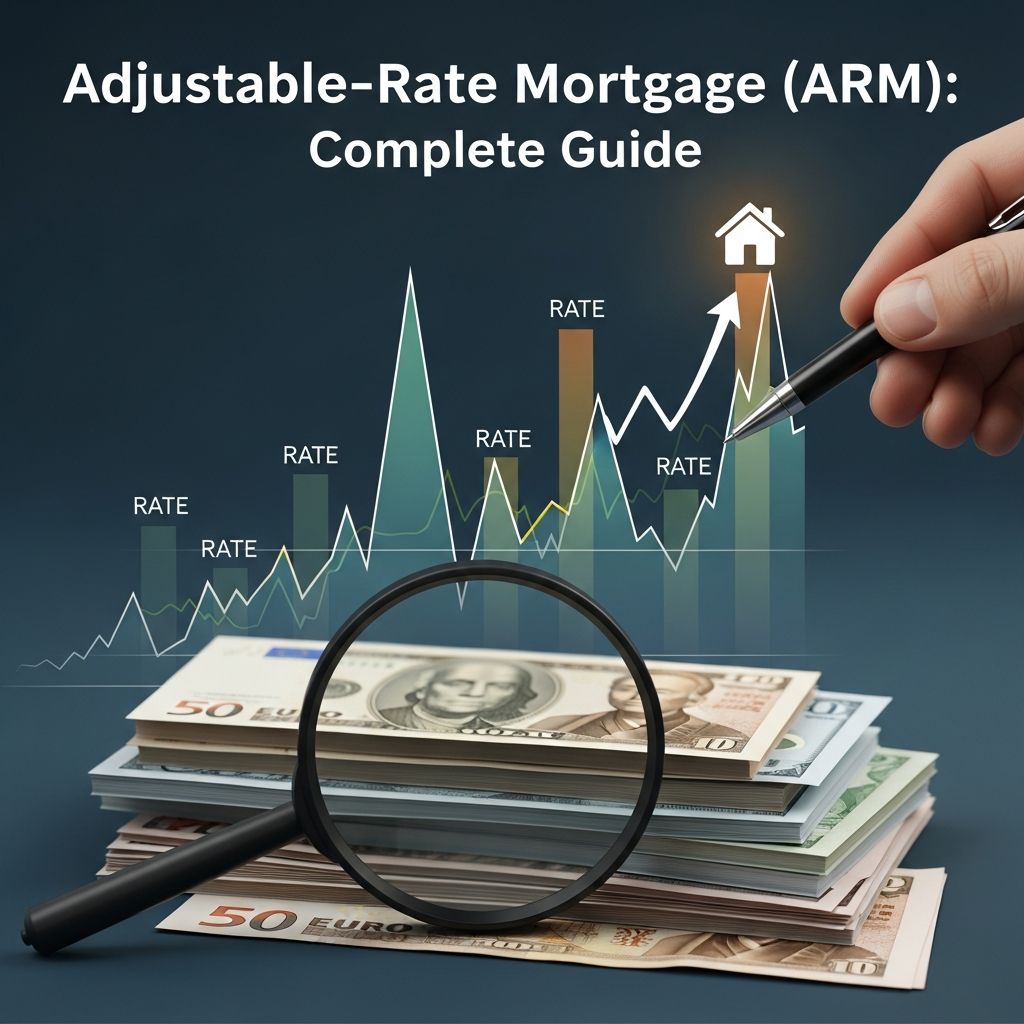
An adjustable-rate mortgage (ARM) is a home loan in which the interest rate applied to the outstanding balance varies throughout the life of the loan. With an ARM, the initial interest rate is typically lower than that of a traditional fixed-rate mortgage, but the rate adjusts periodically based on market conditions and a specific index. This adjustment mechanism means that borrowers may experience fluctuating monthly payments, with some payments potentially becoming significantly higher after the initial rate period concludes.
ARMs are also referred to as floating-rate mortgages, variable-rate mortgages, or adjustable mortgages. They became particularly popular during periods of lower initial rates and have been instrumental in helping borrowers qualify for larger loans. However, they also carry inherent risks if interest rates rise substantially during the loan term.
How Adjustable-Rate Mortgages Work
An ARM typically features two distinct periods:
- Initial Fixed-Rate Period: During this phase, often lasting 3, 5, 7, or 10 years, borrowers enjoy a below-market interest rate. This introductory period is sometimes called a “teaser rate” because it temporarily reduces monthly payments.
- Adjustment Period: After the initial fixed period expires, the interest rate begins to adjust annually, semi-annually, or monthly, depending on the loan terms. These adjustments continue for the remainder of the loan term.
The adjusted rate comprises two components: an index and a margin. The index is a benchmark interest rate determined by market conditions, such as the London Interbank Offered Rate (LIBOR) or the Secured Overnight Financing Rate (SOFR), while the margin is a fixed percentage added by the lender. For example, if the index is 2% and the margin is 3%, the new rate would be 5%.
Key Features and Components of ARMs
Interest Rate Caps
To protect borrowers from unlimited rate increases, ARMs include several types of rate caps:
- Initial Adjustment Cap: Limits how much the rate can increase at the first adjustment period, typically capped at 1-2% above the initial rate.
- Periodic Adjustment Cap: Restricts rate increases during each subsequent adjustment period, usually 1% per adjustment.
- Lifetime Rate Cap: Sets a maximum interest rate for the entire loan term, often capping the rate 5-6% above the initial rate.
These caps serve as essential safeguards, ensuring that borrowers’ payment obligations do not become unmanageable due to dramatic interest rate fluctuations.
Margins and Indexes
The margin represents the lender’s markup and remains constant throughout the loan term. Common indexes used include:
- Prime Rate
- Constant Maturity Treasury (CMT)
- London Interbank Offered Rate (LIBOR)
- Secured Overnight Financing Rate (SOFR)
The choice of index can significantly impact future monthly payments, making it crucial for borrowers to understand which index their specific ARM uses.
Types of Adjustable-Rate Mortgages
Hybrid ARMs
The most common ARM variant, hybrid ARMs combine characteristics of both fixed and adjustable rates. Denoted by terminology such as “5/1 ARM,” “7/1 ARM,” or “10/1 ARM,” the first number indicates the length of the fixed-rate period (in years), while the second number represents the frequency of adjustments (in years). For example, a 5/1 ARM features a fixed rate for five years, then adjusts annually thereafter.
Interest-Only ARMs
During the initial period of an interest-only ARM, borrowers pay only the interest portion of their monthly payment, with no principal reduction. After this period concludes, payments increase significantly as borrowers must begin paying both principal and interest.
Payment-Option ARMs
These mortgages allow borrowers to choose their monthly payment amount during the initial period, selecting from several options. However, if minimum payments do not cover the full interest, negative amortization occurs, increasing the loan balance over time.
ARM vs. Fixed-Rate Mortgages: A Comparison
| Feature | Adjustable-Rate Mortgage (ARM) | Fixed-Rate Mortgage |
|---|---|---|
| Initial Interest Rate | Lower, often 0.5-1% below fixed rates | Higher, reflects full loan risk |
| Payment Predictability | Payments increase after initial period | Payments remain constant throughout |
| Rate Risk | Borrower bears rate increase risk | Lender bears rate risk |
| Best For | Short-term ownership or rising income | Long-term ownership and stability |
| Complexity | More complex terms and conditions | Straightforward and simple |
Advantages of Adjustable-Rate Mortgages
- Lower Initial Payments: The teaser rate typically results in significantly reduced monthly payments during the initial period, improving cash flow and affordability.
- Higher Loan Qualification Amount: Lower initial payments enable borrowers to qualify for larger loan amounts, supporting purchases of more expensive properties.
- Potential Savings: If borrowers plan to sell or refinance before rate adjustments commence, they can benefit from the lower initial rate without facing higher payments.
- Rate Caps Provide Protection: Built-in caps limit the maximum amount rates can increase, providing some degree of predictability and protection.
- Beneficial in Declining Rate Environments: If market interest rates fall, ARM borrowers benefit from lower adjusted rates compared to fixed-rate mortgage holders.
Disadvantages and Risks of Adjustable-Rate Mortgages
- Payment Uncertainty: After the fixed period, monthly payments become unpredictable, making long-term budgeting challenging.
- Potential Payment Shock: When rates adjust upward substantially, monthly payments can increase dramatically, straining finances unexpectedly.
- Increased Financial Risk: Rising interest rates can lead to mortgage payments exceeding the borrower’s ability to pay, risking default or foreclosure.
- Refinancing Risk: If home values decline or credit scores worsen, refinancing to a fixed-rate mortgage may become impossible or prohibitively expensive.
- Complexity: ARMs involve numerous terms, caps, and conditions that borrowers must understand thoroughly to make informed decisions.
- Market Volatility Exposure: Borrowers become exposed to broader economic and interest rate fluctuations over which they have no control.
Who Should Consider an ARM?
Adjustable-rate mortgages may be suitable for certain borrower profiles:
- Short-Term Owners: Borrowers planning to sell or relocate within 3-7 years can benefit from lower initial rates before adjustments begin.
- Rising Income Earners: Those expecting significant income growth may comfortably afford higher payments in future years.
- Strategic Refinancers: Borrowers comfortable refinancing to fixed-rate mortgages if rates decline are well-positioned for ARMs.
- Investment Property Buyers: Real estate investors focused on cash flow may leverage ARMs to improve initial returns.
ARM Market Trends and Historical Context
ARMs gained prominence during the real estate boom of the early 2000s, when aggressive lending practices and low initial rates enabled many borrowers to purchase homes beyond their traditional means. However, when interest rates rose sharply in 2006-2007, many ARM borrowers faced substantial payment increases they could not afford. This led to unprecedented default rates and foreclosures, contributing significantly to the 2008 financial crisis and subsequent Great Recession.
Following this crisis, regulatory reforms imposed stricter lending standards, and ARM popularity declined substantially. In recent years, with interest rates remaining relatively low, ARMs have experienced modest resurgence as borrowers again seek to minimize initial payment obligations. However, lenders and borrowers remain more cautious about ARM terms and borrower qualifications.
How to Evaluate an ARM Offer
When considering an ARM, borrowers should:
- Understand All Terms: Thoroughly review the loan documents, including fixed-rate period, adjustment frequency, margins, indexes, and all rate caps.
- Calculate Maximum Payments: Determine the highest possible payment by calculating what happens if rates reach the lifetime cap, ensuring financial capacity to handle worst-case scenarios.
- Compare Multiple Offers: Obtain ARM quotes from various lenders, comparing initial rates, margins, caps, and overall terms.
- Assess Personal Circumstances: Honestly evaluate your timeline for home ownership, income growth expectations, and risk tolerance before committing to an ARM.
- Consider Refinancing Options: Research the refinancing landscape and your likelihood of refinancing before adjustment periods commence.
Frequently Asked Questions (FAQs)
Q: What is the primary difference between an ARM and a fixed-rate mortgage?
A: The primary difference is that ARM interest rates adjust periodically after an initial fixed period, while fixed-rate mortgages maintain the same rate for the entire loan term. This results in predictable payments with fixed-rate mortgages but variable payments with ARMs.
Q: How much can my ARM interest rate increase?
A: Interest rate increases are limited by rate caps built into your ARM. These include initial adjustment caps (typically 1-2%), periodic caps (usually 1% per adjustment), and lifetime caps (typically 5-6% above the initial rate). Your specific ARM terms will define these limits.
Q: What does “5/1 ARM” mean?
A: A 5/1 ARM features a fixed interest rate for five years, after which the rate adjusts annually. The first number represents the fixed-rate period duration, while the second number indicates the adjustment frequency thereafter.
Q: Can I refinance out of my ARM?
A: Yes, you can refinance an ARM to a fixed-rate mortgage if you qualify based on credit score, income, and home equity. However, refinancing becomes more difficult if home values decline or your credit score worsens. Refinancing typically involves new closing costs and fees.
Q: What happens if I cannot afford my ARM payment after rates adjust?
A: If you cannot afford adjusted payments, you may face several options: refinancing if eligible, requesting loan modification from your lender, selling the home, or potentially facing foreclosure. Contact your lender immediately if payment difficulties arise to explore available options.
Q: Are ARMs still available after the 2008 financial crisis?
A: Yes, ARMs remain available but with stricter lending standards. Lenders now impose more rigorous qualification requirements, require larger down payments, and typically demand proof of income stability. ARM offerings have become more conservative compared to pre-2008 practices.
Q: What index does my ARM use?
A: The specific index varies by lender and loan product. Common indexes include the Prime Rate, Constant Maturity Treasury (CMT), London Interbank Offered Rate (LIBOR), and Secured Overnight Financing Rate (SOFR). Your loan documents will specify which index applies to your ARM.
References
- Adjustable Rate Mortgages — U.S. Consumer Financial Protection Bureau. 2024. https://www.consumerfinance.gov/ask-cfpb/what-adjustable-rate-mortgage-arm-en-1961/
- The Role of Mortgage-Backed Securities in the Financial Crisis — Federal Reserve History. 2024. https://www.federalreservehistory.org/essays/great-recession-of-200709
- Mortgage Interest Rates and Economic Conditions — Board of Governors of the Federal Reserve System. 2024. https://www.federalreserve.gov/
- Understanding ARM Terms and Conditions — U.S. Department of Housing and Urban Development. 2024. https://www.hud.gov/program_offices/housing/sfh/hop/lender/origination/adjrat
- SOFR: Replacing LIBOR as Primary Mortgage Index — Federal Reserve Bank of New York. 2024. https://www.newyorkfed.org/arrc/sofr
Similar Articles








Read full bio of medha deb