Actual Cash Value: Definition & Insurance Coverage
Understand how actual cash value determines insurance reimbursement for property losses.

What Is Actual Cash Value?
Actual cash value (ACV) is a fundamental method used in the insurance industry to determine the amount an insurer will reimburse you when your property is damaged or lost. Unlike other valuation methods, ACV takes into account the current condition and depreciation of your property at the time of the loss, providing a realistic assessment of what your damaged or destroyed items are actually worth in today’s market.
Insurance companies rely on ACV calculations to establish fair claim payouts that reflect the true current value of insured property. This approach recognizes that items lose value over time due to age, wear and tear, and general use. By understanding how ACV works, you can make informed decisions about your insurance coverage and know what to expect if you need to file a claim.
Understanding the Actual Cash Value Definition
Actual cash value represents the replacement cost of your property minus the depreciation it has experienced. In practical terms, it answers the question: “What is this used item worth right now?” rather than “What would a brand new replacement cost?”
Insurance companies use ACV to settle property claims fairly for both the policyholder and the insurer. When you purchase homeowners insurance, renters insurance, or commercial property insurance, you may encounter ACV as one of your coverage options. Understanding this concept is crucial because it directly impacts the amount you’ll receive if you experience a covered loss.
The ACV method ensures that policyholders don’t receive windfalls by being overcompensated for old or well-used items, while also preventing unfair undercompensation. It strikes a balance by valuing property at its actual current market worth rather than replacement cost or original purchase price.
How Insurance Companies Calculate Actual Cash Value
Insurance companies employ a systematic approach to calculating ACV, using depreciation as the primary tool. The calculation process involves several key steps and considerations that vary slightly between insurers but follow the same fundamental formula.
The Basic ACV Formula
The most straightforward way to calculate actual cash value is:
ACV = Replacement Cost Value – Depreciation
This formula subtracts the accumulated depreciation from what it would cost to purchase a brand new item identical to your damaged property.
Determining Depreciation
Insurance companies calculate depreciation by considering several factors about your property:
- The current market price of a similar new item
- The expected useful life of the item
- The item’s current age and condition
- The percentage of useful life remaining at the time of loss
- Wear and tear and obsolescence
Practical Example of ACV Calculation
Let’s walk through a concrete example. Suppose your home floods and you lose three laptops that are two years old. Here’s how an insurance company might calculate the ACV:
- Replacement cost of similar new laptops: $1,000 each
- Expected useful life of laptops: 3 years
- Age of your laptops: 2 years old
- Depreciation rate: 67% (2 years out of 3 years of useful life)
- Depreciation amount: $670
- Actual Cash Value: $1,000 – $670 = $330 per laptop
In this scenario, even though you paid more for the laptops originally, the insurance company would reimburse you $330 per laptop because that reflects their current market value after accounting for depreciation.
Alternative Calculation Methods
Insurance companies may use one of three primary approaches to calculate ACV:
- Repair or Replacement Cost Method: The cost to repair or replace damaged property minus depreciation
- Fair Market Value Method: What the damaged property could sell for in the current market
- Broad Evidence Rule: Considering all relevant evidence of the property’s value, including comparable sales, expert opinions, and condition assessments
Actual Cash Value vs. Replacement Cost Value
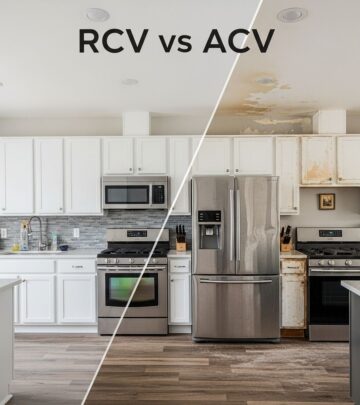
Understanding the difference between ACV and replacement cost value (RCV) is essential when choosing your insurance coverage. These two methods can result in significantly different claim payouts, and selecting the right option depends on your financial situation and preferences.
| Feature | Actual Cash Value (ACV) | Replacement Cost Value (RCV) |
|---|---|---|
| Definition | Property value minus depreciation | Full cost to replace with new item |
| Depreciation Considered | Yes, fully deducted | No depreciation deducted |
| Claim Payout | Lower reimbursement amount | Higher reimbursement amount |
| Premium Cost | Lower premiums | Higher premiums |
| Coverage Benefit | Budget-friendly option | Full recovery protection |
| Best For | Finding used replacements or saving money | Full restoration to pre-loss condition |
Replacement Cost Value Explained
Replacement cost value means your insurance policy will pay what it actually costs to repair or replace your damaged property with a new item of similar kind and quality, without deducting any depreciation. This is the amount you would need to spend today at current market prices to restore your situation to what it was before the loss occurred.
For many people, RCV is the preferred option because it fully restores your belongings and protects you against material and labor cost increases, which is especially important during periods of high inflation. However, the trade-off is that replacement cost value policies typically cost significantly more than ACV policies.
Personal Property Coverage Choices
When you insure the belongings inside your home under your homeowners insurance policy’s personal property coverage, you may have the option to choose between ACV and RCV. Many standard insurance policies provide personal property coverage on an actual cash value basis by default, but you can often upgrade to replacement cost value for an additional premium.
When to Choose Each Option
Choosing between ACV and RCV depends on several factors:
Choose ACV if:
- You want to save money on insurance premiums
- You can quickly find acceptable used replacements for damaged items
- You own mostly older items with significant depreciation
- You have limited budget for insurance costs
Choose RCV if:
- You want maximum protection and peace of mind
- You own newer, valuable items
- You want full recovery to your pre-loss situation
- You’re concerned about rising replacement costs due to inflation
Related Insurance Concepts
Recoverable Depreciation
Recoverable depreciation represents the gap between replacement cost value and actual cash value. This is the portion of value that your property has lost due to age and wear and tear. With replacement cost coverage, you may be able to claim this depreciation from damaged or destroyed property after it’s been replaced. However, recoverable depreciation is typically not part of standard actual cash value insurance policies.
For example, if you have $1,000 in tools that depreciate to $400 (actual cash value), the $600 difference represents recoverable depreciation. With ACV coverage, you receive only $400. With RCV coverage, you might be able to claim the additional $600 in depreciation after you purchase replacement tools.
Frequently Asked Questions About Actual Cash Value
Q: What is the main difference between actual cash value and replacement cost value?
A: The main difference is that actual cash value subtracts depreciation from the replacement cost, while replacement cost value pays the full replacement amount without depreciation deduction. This means ACV policies have lower payouts but lower premiums, while RCV policies provide higher payouts at higher premium costs.
Q: How do insurance companies determine the useful life of an item?
A: Insurance companies use industry standards, manufacturer specifications, and historical data to determine the expected useful life of items. For example, laptops typically have a three to five-year useful life, while furniture might have a longer useful life of 10 to 15 years.
Q: Will I receive the same amount with ACV coverage for all types of property?
A: No, the ACV payout depends on the specific property type, its age, condition, and how much of its useful life remains. Different items depreciate at different rates, so your actual cash value reimbursement will vary based on these factors.
Q: Can I negotiate the actual cash value amount calculated by my insurance company?
A: Yes, you can challenge your insurance company’s ACV calculation if you believe it’s inaccurate. You can provide evidence such as comparable market prices, professional appraisals, or expert opinions to support a higher valuation.
Q: Does actual cash value apply to my home structure or just contents?
A: ACV typically applies to your personal property and contents. For your home’s structure itself, homeowners insurance usually provides coverage based on replacement cost, though this can vary by policy and insurer.
Q: What happens if I have old items that have fully depreciated?
A: If an item has fully depreciated (reached the end of its useful life), your ACV coverage may pay little to nothing for that item, even if it still functions. This is because the item’s value has been completely consumed through depreciation.
Making Your Insurance Decision
Understanding actual cash value is crucial for making informed decisions about your insurance coverage. When shopping for homeowners insurance, renters insurance, or commercial property insurance, you should carefully consider whether ACV or replacement cost value better suits your needs and budget.
Review your current policy to determine what type of valuation method is being used for your property coverage. If you’re unsure, contact your insurance agent to clarify whether your belongings are covered under actual cash value or replacement cost value.
Consider the age of your possessions, your financial ability to replace items out-of-pocket if needed, and your risk tolerance. For valuable or newer items, replacement cost coverage often provides better protection, while actual cash value may be appropriate for older possessions or if you’re seeking to minimize premium costs.
Remember that insurance policies vary significantly between providers, and the same coverage type may be calculated differently by different insurers. Always ask specific questions about how your insurer calculates depreciation and ACV to fully understand your coverage.
References
- Actual Cash Value — American Express. 2025. https://www.americanexpress.com/en-us/credit-cards/credit-intel/actual-cash-value/
- Actual Cash Value (ACV) — The Hartford. 2025. https://www.thehartford.com/small-business-insurance/actual-cash-value
- Insurance: Replacement Cost vs Actual Cash Value — Semutual. 2025. https://www.semutual.nb.ca/news/insurance-replacement-cost-vs-actual-cost-value/
- What Is Actual Cash Value in Business Insurance? — Insureon. 2025. https://www.insureon.com/insurance-glossary/actual-cash-value
- Actual Cash Value vs. Replacement Cost Value — North Carolina Department of Insurance. 2025. https://www.ncdoi.gov/consumers/homeowners-insurance/actual-cash-value-vs-replacement-cost-value
- What’s the Difference Between Actual Cash Value Coverage and Replacement Cost Coverage — National Association of Insurance Commissioners (NAIC). 2025. https://content.naic.org/article/whats-difference-between-actual-cash-value-coverage-and-replacement-cost-coverage
Similar Articles








Read full bio of Sneha Tete