Accountability: Definition, Types, Benefits, and Examples
Understanding accountability: Core principles, mechanisms, and organizational impact.
What Is Accountability?
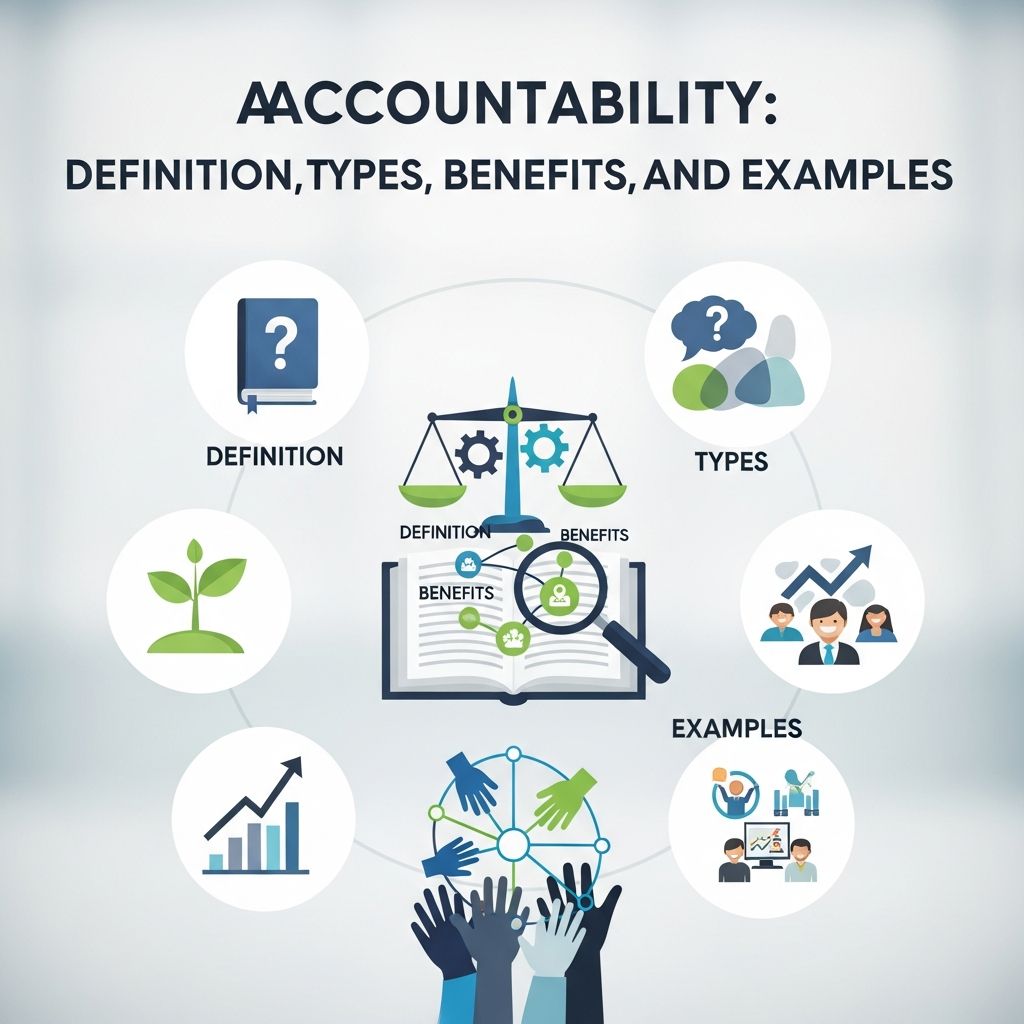
Accountability is the concept of answerability by an individual or a department for the performance or outcomes of specific activities. It represents the obligation to accept responsibility for one’s actions, decisions, and the results that follow. In essence, an accountable party is responsible for the execution of a desired role and must justify their actions to relevant stakeholders.
The principle of accountability is foundational to effective governance and organizational management. It creates a system where individuals and organizations are answerable for their conduct and performance. This concept is particularly critical in the financial sector, where the integrity of reporting and decision-making directly impacts investors, shareholders, and the broader market.
Accountability functions through two primary elements: the delegator (accountor) and the delegatee (accountee). While the accountor delegates tasks and authority to the accountee, the accountor retains ultimate responsibility for ensuring proper execution. This hierarchical structure ensures that accountability is not simply abandoned but rather distributed while maintaining clear lines of responsibility.
The Core Elements of Accountability
Understanding accountability requires examining its key components:
Delegation and Responsibility
A principal party delegates roles to other parties but remains liable if an action is not executed well or in the event of a loss. This dual-layer responsibility ensures that accountability chains cannot be broken. The delegator establishes clear expectations and provides necessary authority, while maintaining oversight and ultimate culpability.
Ethical Behavior and Regulation
The concept of accountability is further dependent on the ethical behavior of the party held to account for the activity and the influence of regulations. Strong ethical frameworks and regulatory oversight reinforce accountability mechanisms and discourage misconduct. Organizations must establish clear ethical guidelines and ensure compliance across all levels.
Care, Knowledge, and Skills
Accountability commands care, knowledge, and skills during professional practice. A slight omission or negligent act is tantamount to professional negligence. This requirement ensures that those held accountable maintain high standards and continuously develop their expertise.
Types of Accountability
Accountability manifests in various forms across different contexts and sectors:
Administrative Accountability
Administrative accountability refers to how public administrators and organizational leaders monitor each other through various mechanisms. This includes program accountability, where different actors demand responsibility for results, and hierarchical accountability, where superiors hold subordinates accountable for delegated duties.
Judicial Accountability
This type involves legal mechanisms through which individuals and organizations can be held accountable for violations of law or contractual obligations. Judicial accountability provides formal avenues for enforcement and consequences.
Market Accountability
Market forces create accountability through competitive pressures and investor scrutiny. Organizations must maintain credibility and performance standards to remain competitive and attract capital.
Political Accountability
In democratic systems, elected officials are held accountable through electoral mechanisms and public scrutiny. Citizens can sanction representatives through voting and other democratic processes when their performance falls short of public expectations.
Professional Accountability
Professionals in various fields are held accountable through professional standards, licensing requirements, and ethical codes. This ensures that practitioners maintain high competency and ethical standards.
Social Accountability
Organizations and individuals are increasingly held accountable by society for their social and environmental impact. This reflects evolving expectations regarding corporate responsibility and sustainable practices.
Key Benefits of Accountability
Improved Financial Reporting Quality
One of the most significant benefits of accountability is that it assures that auditors present an accurate and fair view of a company’s financial health. The auditor is legally and criminally liable for fraud or breach of contract resulting from the audited financial statements. This liability creates strong incentives for thorough and honest financial reporting, which protects investors and maintains market integrity.
Enhanced Corporate Governance
Accountability, alongside other key underpinnings such as integrity and transparency, has proven to be the driving force behind good governance arrangements. Reporting returns on a portfolio of investments in an accountable and transparent manner reduces the chances of corporate misconduct. This creates a strong foundation for organizational success and stakeholder confidence.
Legitimacy and Operational Independence
A clear legal ground for various accountability mechanisms can generate legitimacy for a company. When the actions of a company bear legitimacy in the eyes of investors, it can effectively use granted independence. Conversely, a company’s independence will be short-lived if its activities lack legitimacy. Companies must be accountable for their financial activities to safeguard legitimacy and maintain autonomy.
Performance Enhancement
Although accountability is mostly concerned with financial monitoring, it is also concerned with using internal controls to enhance overall performance. A sound management system defines the rules and actions against which reviews are subjected. This approach minimizes the scope for ad hoc decisions and instead enhances financial performance through systematic oversight.
Stakeholder Confidence
The accountability objective serves as the basis for constructive dialogue between investors and management. It demonstrates how management utilizes the resources with which it is entrusted, building confidence among shareholders and potential investors. Shareholders are keenly interested in the concept of accountability in a company’s operations.
Accountability in Financial Markets
Fiduciary Responsibility
Public companies have a fiduciary responsibility to their shareholders by ensuring accurate and timely reporting of earnings and proper execution of trades. They must also ensure proper communication of information by establishing channels where important information is communicated to shareholders, potential investors, and the public.
Auditing and External Oversight
Accountants are accountable for the quality of financial reporting in any company. However, there are situations when financial statements may be manipulated for selfish gains. This is why financial statements are subject to independent external auditors. Independent auditors possess enough knowledge and experience to detect loopholes in financial statements. Publicly listed companies are required to get their financial statements audited every year and are also required to involve audit committees as part of the board of directors to oversee and enhance transparency.
Care and Accuracy Standards
A reasonable level of care and accuracy is needed to curb possible errors. Failure to maintain these standards may result in penalties. If companies suffice in meeting accountability standards, the responsible party is held accountable for ensuring compliance.
The Evolution of Accountability
The view of accountability continues to broaden in modern times. Shifts in the socio-political environment are driving changes in accountability relationships. As a result, accountability relations in the financial sector are becoming increasingly diversified.
These changes result from notable developments such as the role of media, the emergence of participatory democracy, and the growing need to keep investors and the public up-to-date and directly involved in a company’s activities. In the case of structured accountability, business agencies now realize that legitimacy and a high level of governance and financial positioning are needed to continue to exist.
Accountability Mechanisms and Structure
Design and Implementation
A well-designed accountability mechanism can help strengthen a company’s independence. The framework should clearly define roles, responsibilities, and reporting requirements. Organizations must establish mechanisms such as audit committees, internal controls, and transparent reporting procedures.
Records Management
Accountability cannot exist without proper accounting practices. In other words, an absence of accounting means an absence of accountability. Another key area that contributes to accountability is good records management, which ensures that all transactions and decisions are properly documented and available for review.
Hierarchical Responsibility
The two elements of accountability ensure that responsibility is delegated and not merely forsaken. This suggests that there is a hierarchy in which the principal retains the consequences of responsibility. The powers necessary to achieve objectives usually limit the allocation of roles to other parties, creating a balanced structure where authority matches responsibility.
Practical Example of Accountability
A practical example of the two elements of accountability can be seen when an accountor delegates power to the accountee. Still, it is the accountor who takes responsibility and goes the extra mile to put measures in place to prevent future reoccurrence of a mistake. For instance, in a financial organization, a CFO may delegate budget management responsibilities to department heads. However, the CFO remains accountable for overall financial performance and must establish systems to prevent errors and fraud.
Frequently Asked Questions (FAQs)
Q: Why is accountability important in business?
A: Accountability is essential in business because it ensures responsible decision-making, improves financial reporting quality, builds stakeholder confidence, enhances organizational performance, and maintains the integrity of markets. It creates clear lines of responsibility and consequences, encouraging ethical behavior and proper execution of duties.
Q: What is the difference between accountability and responsibility?
A: While often used interchangeably, responsibility refers to the duty to perform a task, whereas accountability refers to the obligation to answer for the results of that task. Responsibility is about performing work; accountability is about being answerable for the outcomes and quality of that work.
Q: How does accountability improve financial reporting?
A: Accountability improves financial reporting by creating legal and professional consequences for inaccurate or fraudulent statements. External auditors face liability for audit quality, motivating thorough investigations. Audit committees provide additional oversight, and transparent reporting mechanisms ensure stakeholders receive accurate information about company financial health.
Q: What mechanisms help enforce accountability?
A: Key enforcement mechanisms include independent audits, audit committees, internal controls, transparent reporting procedures, regulatory oversight, professional standards, ethical codes, and legal frameworks. These mechanisms work together to create a comprehensive system that encourages accountability at all organizational levels.
Q: How has accountability evolved in modern organizations?
A: Modern accountability has expanded beyond financial metrics to include social, environmental, and governance factors. Increased media scrutiny, participatory democracy, and stakeholder engagement have broadened accountability expectations. Organizations now must account for their impact on multiple stakeholder groups and society as a whole.
References
- Accountability – Overview, Roles, Examples — Corporate Finance Institute. https://corporatefinanceinstitute.com/resources/management/accountability/
- Accountability — Wikipedia. https://en.wikipedia.org/wiki/Accountability
- Accountability – ESG Lexicon — Cambridge Strategy Group. https://www.esglexicon.com/glossary/term/accountability/
Similar Articles








Read full bio of Sneha Tete