Absolute Advantage in Economics: Definition and Examples
Understanding how nations, companies, and individuals gain competitive edge through efficient production.
Absolute Advantage: Definition and Meaning
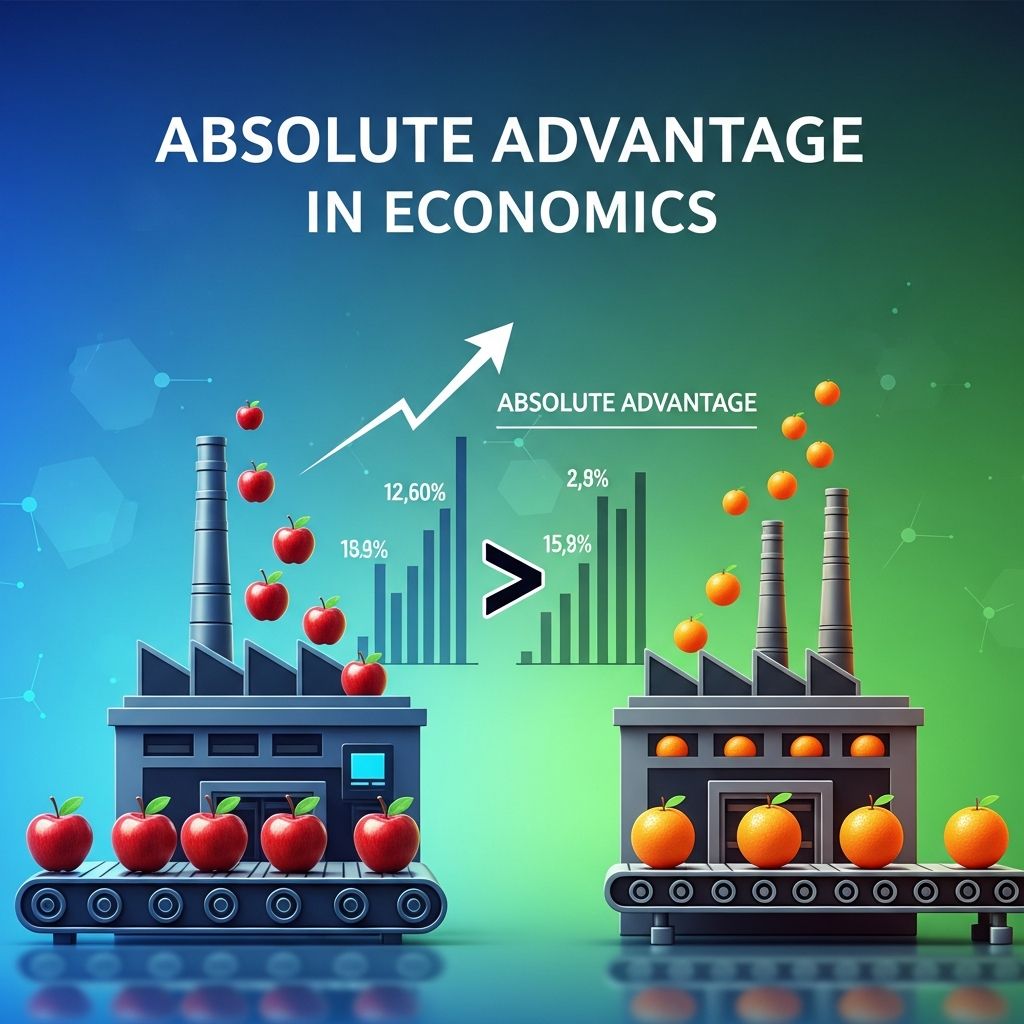
In economics, absolute advantage refers to the capacity of any economic agent—whether an individual, company, or nation—to produce a larger quantity of a good or service than its competitors, typically at a lower cost and with greater efficiency. This fundamental economic principle describes the ability to generate more output using fewer inputs or employing more efficient production processes. When an entity possesses an absolute advantage, it requires fewer resources to manufacture a product, allowing it to undercut competitors’ prices while maintaining or even increasing profit margins.
The concept of absolute advantage forms the foundation of modern trade theory and specialization. It explains why certain countries, companies, and individuals focus their productive efforts on specific goods or services where they can outperform their competitors. By understanding this principle, we can better comprehend the dynamics of global commerce, labor specialization, and economic growth.
Historical Origins and Development
Scottish economist Adam Smith first introduced the concept of absolute advantage in his seminal 1776 work, “An Inquiry into the Nature and Causes of the Wealth of Nations.” Smith’s groundbreaking theory challenged the prevailing mercantilist economic model that had dominated policy between the 16th and 18th centuries. Mercantilism advocated for national economic policies designed to maximize a nation’s trade surplus and accumulate gold and money reserves—an approach that Smith and later critics like John Locke and David Hume found fundamentally flawed.
Smith theorized that countries with absolute advantages in different commodities could gain simultaneously through exports and imports, making unrestricted international trade crucial to the global economic framework. Rather than viewing trade as zero-sum competition, Smith demonstrated that free trade and specialization could benefit all participating nations. His analysis marked a paradigm shift from mercantilism toward a more enlightened understanding of international commerce.
How Absolute Advantage Works
Absolute advantage operates through several interconnected mechanisms that improve overall productivity and reduce production costs.
Specialization and Division of Labor
Smith emphasized that specialization of labor, or division of labor, significantly increases productivity per unit of labor and reduces production costs. When workers focus on tasks where they excel, they develop expertise, speed, and efficiency. This concentrated effort generates substantially higher output than generalist approaches. For example, a shoemaker who specializes exclusively in shoemaking produces far more pairs of shoes than someone attempting multiple professions simultaneously. The principle applies equally to nations: countries that concentrate on producing goods where they possess natural or acquired advantages achieve greater total output.
Economies of Scale
Smith also introduced the concept of economies of scale to explain declining production costs. As output increases through labor diversification and specialization, average costs per unit decrease significantly. Larger-scale production allows businesses to spread fixed costs across more units, invest in more efficient machinery, and negotiate better prices for raw materials. This dynamic creates a virtuous cycle where specialization leads to greater production, which in turn lowers costs and increases competitiveness.
Natural Resources and Technology
Absolute advantage emerges from both natural and acquired factors. Natural advantages stem from a country’s climatic environment and natural resource endowments. Nations blessed with abundant fertile land, mineral deposits, or favorable weather conditions possess inherent advantages in producing certain goods. Acquired advantages arise from technological development and skill advancement. Countries investing in education, research, and infrastructure develop superior production technologies and skilled workforces that create competitive edges.
Absolute Advantage Versus Comparative Advantage
While frequently confused, absolute advantage and comparative advantage represent fundamentally different economic concepts that serve different purposes in trade analysis.
| Aspect | Absolute Advantage | Comparative Advantage |
|---|---|---|
| Definition | The ability to produce more goods using fewer resources | The ability to produce goods at lower opportunity cost |
| Focus | Financial costs of production and efficiency | Opportunity costs and trade-offs in production |
| Measure | Direct comparison of resource inputs and outputs | Comparison of what must be sacrificed to produce alternatives |
| Trade Outcomes | May not guarantee mutual gains from trade | Always ensures mutually beneficial trade possibilities |
| Relevance | Important for understanding production efficiency | Critical for determining optimal specialization patterns |
Smith’s theory, which focused exclusively on absolute advantage, did not account for opportunity costs—the value of the next best alternative foregone when making a choice. This limitation became apparent as economist David Ricardo developed his theory of comparative advantage in his 1817 work, “On the Principles of Political Economy and Taxation.” Ricardo demonstrated that two parties could benefit from specialization and trade even when one party possessed absolute advantage in everything. The crucial factor is comparative advantage—each party’s relative efficiency in producing different goods.
Real-World Examples of Absolute Advantage
International Trade Example
Consider two countries, the United Kingdom and Portugal, examining cloth and wine production:
| Country | Hours for Cloth | Hours for Wine |
|---|---|---|
| UK | 80 | 100 |
| Portugal | 120 | 90 |
The UK requires fewer labor hours to produce cloth (80 vs. 120), giving it absolute advantage in cloth production. Portugal requires fewer hours for wine (90 vs. 100), giving it absolute advantage in wine. When both countries specialize in their areas of absolute advantage and trade with each other, they produce more total output than if each attempted self-sufficiency. The UK focuses entirely on cloth while Portugal concentrates on wine, then both nations exchange to obtain both goods in greater quantities than possible through isolated production.
Individual and Company Example
Imagine two professionals: Kendall is an excellent accountant earning $150 per hour, and she can also type 80 words per minute. James is an adequate accountant earning $50 per hour but types 90 words per minute. Although Kendall types slower than James, she has absolute advantage in both accounting and typing because she produces more value per hour in each activity. However, economically, Kendall should focus on accounting (her highest-paying skill) while hiring James for typing services. Everyone benefits: Kendall earns more, James has employment, and the combined output increases.
Charitable Fundraising Example
Two friends, Gina and Mike, volunteer to help a charity by printing T-shirts and building birdhouses. In scenario one, Gina can print 5 T-shirts or build 3 birdhouses per hour, while Mike can print 3 T-shirts or build 2 birdhouses per hour. Gina possesses absolute advantage in both activities since she’s more productive at each task. In a second scenario, suppose Gina takes a screen-printing class and now prints 10 T-shirts hourly but still builds only 1 birdhouse, while Mike learns woodworking and now builds 5 birdhouses but prints only 2 T-shirts per hour. Now Gina has absolute advantage only in T-shirt printing, while Mike has absolute advantage in birdhouse construction. Specialization based on these advantages maximizes total output.
Limitations and Criticisms of Absolute Advantage Theory
Bilateral and Limited Commodity Assumptions
Smith’s original Absolute Advantage Theory assumed that only bilateral trade between two nations could occur and that trade involved only two commodities. This oversimplification became inadequate as international commerce expanded dramatically. Modern trade involves numerous nations exchanging hundreds of products simultaneously. The theory failed to account for multilateral trade relationships where multiple countries simultaneously trade various goods and services with each other, reflecting real-world complexity.
Free Trade Assumptions
The theory assumed that free trade existed between nations without barriers or restrictions. In reality, governments implement numerous protectionist measures including tariffs, quantitative restrictions, technical barriers to trade, environmental regulations, and public policy constraints. These interventions significantly alter trade patterns and absolute advantage calculations. Nations don’t always trade according to theoretical predictions because political considerations, security concerns, and domestic policy objectives often override pure economic efficiency.
Comparative Advantage’s Superior Framework
Ricardo’s later development of comparative advantage theory addressed absolute advantage’s limitations by focusing on opportunity costs rather than absolute production quantities. This more sophisticated framework explains why trade remains beneficial even when one nation can produce everything more efficiently. Comparative advantage provides more realistic guidance for determining which goods nations should specialize in producing and trading.
Achieving Absolute Advantage
Organizations and nations can pursue several strategies to establish or strengthen absolute advantage:
Technological Investment: Developing superior production technologies, processes, and equipment increases output while reducing input requirements. Research and development initiatives drive innovation that creates lasting competitive advantages.
Workforce Development: Education, training, and skill development enhance labor productivity. Specialized expertise allows workers to perform tasks more efficiently and effectively than generalists.
Resource Optimization: Efficient allocation and management of natural resources, capital, and labor maximizes productive output. Process improvements and lean manufacturing principles eliminate waste.
Infrastructure Investment: Quality transportation networks, energy systems, and communications infrastructure reduce production and distribution costs.
Scale Expansion: Growing production volume leverages economies of scale, spreading fixed costs and reducing per-unit expenses.
Absolute Advantage in Modern Context
Although introduced centuries ago, absolute advantage remains relevant to contemporary economics. Multinational corporations leverage absolute advantages by locating production facilities in regions with superior conditions, lower costs, or specialized expertise. Global supply chains reflect absolute advantages as companies source components from nations where they can be produced most efficiently. Nations similarly specialize based on absolute advantages, from technology hubs in Silicon Valley to agricultural production in fertile regions to manufacturing centers in areas with lower labor costs and infrastructure advantages.
Frequently Asked Questions
Q: Can a country have no absolute advantage?
A: Yes. When comparing multiple products across countries, it’s theoretically possible for one nation to require more labor hours for every commodity compared to another nation. That country would lack absolute advantage in anything, though it might still benefit from comparative advantage in relative terms.
Q: How does absolute advantage differ from competitive advantage?
A: Absolute advantage measures the ability to produce more efficiently using fewer resources. Competitive advantage is a broader concept encompassing brand reputation, distribution networks, and strategic positioning—elements beyond production efficiency alone.
Q: Why do countries trade if one has absolute advantage in everything?
A: Because comparative advantage, not absolute advantage, determines beneficial trade patterns. Even when one nation can produce everything more efficiently, both nations gain by specializing according to comparative advantage—focusing on goods where their relative efficiency advantage is greatest.
Q: Can absolute advantage change over time?
A: Absolutely. Technological innovations, resource discoveries, workforce development, infrastructure improvements, and policy changes can shift absolute advantages between nations and organizations. What seems permanent today may shift tomorrow.
Q: Is absolute advantage always beneficial for workers?
A: While specialization increases total output, it may create disruption for workers in less-competitive sectors. Regions losing industries to areas with absolute advantage may experience unemployment and economic hardship, though overall welfare typically improves with free trade.
References
- What is Absolute Advantage? — Corporate Finance Institute. Accessed 2025-11-29. https://corporatefinanceinstitute.com/resources/economics/what-is-absolute-advantage/
- Absolute Advantage — Investopedia Video. 2014-02-26. https://www.youtube.com/watch?v=5CrygjvyUPU
- Absolute Advantage — Wikipedia. Accessed 2025-11-29. https://en.wikipedia.org/wiki/Absolute_advantage
Similar Articles








Read full bio of Sneha Tete