8 Types of Savings Accounts: Where to Save Your Money
Discover the best savings accounts for your financial goals and maximize your earnings.
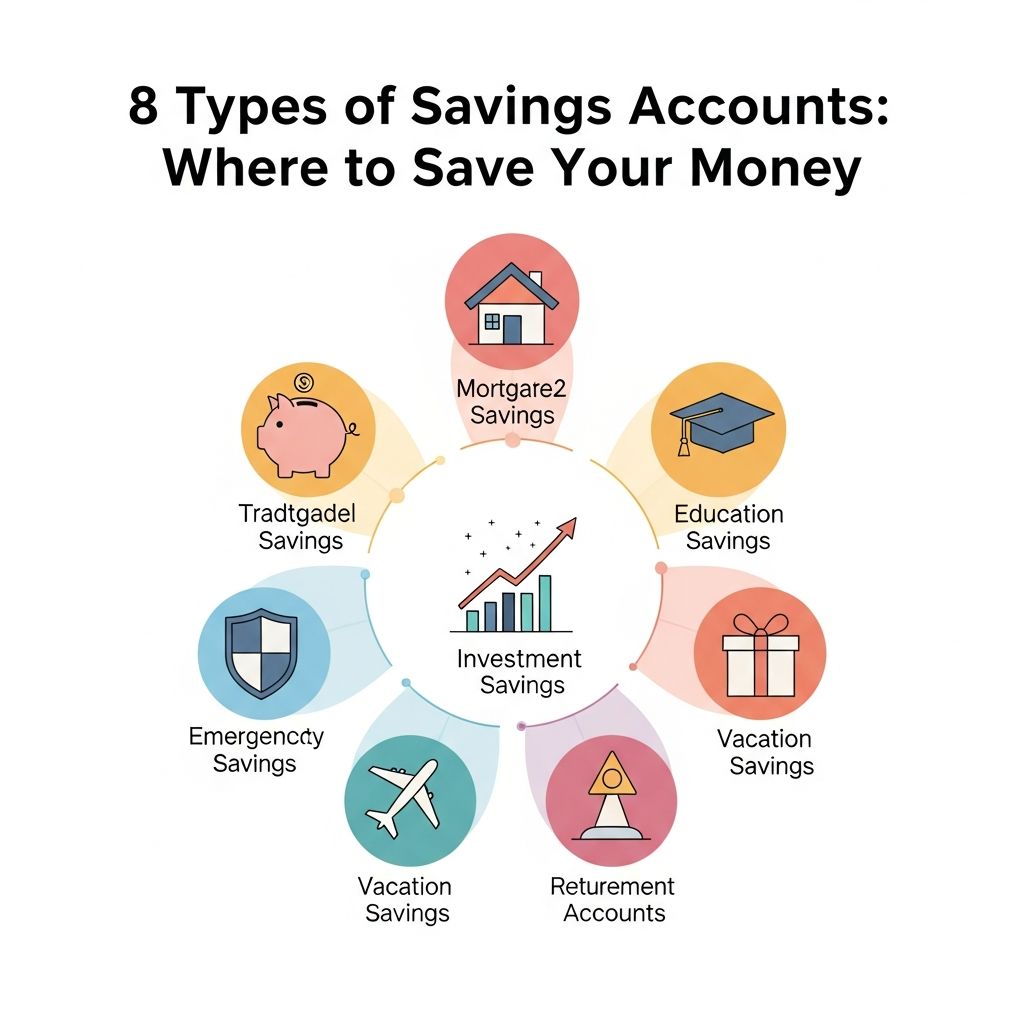
Not all savings accounts are created equal. The difference between a traditional savings account earning 0.01% annual percentage yield (APY) and a high-yield savings account earning 4.20% APY can result in $419 in additional annual interest on just a $10,000 balance. Understanding the various types of savings accounts available is essential for maximizing your earnings and meeting your financial goals.
Key Takeaways
- High-yield savings accounts pay up to 4.20% APY, which is approximately 400 times more than traditional savings accounts at 0.01%
- Certificates of Deposit (CDs) lock your money for fixed terms ranging from 1 month to 5 years in exchange for guaranteed rates
- Money market accounts offer hybrid features combining checking-like capabilities with savings-level interest rates
- Different account types serve different savings goals, from emergency funds to retirement planning
- Online banks consistently offer higher rates because they have lower overhead costs than brick-and-mortar institutions
Quick Comparison: 8 Types of Savings Accounts
| Account Type | Best For | Typical APY | Liquidity | FDIC Insurance | Monthly Fees |
|---|---|---|---|---|---|
| Traditional Savings Account | Convenience at your current bank | 0.01% | High (daily access) | Yes | Often $5-$12 (waivable) |
| High-Yield Savings Account | Emergency funds, short-term goals | Up to 4.20% APY | High (daily access) | Yes | Usually $0 |
| Student Savings Account | Students under 18-24 | Up to 4.20% APY | High (daily access) | Yes | Usually $0 |
| Certificates of Deposit (CDs) | Money you won’t need for 1-5+ years | Up to 4.25% APY | Low (early withdrawal penalty) | Yes | Usually $0 |
| Money Market Account | Hybrid checking-savings needs | Up to 4.25% APY | High (daily access) | Yes | Varies ($0-$15) |
| Cash Management Account | Brokerage cash, multi-bank spreading | Around 4.00% APY | High (daily access) | Often via partner banks | Usually $0 |
| Health Savings Account (HSA) | Medical expenses (requires HDHP) | Depends on investments | High (for medical only) | Varies by provider | Varies ($0-$5) |
| IRA/Roth IRA | Retirement (10+ years out) | Depends on investments | Low (early withdrawal penalty) | Varies by holdings | Varies by custodian |
1. Traditional Savings Account
The traditional savings account is the basic savings product offered by most banks and credit unions. This account type allows you to deposit and withdraw money at any time, and it earns variable interest on your balance.
Current Rates
Interest rates on traditional savings accounts are among the lowest available. The national average savings account yield is 0.62% APY according to current data, though some major banks pay considerably less. For example, large institutions like Chase offer just 0.01% on their standard savings accounts. These low rates make traditional savings accounts less attractive for those looking to grow their savings meaningfully.
When to Use
Traditional savings accounts are best suited for those who prioritize convenience and easy access to their funds. They work well if you maintain multiple accounts at a single bank and want to keep everything in one place. However, if your goal is to earn substantial interest on your savings, this account type falls short of better alternatives.
2. High-Yield Savings Account
A high-yield savings account pays significantly higher interest rates than traditional savings accounts, typically offered by online banks with lower overhead costs. These accounts have revolutionized the savings landscape for everyday consumers.
Current Rates and Benefits
High-yield savings accounts currently offer rates hovering around 4.20% APY, which is dramatically higher than the 0.01% offered by traditional accounts. This difference translates to substantially more money in your pocket. Online banks can offer these competitive rates because they don’t maintain expensive brick-and-mortar branches. They pass these operational savings directly to customers through better interest rates.
Why Online Banks Lead
The absence of physical branches allows online banks to operate with significantly lower overhead expenses. These savings enable them to offer rates that are up to 420 times higher than traditional banks. For someone with $10,000 in savings, choosing a high-yield account could earn an extra $419 annually compared to a traditional account.
3. Student Savings Account
Student savings accounts are specifically designed for young people, typically those under age 18 to 25. These accounts feature benefits tailored to students’ needs and financial situations.
Key Features
Student savings accounts typically include no monthly fees, low or no minimum balance requirements, and sometimes incorporate financial education tools to help young savers develop healthy money management habits. Some accounts also provide guidance on budgeting and saving strategies.
Interest Rates
Rates on student savings accounts tend to be low to middling, ranging from modest percentages to potentially higher rates depending on the financial institution. However, if you’re under 18, you might have better options with regular high-yield savings accounts, especially if you can open a joint account with a parent or guardian. Many students find they can access superior rates through standard high-yield products rather than age-specific accounts.
4. Certificates of Deposit (CDs)
Certificates of Deposit are time-based savings products where you agree to lock your money away for a specific period in exchange for a guaranteed interest rate. CDs offer some of the highest rates available for risk-free savings.
How CDs Work
When you open a CD, you commit to keeping your funds deposited for a predetermined term, typically ranging from 1 month to 5 years or longer. During this period, your money earns a fixed APY that won’t change, regardless of market fluctuations. This predictability is one of CD’s main advantages.
Current Rates
CD rates currently reach up to 4.25% APY, making them competitive with or slightly higher than high-yield savings accounts. The specific rate depends on your chosen term length and the issuing bank.
Early Withdrawal Penalties
The primary trade-off with CDs is liquidity. If you need to withdraw your funds before the CD matures, you’ll typically face an early withdrawal penalty that could eliminate much or all of your earned interest. This makes CDs ideal for money you genuinely won’t need for the specified term.
5. Money Market Account
Money market accounts represent a hybrid between traditional savings accounts and checking accounts, offering the interest-earning benefits of savings with some transactional flexibility of checking.
Unique Features
Money market accounts often come with debit cards and check-writing privileges, giving you more flexibility than standard savings accounts. This combination allows you to earn competitive interest rates while maintaining easier access to your funds through checks and debit cards.
Interest Rates
Currently, money market accounts offer rates up to 4.25% APY, comparable to CD rates and competitive with high-yield savings accounts. This makes them an attractive option for those seeking both higher returns and transaction flexibility.
Monthly Fees
Money market account fees vary by institution, ranging from $0 to $15 monthly. Some banks waive fees if you maintain a minimum balance, so it’s important to compare fee structures when selecting an account.
6. Cash Management Account
Cash management accounts are relatively newer products that combine the benefits of traditional savings with modern investment platform features.
Purpose and Benefits
Cash management accounts are designed for individuals holding cash at brokerage firms or those wanting to spread deposits across multiple banks for higher FDIC insurance coverage. These accounts typically earn around 4.00% APY and provide easy access to your funds without the liquidity restrictions of CDs.
Insurance and Safety
FDIC insurance on cash management accounts often extends through partner banks, allowing you to maintain higher total protected balances than traditional single-bank accounts. They typically charge no monthly fees, making them an economical choice for managing brokerage cash or maximizing insured deposits.
7. Health Savings Account (HSA)
Health Savings Accounts serve a specific purpose: helping individuals save money for medical expenses while receiving favorable tax treatment.
Requirements and Eligibility
To open an HSA, you must be enrolled in a High Deductible Health Plan (HDHP). This requirement ensures HSAs remain tied to qualified health insurance coverage.
Interest and Investment Options
HSA interest rates typically run lower than high-yield savings accounts, but one distinctive feature is the ability to invest your HSA funds in stocks, bonds, exchange-traded funds (ETFs), and other securities if your account provider allows. This investment capability means your returns can potentially exceed traditional HSA savings rates, depending on your chosen investments.
Uses and Fees
HSAs offer significant tax advantages—contributions are tax-deductible, growth is tax-free, and withdrawals for qualified medical expenses are tax-free. Monthly fees and account features vary by provider, ranging from $0 to $5 in fees.
8. IRA and Roth IRA
Individual Retirement Accounts (IRAs) and Roth IRAs are specialized savings vehicles designed specifically for long-term retirement planning with substantial tax advantages.
Account Structure
Both traditional and Roth IRAs allow you to make regular contributions and invest those funds in various securities. Returns depend entirely on your chosen investments, whether stocks, bonds, mutual funds, or other options.
Liquidity Restrictions
IRAs are designed for long-term retirement savings, typically with a 10+ year time horizon. Early withdrawals before retirement eligibility trigger penalties and potential tax consequences, making these accounts unsuitable for near-term savings goals.
Account Fees
Monthly custodian fees vary depending on your IRA provider and the specific investments held. Planning for both contribution strategy and fee structure is important when choosing an IRA custodian.
Savings Guidelines by Goal
Understanding which account type matches your financial objectives is crucial for optimizing your savings strategy.
Emergency Fund (3-6 Months of Expenses)
Store your emergency fund in a high-yield savings account. You need immediate access to these funds without penalties, and high-yield accounts provide superior returns compared to traditional savings while maintaining full liquidity. For someone with $4,000 monthly expenses, that means $12,000 to $24,000 earning 4.20% instead of 0.01%.
Short-Term Goals (0-5 Years)
For money you’ll need within five years, choose between high-yield savings accounts and CDs. If you might need access before your target date, high-yield savings provides flexibility. If you’re confident you won’t need the funds, CDs often offer slightly higher rates with guaranteed returns.
Long-Term Goals (5+ Years and Beyond)
Long-term savings should extend beyond deposit accounts into investment vehicles. Consider stocks, bonds, mutual funds held in a standard brokerage account, or tax-advantaged retirement accounts like IRAs and Roth IRAs. These investments have higher growth potential appropriate for longer time horizons.
Frequently Asked Questions
Q: What is the difference between APY and interest rate?
A: Annual Percentage Yield (APY) includes the effect of compound interest, showing the total interest you’ll earn annually. The interest rate alone doesn’t account for compounding, making APY the more accurate measure for comparing accounts.
Q: Are savings accounts FDIC insured?
A: Yes, deposit accounts at FDIC-insured banks are protected up to $250,000 per depositor, per bank. This applies to most traditional savings, high-yield savings, money market, and CD accounts. Credit union accounts receive similar NCUA insurance coverage.
Q: Can I withdraw money from a CD early?
A: Yes, you can withdraw money from a CD before maturity, but you’ll typically pay an early withdrawal penalty. This penalty often eliminates most or all earned interest, making early withdrawal costly. Only open a CD if you’re confident you won’t need the funds before maturity.
Q: Why do online banks offer higher rates?
A: Online banks have significantly lower operating costs because they don’t maintain physical branch networks. This expense savings allows them to pass higher interest rates to customers. Without overhead from buildings, staff, and infrastructure, online banks can compete primarily on rates.
Q: Which account type is best for my situation?
A: Your best choice depends on your specific needs. Use high-yield savings for emergency funds and short-term goals requiring flexibility. Choose CDs if you have money you won’t need for a fixed period. Consider money market accounts if you need both competitive rates and transaction features. For retirement savings, prioritize IRAs or Roth IRAs.
Q: Do all savings accounts have monthly fees?
A: No. Many high-yield savings accounts, student accounts, and CDs charge zero monthly fees. Traditional savings accounts and money market accounts sometimes have monthly maintenance fees, though these are often waivable with minimum balances or direct deposits.
Q: How do interest rates on savings accounts change?
A: Savings account rates are variable and can change at any time. Banks adjust rates based on market conditions and Federal Reserve policy. CDs lock in fixed rates for their entire term, while savings accounts, high-yield savings, and money market accounts may see rate adjustments. Check your account terms to understand how often rates are reviewed.
Q: Can I have multiple savings accounts?
A: Yes, you can maintain multiple savings accounts at different banks. Many people maintain separate accounts for different goals—one for emergencies, one for vacation savings, another for a home down payment. Just remember that FDIC insurance covers up to $250,000 per account type per bank, so spreading accounts across banks can provide additional protection.
References
- 8 Types Of Savings Accounts: Where To Save Your Money — Bankrate. 2025-11-29. https://www.bankrate.com/banking/savings/types-of-savings-accounts/
- Best High-Yield Savings Accounts Of November 2025 — Bankrate. 2025-11-29. https://www.bankrate.com/banking/savings/best-high-yield-interests-savings-accounts/
- Best Money Market Account Rates Of November 2025 — Bankrate. 2025-11-29. https://www.bankrate.com/banking/money-market/rates/
- How to Choose the Best High-Yield Savings Account for You — Bankrate. 2025-11-29. https://www.bankrate.com/banking/how-to-choose-the-best-high-yield-savings-account/
- Money Market Accounts vs. Savings Accounts vs. CDs — Bankrate. 2025-11-29. https://www.bankrate.com/banking/savings/money-market-vs-savings-accounts-vs-cds/
- How To Choose The Right Savings Account: 7 Questions to Ask — Bankrate. 2025-11-29. https://www.bankrate.com/banking/savings/questions-for-choosing-a-savings-account/
Similar Articles








Read full bio of medha deb