70% Retirement Rule: Calculate Your Target Income
Discover how the 70% retirement rule helps estimate your savings needs for a secure future without lifestyle cuts.

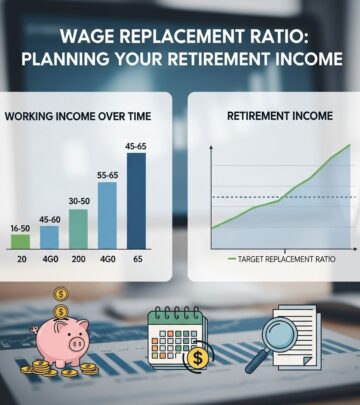
The 70% retirement rule offers a straightforward way to project your income requirements after leaving the workforce, suggesting you’ll need about 70% of your current after-tax earnings to sustain your lifestyle. This benchmark serves as an initial target for savers aiming to build adequate nest eggs.
Core Principles of Income Replacement in Retirement
Retirement planning hinges on replacing enough pre-retirement income to cover living costs without employment wages. Financial experts often cite 70% as a baseline because certain expenses drop post-career, while essential outlays persist. For instance, a worker earning $80,000 annually after taxes might target $56,000 yearly in retirement funds.
This approach accounts for shifts in spending patterns. Housing costs may decline if mortgages end, transportation expenses could fall without commuting, and work attire becomes optional. However, healthcare and leisure might rise, requiring balanced projections.
Step-by-Step Calculation Guide
To apply the rule, start with your net annual income—the amount after taxes and deductions. Multiply by 0.70 for your target retirement spend. Divide by 12 for monthly figures.
| Current Net Income | 70% Target (Annual) | Monthly Equivalent |
|---|---|---|
| $60,000 | $42,000 | $3,500 |
| $100,000 | $70,000 | $5,833 |
| $150,000 | $105,000 | $8,750 |
These examples assume standard tax withholding. Adjust for state taxes or unique deductions. High earners may need less than 70% proportionally, as lifestyle costs don’t scale linearly with income.
Age-Specific Savings Milestones
Beyond income targets, track progress against age-based benchmarks. Fidelity recommends multiples of current salary saved by key ages, assuming 45% from personal savings and the rest from Social Security.
- Age 30: 1x salary (e.g., $50,000 income → $50,000 saved)
- Age 35: 2x salary
- Age 40: 3x salary
- Age 45: 4x salary
- Age 50: 6x salary
- Age 55: 7x salary (or higher for early retirement)
- Age 60: 8x salary
- Age 67: 10x salary
A 45-year-old with $90,000 salary should have $360,000 saved. Falling short? Ramp up contributions via 401(k)s or IRAs.
Factors Driving the 70% Benchmark
Several dynamics explain why 70% suffices over 100%.
- Tax Relief: No FICA taxes (7.65% employee share) on withdrawals; lower brackets reduce income tax bite.
- Savings Cessation: Retirement contributions end, freeing that cash flow.
- Expense Reductions: Paid-off homes eliminate mortgage payments; less fuel and maintenance from ditching daily drives.
Self-employed individuals save more (15.3% FICA), amplifying the gap. Social Security bridges part of the need, typically 20-40% replacement for average earners.
Customizing for Unique Circumstances
The rule isn’t universal. Tailor it to your profile.
- Debt-Laden Households: Ongoing loans may push needs to 80-90%.
- Mortgage-Free Retirees: 60% might work if downsizing.
- High-Income Professionals: Often 50-60% replaces comfortably, per actuarial models.
- Early Retirees: Extend horizon; save 25-30% income yearly from age 35.
Lifestyle ambitions matter. Frequent travel or gifting elevates targets; frugal minimalism lowers them.
Integrating the 4% Withdrawal Strategy
Pair 70% with the 4% rule for total savings goals. Sustainable annual drawdown is 4% of portfolio, inflation-adjusted, based on historical returns.
Formula: Annual Need ÷ 0.04 = Required Savings.
| 70% Annual Need | 4% Rule Savings Target |
|---|---|
| $42,000 | $1,050,000 |
| $70,000 | $1,750,000 |
| $105,000 | $2,625,000 |
For $70,000 need, accumulate $1.75 million. Critics note market risks; alternatives include dynamic withdrawals tied to performance.
Investment Growth via Rule of 70
Estimate doubling time with Rule of 70: Years = 70 ÷ Annual Return %. At 7% return, doubles every 10 years—key for compounding.
- 10% return: 7 years
- 7% return: 10 years
- 5% return: 14 years
- 4% return: 17.5 years
Young savers favor stocks for faster growth; near-retirees shift to bonds.
Boosting Savings Rates for Success
Fidelity advises 15% of pre-tax pay annually, including matches. High earners: 20-30% for robust replacement. Automate via payroll deductions.
Max employer plans first, then Roth IRAs. Delay Social Security to 70 for 8% yearly boosts.
Common Oversights and Fixes
Avoid pitfalls:
- Inflation Blind Spots: 3% erodes purchasing power; factor into projections.
- Healthcare Costs: Medicare gaps demand HSAs.
- Longevity Risk: Plan for 30+ years; stress-test scenarios.
Use calculators from DOL or Fidelity for personalization.
Frequently Asked Questions
Is 70% enough for everyone?
No—adjust for debts, health, and goals. Lower earners may need 90%; high earners 50-60%.
How does Social Security factor in?
It covers 20-40%; savings fill the rest toward 70%.
What if I’m behind on benchmarks?
Increase contributions, cut expenses, side-hustle, or work longer.
Does the 4% rule guarantee safety?
Historical, not foolproof—monitor markets and adapt.
Should I use pre- or post-tax income?
Post-tax for accuracy, as retirement draws face taxes.
Building a Resilient Plan
Combine rules with holistic review: track net worth quarterly, consult advisors annually. Diversify assets, hedge inflation with TIPS/real estate. Consistent action trumps perfection—start now for compounding magic.
Retirement thrives on preparation. The 70% rule demystifies the math, but execution defines outcomes.
References
- What is the 70% Rule for Retirement Savings? — Experian. 2023. https://www.experian.com/blogs/ask-experian/what-is-70-percent-rule-for-retirement-savings/
- Rule of 70: Definition, How to Calculate It, and Example — Berger Financial Group. 2024. https://www.bergerfinancialgroup.com/rule-of-70-definition-how-to-calculate-it-and-example/
- How much should high earners save for retirement each year? — Milliman. 2023-05-15. https://www.milliman.com/en/insight/how-much-should-high-earners-save-retirement
- How Much Do You Need to Retire Comfortably? — Anew Advisors. 2024. https://anewadvisors.com/blog/how-much-do-you-need-to-retire-comfortably
- Retirement Rules: Which to Follow, Which to Rethink — Heritage Financial. 2023. https://heritagefinancial.net/retirement-rules/
- Retirement guidelines — Fidelity Investments. 2025. https://www.fidelity.com/viewpoints/retirement/retirement-guidelines
- Taking the Mystery Out of Retirement Planning — U.S. Department of Labor. 2022. https://www.dol.gov/agencies/ebsa/about-ebsa/our-activities/resource-center/publications/taking-the-mystery-out-of-retirement-planning
Similar Articles








Read full bio of medha deb