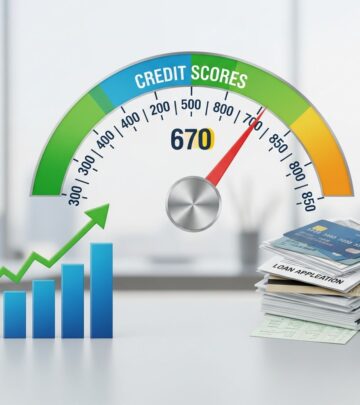
674 Credit Score: 6 Steps To Raise Your Score Fast
Discover what a 674 credit score means for loans, cards, and your finances, plus proven steps to boost it higher for better opportunities.

A 674 credit score positions you in a transitional zone of creditworthiness, often classified as good under FICO models but approaching fair in others like VantageScore. This score influences everything from interest rates on loans to approval odds for credit cards, signaling moderate risk to lenders while leaving ample room for enhancement through targeted habits.
Decoding Credit Scores and Their Role in Finance
Credit scores serve as numerical summaries of your borrowing history, ranging from 300 to 850 across major models. Developed by entities like Fair Isaac Corporation (FICO) and VantageScore, these scores help lenders predict repayment reliability. A score like 674 reflects a blend of strengths and potential weaknesses in your financial track record.
Key components driving the calculation include payment timeliness (about 35% weight), debt levels (30%), credit history duration (15%), recent inquiries (10%), and account variety (10%). For someone at 674, positive payment patterns might coexist with elevated debt usage or shorter history.
Where Does 674 Fit in Standard Score Bands?
Score classifications vary by model, affecting how institutions perceive your profile. Here’s a breakdown:
| Category | FICO Score 8 Range | VantageScore 3.0/4.0 Range |
|---|---|---|
| Exceptional/Superprime | 800-850 | 781-850 |
| Very Good/Prime | 740-799 | 661-780 |
| Good/Near Prime | 670-739 | 601-660 |
| Fair | 580-669 | 601-660 (overlaps) |
| Poor/Subprime | 300-579 | 300-600 |
At 674, you’re solidly in FICO’s good tier, qualifying for many products but potentially facing VantageScore’s near-prime label with stricter terms. Lenders blend these models, so a 674 often unlocks decent options without elite perks.
Lender Perspectives on a 674 Score
Financial institutions view 674 as reliable yet not top-tier. Approval rates hover higher than subprime levels (below 580), but expect premiums over prime borrowers (740+). For instance:
- Personal Loans: Viable from online lenders or credit unions, though APRs might range 10-20% versus 6-12% for excellent scores.
- Credit Cards: Access to standard rewards cards possible, but secured or subprime options if history is thin.
- Auto Financing: Feasible with rates around 7-10%, higher than the 4-6% for very good scores.
- Mortgages: Conventional loans demand 620+, so you’re eligible, but FHA paths offer flexibility with added fees.
Higher costs stem from perceived risk; data shows fair/good scorers default less than poor but more than prime.
Real-World Impacts of Holding a 674 Credit Score
Beyond approvals, 674 shapes daily finances. Higher APRs on a $10,000 loan at 12% versus 7% add $1,200+ in interest over five years. Renters might pay deposits, while insurers could hike premiums 20-50% based on credit-linked risk models.
Employment screening increasingly checks scores for finance roles, and utilities may require deposits. Positively, it’s above the U.S. average (around 715 FICO), aiding rebuilding from lower starts.
Core Factors Shaping Your 674 Score
Understanding influences empowers change. Primary drivers:
- Payment History (35%): Even one 30-day late mark drags scores; consistency rebuilds trust.
- Credit Utilization (30%): Aim under 30%—e.g., $3,000 balance on $10,000 limit hurts less than 90% usage.
- History Length (15%): Averages 7-10 years boost scores; closing old accounts shortens this.
- New Credit (10%): Multiple inquiries in 12 months signal risk, dropping scores 5-10 points temporarily.
- Mix (10%): Blend of cards, loans shows management skill.
Step-by-Step Plan to Elevate from 674
Raising to 700+ is achievable in 3-6 months with discipline. Prioritize:
- Review Reports: Pull free weekly files from AnnualCreditReport.com; dispute inaccuracies (affect 1 in 5 reports).
- Automate Payments: Set alerts and auto-pay to eliminate lates, the top booster.
- Slash Utilization: Pay balances twice monthly; request limit hikes without hard pulls.
- Preserve Age: Keep veteran accounts active with small use.
- Limit Applications: Space new credit 6+ months apart.
- Add Positive Data: Become authorized user on strong account or use credit-builder loans.
Track progress via free tools like Credit Karma (VantageScore) or bank apps (FICO).
Tools and Products Suited for 674 Scorers
Certain offerings target this range:
| Product Type | Examples | Typical Terms |
|---|---|---|
| Unsecured Cards | Capital One Platinum, Discover it Secured | 15-25% APR, $300+ limits |
| Personal Loans | Upstart, LendingClub | 10-18% APR, $1k-$50k |
| Auto Loans | Local credit unions | 6-11% APR |
Avoid payday loans; focus on builders like Chime Credit Builder for utilization wins without hard inquiries.
Long-Term Habits for Sustained Score Growth
Beyond quick fixes, cultivate:
- Budgeting via 50/30/20 rule (needs/wants/savings).
- Diversifying without overextending.
- Annual report audits.
- Emergency funds to prevent debt spirals.
Credit health correlates with wealth; consistent 700+ scorers save thousands yearly on borrowing.
Frequently Asked Questions
Can I get a mortgage with a 674 credit score?
Yes, FHA loans start at 580 with 3.5% down; conventional at 620. Expect 6-8% rates versus 5% for 740+.
How long to boost from 674 to good/excellent?
30-90 days for 20-50 point gains via utilization drops; 6-12 months for history builds.
Does a 674 score affect renting or jobs?
Landlords check (60% do); scores below 650 prompt deposits. Some employers screen for finance positions.
Is 674 above average?
Yes, U.S. FICO median is 711-715; 674 edges fair territory but outperforms 30% of population.
What if my score drops below 674?
Monitor for errors or high utilization; sub-670 limits premium products, hikes rates 2-5%.
Monitoring and Next Steps
Enroll in alerts from bureaus (Equifax, Experian, TransUnion). Apps like Mint integrate scores with spending. A 674 is a solid base—leverage it wisely for upward mobility.
References
- 615 Credit Score: A Guide to Credit Scores — Chase Bank. 2023. https://www.chase.com/personal/credit-cards/education/credit-score/615-credit-score
- Credit Score Ranges & What They Mean — Chase Bank. 2024. https://www.chase.com/personal/credit-cards/education/credit-score/credit-score-ranges-and-what-they-mean
- Chase cut my credit-card limit due to lower usage — MarketWatch (Morningstar). 2026-02-05. https://www.morningstar.com/news/marketwatch/20260205182/chase-cut-my-credit-card-limit-due-to-lower-usage-will-this-affect-my-credit-score-and-lead-other-banks-to-do-the-same
- What Is a Credit Score, and Why Is It Important? — Chase Bank. 2024. https://www.chase.com/personal/investments/learning-and-insights/article/what-is-a-credit-score-and-why-is-it-important
- What Affects Your Credit Scores? — Chase Bank. 2024. https://www.chase.com/personal/credit-cards/education/credit-score/what-affects-your-credit-scores
Similar Articles








Read full bio of Sneha Tete