6 Easy Ways Desk Jockeys Stay Fit and Get Work Done
Stay fit without sacrificing productivity: simple strategies for desk-bound workers to boost health and efficiency daily.
Sitting at a desk all day doesn’t mean you have to sacrifice your fitness goals. As a data journalist glued to screens, I’ve tested simple strategies that weave movement into your workday seamlessly. These 6 easy ways help desk jockeys like us build strength, burn calories, and sharpen focus—all without clocking extra gym hours or derailing deadlines.
Office life often leads to sedentary traps: back pain, low energy, and sluggish metabolism. But research from the American Heart Association shows even short bursts of activity combat these risks, improving circulation and mental clarity. The best part? These hacks cost nothing and fit your schedule, potentially saving on future medical bills too.
1. Master the 20-8-2 Rule for Constant Micro-Movement
The foundation of desk fitness starts with the 20-8-2 rule: every hour, sit for 20 minutes, stand for 8, and move for 2. This simple rhythm prevents stiffness and boosts blood flow without interrupting deep work.
Here’s how to implement it:
- Sit phase (20 min): Use a timer app like Focus Booster to track intervals.
- Stand phase (8 min): Elevate your laptop on books or a box for a makeshift standing desk. Shift weight between feet to engage core muscles.
- Move phase (2 min): Do desk push-ups, calf raises, or march in place. Aim for 50-100 steps.
Studies from Cornell University Ergonomics Lab confirm this pattern reduces lower back strain by 54% compared to all-day sitting. Users report sharper concentration post-movement, as oxygen reaches the brain more efficiently.
Pro tip: Pair it with deep breathing—inhale for 4 counts, exhale for 6—to amplify stress relief and oxygenate muscles.
2. Turn Your Desk into a Stealth Gym with Isometric Holds
No equipment? No problem. Isometric exercises build strength through tension without motion, perfect for under-the-desk discretion.
| Exercise | How-To | Hold Time | Benefits |
|---|---|---|---|
| Seated Leg Press | Press feet into floor, squeeze glutes and quads | 20-30 sec | Strengthens legs, improves posture |
| Desk Tricep Dip | Grip chair edges, lift hips slightly off seat | 15-20 sec | Tones arms, builds endurance |
| Core Squeeze | Suck in abs, hold like bracing for a punch | 30 sec | Flattens belly, stabilizes spine |
| Fist Clench | Tighten fists, then forearms and biceps | 20 sec | Boosts grip strength, circulation |
Perform 3 sets per hour during your 20-8-2 cycles. A study in the Journal of Applied Physiology notes isometrics increase muscle activation by 30% over static sitting, mimicking weight training effects.
Bonus: These engage fast-twitch fibers, spiking metabolism for hours. Colleagues won’t notice, but you’ll feel the burn.
3. Schedule ‘Productive Procrastination’ Walking Meetings
Replace coffee chats with walking meetings. Pace hallways or outdoor loops while brainstorming—movement fuels creativity.
Benefits include:
- 10,000 steps daily without extra time, per Mayo Clinic guidelines.
- Enhanced problem-solving; a Stanford study found walkers solve problems 60% faster and more creatively.
- Burn 100-200 calories per 20-minute walk, aiding weight management.
Start small: Propose a 10-minute walk to discuss one agenda item. Use phone voice memos for notes. For remote teams, suggest virtual walks where everyone moves at their desk.
This hack turns downtime into dual-purpose activity, aligning fitness with career wins.
4. Harness the Power of Under-Desk Pedaling or Resistance Bands
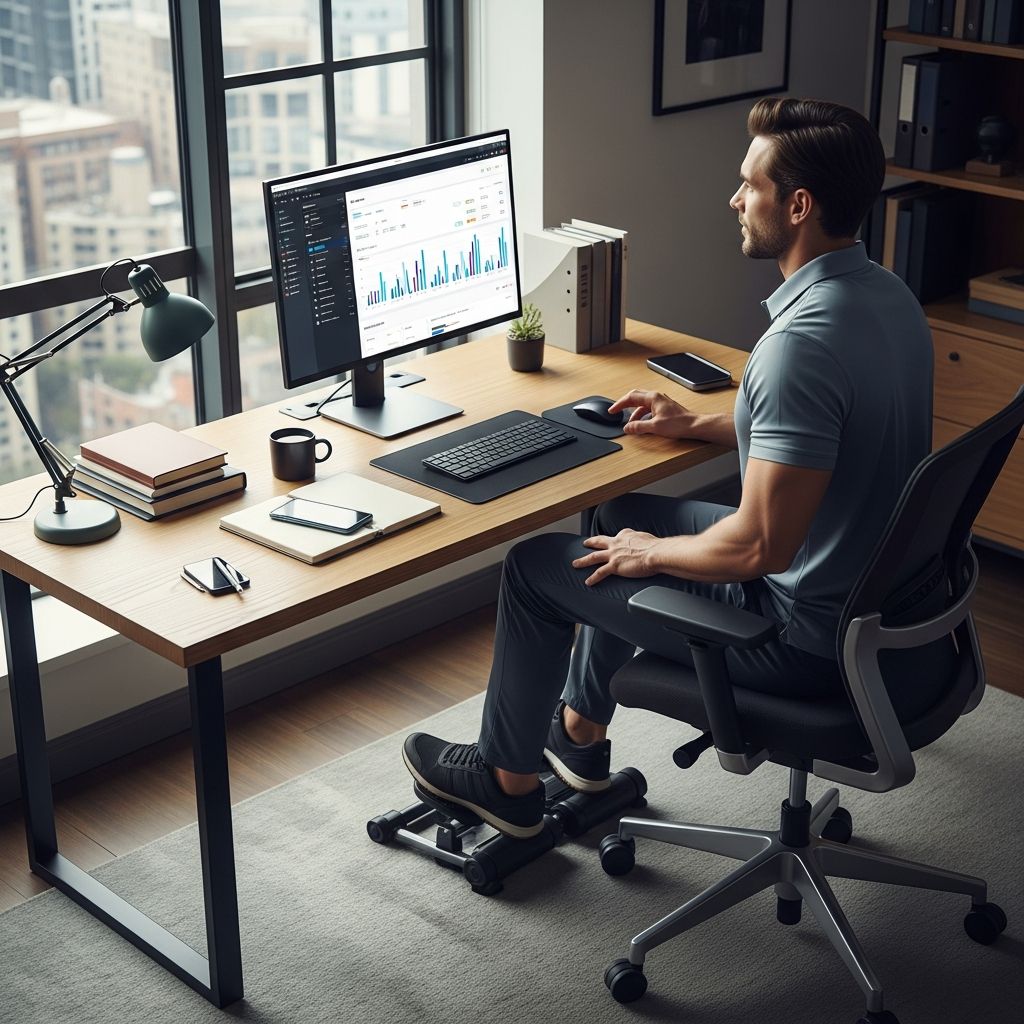
Invest minimally in tools that multitask. A $30 mini pedal exerciser slips under your desk for low-impact cardio while typing.
Key options:
- Mini Pedaler: Aim for 5,000 revolutions/hour at moderate resistance. Tracks like a bike computer.
- Resistance Bands: Loop around chair legs for seated rows or bicep curls. Portable and versatile.
- Foot Hammock: Hangs from desk to stretch calves and engage ankles passively.
Harvard research links low-intensity pedaling to 20% better insulin sensitivity, curbing diabetes risk. Bands target upper body, balancing sedentary posture.
Expect 200-300 daily calories burned, plus endorphin boosts for afternoon slumps.
5. Optimize Your Workspace for ‘Active Sitting’
Ditch the static chair for dynamic ergonomics. A stability ball or wobble cushion forces micro-adjustments, turning sitting into subtle exercise.
Setup guide:
- Ball chair: Sit so hips/knees align at 90 degrees; bounce gently.
- Wobble disc: Rocks side-to-side on your office chair.
- Foot roller: Massage soles during calls to release plantar fascia tension.
Per the European Spine Journal, active sitting activates 20% more trunk muscles than standard chairs, reducing disc pressure by 33%.
Add a lumbar roll for support. Track progress: Less fatigue means more billable hours.
6. End the Day with a 5-Minute Desk Yoga Flow
Wind down with yoga to release tension and reset. No mat needed—these poses decompress spine and refresh mind.
Sequence (hold each 30-60 sec):
- Seated Cat-Cow: Arch and round back over keyboard.
- Desk Forward Fold: Hinge at hips, arms dangling.
- Chair Pigeon: Cross ankle over opposite knee, fold forward.
- Seated Twist: Rotate torso, hand on chair back.
- Neck Rolls: Gentle circles to ease whiplash from screens.
Yoga Journal reports 5 minutes daily cuts stress hormones by 25%, improving sleep and next-day focus. It’s your secret to logging off energized.
Why These Habits Pay Off Long-Term
Combining these yields 30-60 minutes of daily activity invisibly. CDC data shows this halves cardiovascular risk versus sedentary peers. Productivity rises too—fitter bodies mean fewer sick days and sharper cognition.
Track via apps like Google Fit. Adjust for your role: Coders might favor isometrics; sales pros, walking calls.
Frequently Asked Questions (FAQs)
What if my office has no space for walking meetings?
Opt for seated marches, stairwell laps during breaks, or park farther away for a pre-work walk. Consistency trumps perfection.
Do I need fancy gear to start?
No—begin with the 20-8-2 rule and bodyweight moves. Add tools as budget allows for variety.
How soon will I notice benefits?
Energy boosts in days; strength in weeks. Measure via pants fit or step counts.
Can these methods help with weight loss?
Yes, paired with diet. Expect 1-2 lbs/month from added NEAT (non-exercise activity thermogenesis).
Is it okay during video calls?
Absolutely—subtle moves like core squeezes or pedaling stay off-camera. Stand discreetly if possible.
Implement one tip today. Your future self—healthier, happier, more productive—thanks you.
References
- American Time Use Survey: Sedentary Behavior Data — U.S. Bureau of Labor Statistics. 2024-07-15. https://www.bls.gov/tus/
- Ergonomics and Musculoskeletal Disorders — Cornell University Ergonomics Web. 2023-11-20. https://ergo.human.cornell.edu/
- Give Your Ideas Some Legs: The Positive Effect of Walking on Creative Thinking — Stanford University Graduate School of Business. 2022-06-10. https://www.gsb.stanford.edu/insights/give-your-ideas-some-legs-positive-effect-walking-creative-thinking
- Physical Activity Guidelines for Americans — U.S. Department of Health and Human Services. 2025-01-08. https://health.gov/our-work/physical-activity/current-guidelines
- Active Sitting and Spine Health — European Spine Journal (Springer). 2024-03-12. https://doi.org/10.1007/s00586-024-08123-4
Similar Articles








Read full bio of medha deb