5 Ways to Avoid Early Withdrawal Penalties on CDs
Discover proven strategies to access your CD funds without facing costly early withdrawal penalties and maximize your savings.
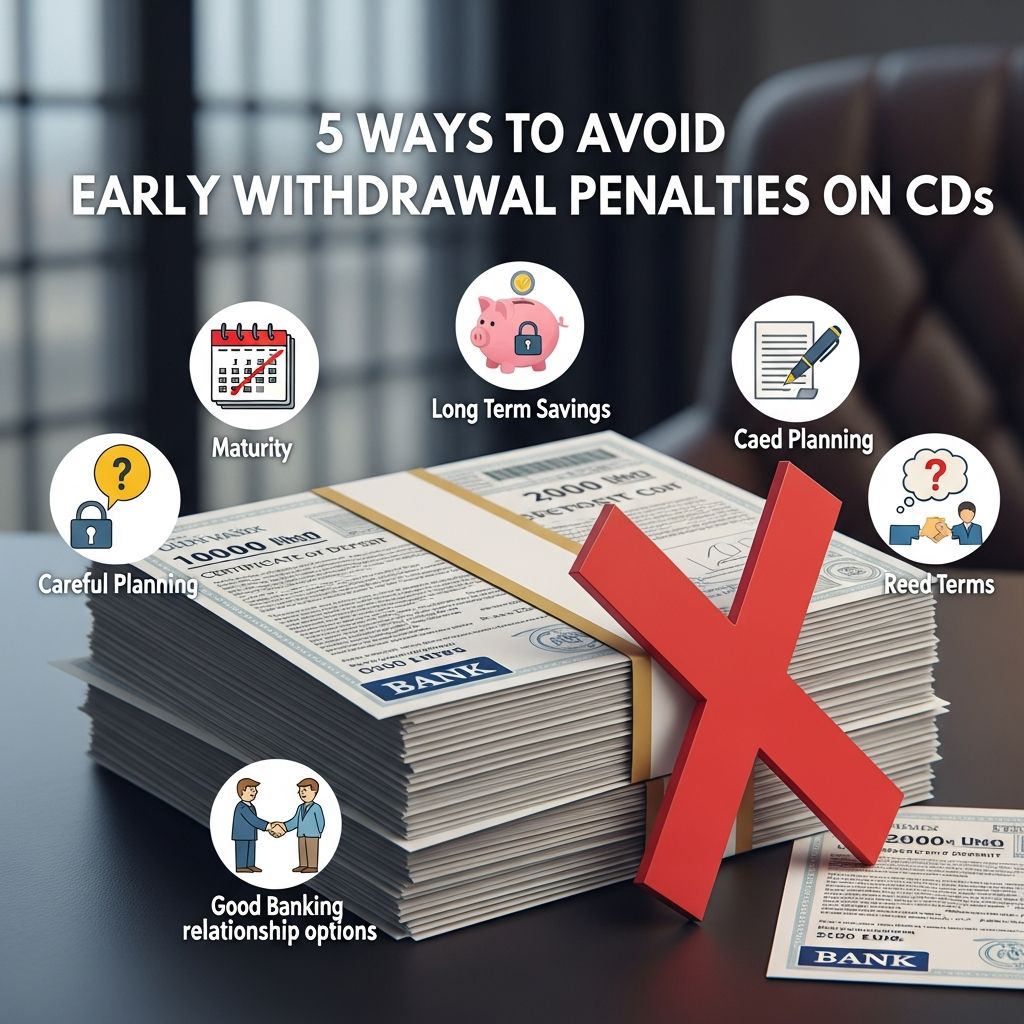
Certificates of deposit (CDs) offer competitive interest rates for savers willing to lock away their money for a fixed term. However,
early withdrawal penalties
can erode your earnings or even principal if you access funds before maturity. Federal regulations require banks to impose at least seven days of simple interest as a penalty for withdrawals within the first six days, but institutions often set harsher terms, such as 90 to 180 days of interest for longer-term CDs. This article explores five practical strategies to sidestep these penalties, drawing from established financial practices to help you maintain liquidity without sacrificing returns.What Are CD Early Withdrawal Penalties?
CD early withdrawal penalties are fees banks charge for breaking the fixed-term agreement. These typically deduct a portion of accrued interest—often equivalent to several months’ earnings—or a flat fee, whichever is greater. For instance, a one-year CD might penalize 90 days of interest on the withdrawn amount. In severe cases, especially early in the term, penalties can exceed earned interest, dipping into your principal. Partial withdrawals are rare and still incur penalties on the accessed portion. Understanding these risks is crucial before committing funds.
1. Wait Until Maturity (The Simplest Approach)
The most straightforward way to avoid penalties is to
wait for your CD to mature
. CDs are designed for funds you won’t need until the end of the term, typically ranging from 3 months to 5 years. Upon maturity, banks provide agrace period
—usually 7 to 10 days—during which you can withdraw without penalty. Monitor your maturity date closely, as many institutions automatically renew the CD afterward, potentially at a lower rate.- Pro Tip: Opt for shorter-term CDs (e.g., 6-12 months) if you anticipate needing access sooner, balancing yield with liquidity.
- Rates Context: As of early 2026, short-term CDs often yield 4-5% APY, competitive with savings accounts but with guaranteed returns.
This method preserves all interest but requires disciplined planning. Set calendar reminders for maturity dates to act promptly during the grace period.
2. Build a Liquid Emergency Fund First
Before purchasing a CD, establish a
liquid emergency fund
covering 3-6 months of living expenses in a high-yield savings account or money market fund. This buffer prevents the need to tap CDs during unforeseen events like medical bills or job loss. Savings accounts offer penalty-free access and rates often approaching CD yields without lock-up periods.| Account Type | Liquidity | Typical APY (2026) | Best For |
|---|---|---|---|
| High-Yield Savings | Immediate | 4.5-5.2% | Emergencies |
| Money Market | High (check-writing) | 4.3-5.0% | Short-term needs |
| Standard CD | Low (term-locked) | 4.0-5.5% | Known future goals |
By prioritizing liquidity elsewhere, CDs become a true ‘set-it-and-forget-it’ vehicle for excess savings.
3. Choose No-Penalty CDs for Flexibility
**No-penalty CDs** (also called liquid CDs) allow withdrawals anytime after an initial holding period (often 6-7 days) without fees. They typically have terms around 7-13 months and slightly lower rates than standard CDs—trading flexibility for modest yield reduction. Institutions like Ally and Marcus by Goldman Sachs frequently offer these.
- Key Features: Full principal and interest access; grace period still applies at maturity.
- Drawbacks: Lower APYs (e.g., 4.0% vs. 4.5% for standard); limited availability.
- Use Case: Ideal for parking funds where rates might fluctuate or needs are unpredictable.
Shop via deposit networks like Raisin for the best no-penalty rates across banks.
4. Use a CD Ladder Strategy
**CD laddering** involves dividing funds across multiple CDs with staggered maturities (e.g., 3, 6, 12, 24 months). This provides regular access points without full early withdrawal. As each ‘rung’ matures, withdraw or reinvest, capturing higher rates if they rise.
Example Ladder for $10,000:
| Rung | Amount | Term | Maturity Access |
|---|---|---|---|
| 1 | $2,500 | 3 months | Quarterly |
| 2 | $2,500 | 6 months | Bi-annual |
| 3 | $2,500 | 12 months | Annual |
| 4 | $2,500 | 24 months | Every 2 years |
Laddering averages yields across terms and hedges against rate changes. In rising rate environments like 2023-2025, reinvesting mature rungs boosts returns.
5. Leverage Penalty Exceptions and Flexible Terms
Certain situations waive penalties: death, legal incompetence, or disability of the account holder. Some banks offer additional exceptions, like Alliant Credit Union’s IRA CD waiving fees post-age 72 or upon disability. Additionally, seek CDs with
flexible penalties
allowing partial withdrawals (penalty only on withdrawn amount) or minimal fees.- Negotiate Waivers: Explain hardships; some institutions waive for ‘reasonable’ reasons.
- IRA CDs: Special rules may apply, enhancing flexibility.
- Shop Smart: Compare via FDIC-insured networks for lenient terms.
Always review the truth-in-savings disclosure before opening.
Additional Tips for CD Success
- Align Terms with Goals: Match CD length to known expenses like tuition or home down payments.
- Monitor Rates: Use online aggregators for competitive APYs; brokered CDs offer more options.
- Consider Alternatives: If penalties loom, high-yield savings or I Bonds provide liquidity.
- Tax Implications: Penalties may be deductible on taxes, offsetting some loss.
Frequently Asked Questions (FAQs)
Q: Can I lose my principal from a CD early withdrawal?
A: Yes, if the penalty exceeds earned interest, banks dip into principal—common for short holding periods.
Q: What’s the minimum federal CD penalty?
A: Seven days of simple interest for withdrawals in the first six days.
Q: Are no-penalty CDs widely available?
A: Less common than standard CDs but offered by online banks; terms often 7-11 months.
Q: How does CD laddering help in rising rates?
A: Frequent maturities allow reinvestment at higher rates without penalty.
Q: Should I pay a penalty to chase higher yields?
A: Calculate net gain; sometimes worthwhile if new rates significantly exceed penalty costs.
Final Thoughts on Protecting Your CD Investments
By implementing these five strategies—waiting for maturity, maintaining emergency funds, selecting no-penalty CDs, laddering, and exploiting exceptions—you can enjoy CD benefits without penalty pitfalls. In 2026’s volatile rate environment, flexibility is key to optimizing returns. Always verify terms with FDIC-insured institutions.
References
- CD Early Withdrawal Penalty: What to Know and How to Avoid It — NerdWallet. 2025-06-15. https://www.nerdwallet.com/banking/learn/cd-early-withdrawal-fees
- CD Early Withdrawal Penalties: Exceptions & Considerations — RetireGuide. 2025-08-22. https://www.retireguide.com/retirement-planning/investing/certificate-of-deposit/cds-early-withdrawal-penalties/
- How To Avoid A CD Early Withdrawal Penalty — Bankrate. 2025-11-10. https://www.bankrate.com/banking/cds/how-to-avoid-cd-early-withdrawal-penalty/
- CD Early Withdrawal Penalty: What You Should Know — Ally Bank. 2025-04-05. https://www.ally.com/stories/save/cd-early-withdrawal-penalties/
- Early Withdrawal Penalties on CDs: What You Need to Know — Rising Bank. 2025-09-18. https://www.risingbank.com/cd-early-withdrawal-penalty/
- How to avoid CD early withdrawal penalties — CBS News. 2025-07-30. https://www.cbsnews.com/news/how-to-avoid-cd-early-withdrawal-penalties/
Similar Articles








Read full bio of medha deb