403(b) vs Roth IRA: Advantages and Disadvantages
Compare 403(b) and Roth IRA plans to determine which retirement savings option fits your financial goals.
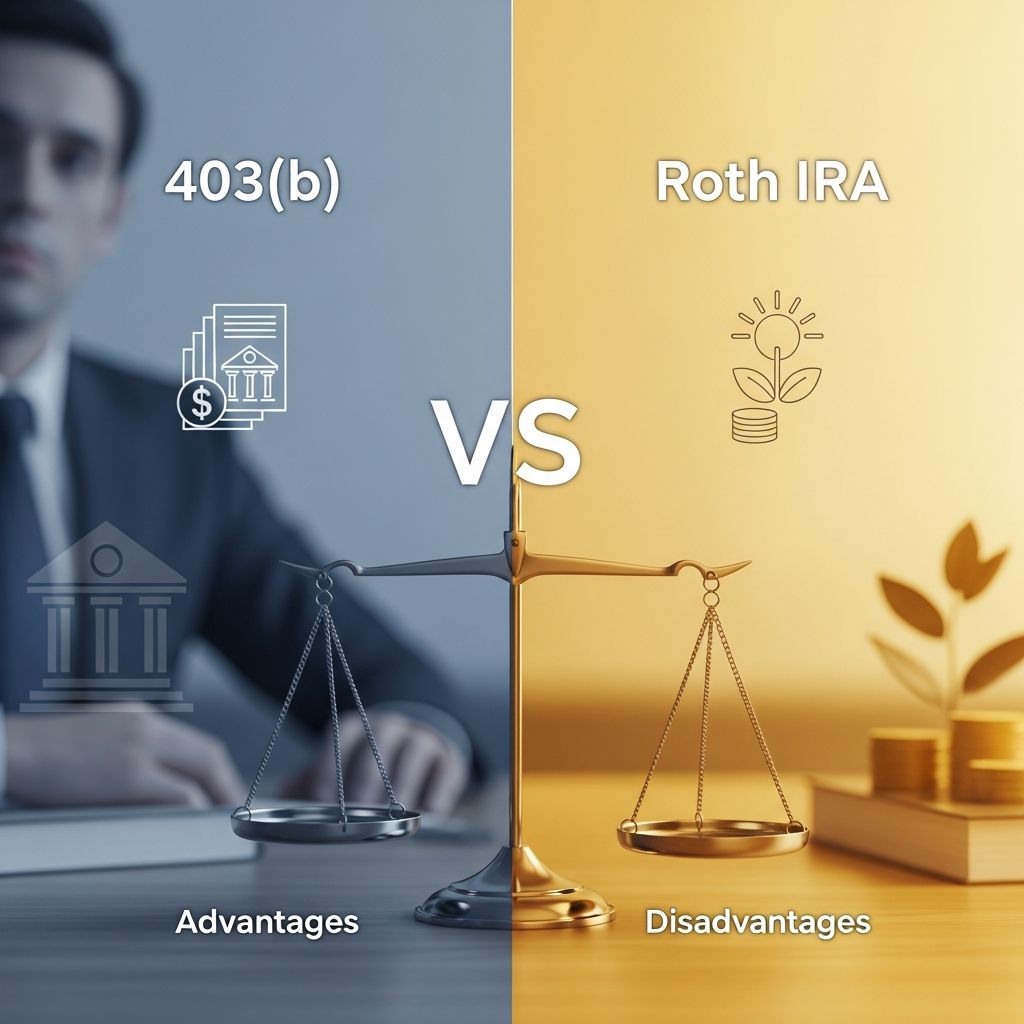
When planning for retirement, understanding the differences between various retirement accounts is crucial for making informed financial decisions. Two popular tax-advantaged retirement plans are the 403(b) and the Roth IRA. While both offer valuable benefits for retirement savings, they operate differently in terms of contributions, tax treatment, investment options, and withdrawal rules. Choosing between these two accounts depends on your income level, employment situation, tax bracket, and long-term financial goals.
Understanding 403(b) Plans
A 403(b) plan is a tax-advantaged retirement savings plan available primarily to employees of public schools, certain tax-exempt organizations, and some ministers. The plan is named after Section 403(b) of the Internal Revenue Code. These plans function similarly to 401(k) plans but are specifically designed for employees of educational institutions and non-profit organizations.
One of the primary advantages of a 403(b) plan is that contributions are made through automatic payroll deductions, making retirement savings convenient and consistent. Your employer may also offer matching contributions, effectively providing free money for your retirement. Additionally, contributions to a traditional 403(b) reduce your taxable income in the year they are made, potentially lowering your overall tax bill.
Understanding Roth IRA
A Roth IRA is an individual retirement account that operates on an after-tax contribution basis. Unlike traditional IRAs or 403(b) plans, contributions to a Roth IRA do not reduce your current taxable income. However, the primary advantage is that qualified distributions in retirement are completely tax-free, and your money grows tax-free throughout the accumulation phase.
Roth IRAs are available to anyone with earned income, regardless of employment situation. They offer greater flexibility in investment choices compared to many employer-sponsored plans and allow penalty-free withdrawals of contributions (though not earnings) before retirement age if needed.
Contribution Limits Comparison
One of the most significant differences between 403(b) plans and Roth IRAs lies in their contribution limits.
403(b) Contribution Limits
The annual contribution limit for a 403(b) in 2025 is $23,500 for participants under age 50. Employees aged 50 and older can make an additional catch-up contribution of $7,500, bringing their total to $31,000. For participants aged 60 to 63, an enhanced catch-up contribution of $11,250 is available instead of the standard $7,500, allowing these individuals to contribute up to $34,750 annually. Additionally, employees with 15 or more years of service with their employer may qualify for additional contributions under special provisions.
Roth IRA Contribution Limits
The annual contribution limit for a Roth IRA in 2025 is $7,000 for individuals under age 50, and $8,000 for those aged 50 and older. These limits are substantially lower than 403(b) contribution limits, meaning you can save significantly more annually through a 403(b) plan if you have access to one through your employer.
Tax Treatment: Key Advantages and Disadvantages
403(b) Tax Treatment
Traditional 403(b) contributions are made with pre-tax dollars, meaning your contributions reduce your taxable income for the year. This provides an immediate tax benefit by lowering your current tax liability. However, when you withdraw funds in retirement, distributions are taxed as ordinary income. Your employer matching contributions, if offered, are also made on a pre-tax basis and taxed upon withdrawal.
The advantage of this approach is that it reduces your tax burden during your peak earning years when you may be in a higher tax bracket. The disadvantage is that you may face higher tax obligations in retirement if you withdraw substantial amounts.
Roth IRA Tax Treatment
Roth IRA contributions are made with after-tax dollars, providing no immediate tax deduction. However, qualified distributions in retirement—including all earnings—are completely tax-free. To qualify for tax-free withdrawals, the account must have been established at least five years prior, and you must be at least 59½ years old (with some exceptions for disability or first-time home purchase up to $10,000 lifetime).
The advantage is predictable, tax-free income in retirement. The disadvantage is that you receive no immediate tax benefit from your contributions, though the long-term tax-free growth can be substantial.
Income Limits and Eligibility
403(b) Income Limits
There are no income limits for contributing to a 403(b) plan. Regardless of how much you earn, if your employer offers a 403(b) plan, you can participate and contribute up to the maximum annual limit. This makes 403(b) plans particularly valuable for high-income earners who may be restricted from contributing to Roth IRAs.
Roth IRA Income Limits
Roth IRAs have strict income phase-out limits that restrict higher-income earners from contributing. For 2025, single filers can contribute the maximum if their modified adjusted gross income (MAGI) is less than $150,000, with contributions phasing out up to $165,000. For married couples filing jointly, the maximum contribution is available with a MAGI under $236,000, phasing out between $236,000 and $246,000. These income limits are adjusted annually and can prevent high earners from accessing Roth accounts directly, though backdoor Roth conversions may be available.
Required Minimum Distributions (RMDs)
403(b) RMD Requirements
Traditional 403(b) plans require minimum distributions beginning at age 73 (as of 2023) or at retirement, whichever is later. Once you begin withdrawals, you must take required minimum distributions each year based on IRS life expectancy tables. This can be disadvantageous if you don’t need the income and want to allow your account to continue growing tax-deferred.
Roth IRA RMD Requirements
One significant advantage of Roth IRAs is that they do not require minimum distributions during your lifetime. You can allow your account to grow tax-free indefinitely, providing greater flexibility in retirement planning and the ability to leave a larger tax-free inheritance to beneficiaries. This makes Roth IRAs particularly attractive for those who don’t need retirement income immediately.
Advantages of 403(b) Plans
The 403(b) plan offers several compelling advantages for eligible employees:
– Higher contribution limits: You can save significantly more annually compared to a Roth IRA, with limits reaching $34,750 for those aged 60-63.- Employer matching: Many employers offer matching contributions, providing immediate returns on your investment.- Automatic payroll deductions: Contributions are deducted automatically from your paycheck, making consistent saving effortless.- Immediate tax deduction: Contributions reduce your current taxable income, lowering your immediate tax bill.- No income limits: High earners can contribute regardless of income level.- Catch-up contributions: Those aged 50 and older can make additional contributions, with enhanced options for those aged 60-63.
Disadvantages of 403(b) Plans
Despite their advantages, 403(b) plans have certain drawbacks:
– Limited investment options: Your employer selects the investment providers and options available, limiting your choices.- RMD requirements: You must begin taking distributions at age 73, which may not align with your financial needs.- Taxable distributions: All withdrawals are taxed as ordinary income in retirement.- Limited accessibility: Only available through specific employers (schools, non-profits, certain religious organizations).- Restricted early access: Early withdrawals before age 59½ typically incur a 10% penalty plus taxes, with limited exceptions.
Advantages of Roth IRAs
Roth IRAs offer distinct advantages that make them attractive for many retirement savers:
– Tax-free growth: All earnings grow completely tax-free over time.- Tax-free qualified distributions: Withdrawals in retirement are entirely tax-free if the account meets the five-year rule.- No RMD requirements: You can let your money grow indefinitely without forced distributions during your lifetime.- Flexible contributions access: You can withdraw contributions (not earnings) at any time without penalty or taxes.- Greater investment control: You choose your custodian and have access to virtually any investment option.- Tax-free inheritance: Beneficiaries inherit tax-free growth, though they must distribute inherited Roth IRAs under certain rules.- Loan alternatives: While not an outright loan feature, the ability to withdraw contributions provides emergency access to funds.
Disadvantages of Roth IRAs
Roth IRAs also have limitations to consider:
– Lower contribution limits: Annual contributions are limited to $7,000 ($8,000 if 50+), significantly less than 403(b) plans.- Income restrictions: Phase-out limits prevent high earners from contributing directly.- No immediate tax benefit: Contributions don’t reduce your current taxable income.- Five-year rule: You must wait five years from your first Roth contribution before withdrawing earnings tax-free.- No employer matching: Unlike 403(b) plans, employers cannot contribute to IRAs.- Self-directed funding: You must personally fund your account; there are no automatic payroll deductions through most employers.
Roth 403(b): A Hybrid Option
Some employers offer Roth 403(b) accounts, which combine features of both plans. With a Roth 403(b), you make after-tax contributions like a Roth IRA, but you benefit from the higher contribution limits of a 403(b) ($23,500 in 2025). Qualified distributions are tax-free. However, Roth 403(b) accounts do have RMD requirements beginning at age 73, unlike traditional Roth IRAs. Additionally, there are no income limits for Roth 403(b) contributions, making them available to all employees regardless of earnings. Employer matching contributions to Roth 403(b) accounts are typically made on a pre-tax basis and taxed upon withdrawal, while employee Roth contributions and their earnings grow tax-free.
Can You Have Both?
Yes, you can contribute to both a 403(b) and a Roth IRA in the same year, provided you meet the eligibility requirements for each. This strategy allows you to maximize retirement savings by taking advantage of both the higher 403(b) limits and the tax-free growth of a Roth IRA. For example, you might maximize your 403(b) to get employer matching, then contribute additional funds to a Roth IRA for tax-free growth and greater investment control.
Choosing Between 403(b) and Roth IRA
Early Career, Lower Tax Bracket
If you’re young and in a lower tax bracket, a Roth IRA or Roth 403(b) may be preferable. You’ll pay taxes on contributions now at a lower rate, allowing decades of tax-free growth. This strategy positions you to potentially pay lower lifetime taxes.
Mid-Career, Higher Income
During peak earning years, a traditional 403(b) may be advantageous. The immediate tax deduction reduces your taxable income during high-earning years, providing substantial tax savings. If your employer offers matching, this is an important benefit to capture.
High Income Earners
If your income exceeds Roth IRA limits, a 403(b) (traditional or Roth) through your employer becomes crucial for additional retirement savings beyond IRA limits. The absence of income restrictions makes employer plans essential for high earners.
Control and Investment Choice Priority
If you prioritize investment control and flexibility, a Roth IRA offers superior options. You choose your custodian and can invest in virtually any asset class, whereas 403(b) plans limit you to employer-selected options.
Frequently Asked Questions
Q: Which account should I prioritize: 403(b) or Roth IRA?
A: If your employer offers a 403(b) match, prioritize contributing enough to capture the full match first—it’s free money. Then maximize a Roth IRA if eligible. Finally, contribute additional funds to your 403(b) if you have remaining savings capacity.
Q: Can I contribute to a 403(b) and traditional IRA in the same year?
A: Yes, you can contribute to both simultaneously. However, your ability to deduct traditional IRA contributions may be limited if you have access to a 403(b) plan, depending on your income.
Q: What happens to my 403(b) if I leave my job?
A: You can typically roll your 403(b) into an IRA or your new employer’s retirement plan if you change jobs. This rollover preserves the tax-deferred status of your savings.
Q: Is a Roth conversion from a 403(b) possible?
A: Yes, you may be able to roll over or convert a traditional 403(b) to a Roth IRA, though this involves paying taxes on the converted amount in the year of conversion.
Q: What’s the five-year rule for Roth IRAs?
A: You must hold a Roth IRA for at least five tax years before withdrawing earnings tax-free. Contributions can be withdrawn anytime tax and penalty-free.
Q: Do Roth 403(b)s have RMD requirements?
A: Yes, Roth 403(b) accounts require minimum distributions beginning at age 73, unlike traditional Roth IRAs which have no lifetime RMD requirements.
Conclusion
Both 403(b) and Roth IRA accounts serve important roles in retirement planning. A 403(b) offers higher contribution limits, employer matching opportunities, and immediate tax benefits, making it ideal for employees of eligible organizations. A Roth IRA provides tax-free growth, greater investment flexibility, and no RMD requirements, appealing to those seeking long-term tax-free income.
The best choice depends on your specific situation: your age, current tax bracket, expected future tax bracket, income level, employer offerings, and retirement goals. Many retirement savers benefit from utilizing both accounts strategically. Consider consulting with a financial advisor to develop a retirement strategy tailored to your unique circumstances and maximize your retirement savings potential.
References
- 403(b) vs Roth IRA: Key Differences and How to Choose — SoFi. 2025. https://www.sofi.com/learn/content/roth-ira-vs-403b/
- 403(b) vs. IRA: Are They the Same? — NerdWallet. 2025. https://www.nerdwallet.com/retirement/learn/is-a-403b-an-ira
- Comparing Traditional and Roth 401(k)/403(b) Contributions — Capital Group. 2025. https://www.capitalgroup.com/individual/planning/retirement-planning/compare-traditional-roth-401k-403b.html
- To Roth or Not to Roth in Your 403(b) — WEA Member Benefits. 2025. https://www.weabenefits.com/resource/retirement-forms-and-brochures/to-roth-or-not-to-roth-in-your-403b/
- Choosing between pre-tax and Roth after-tax options — TIAA. 2025. https://www.tiaa.org/public/learn/financial-essentials/traditional-or-roth-retirement-plan-options
- Traditional vs. Roth Options: Choosing the Best Path — UT System. 2025. https://www.utsystem.edu/offices/employee-benefits/ut-retirement-program/voluntary-retirement-programs/traditional-vs-roth-options
Similar Articles








Read full bio of Sneha Tete