401(k) vs 403(b): Key Differences Explained
Understand the differences between 401(k) and 403(b) retirement plans for optimal savings.
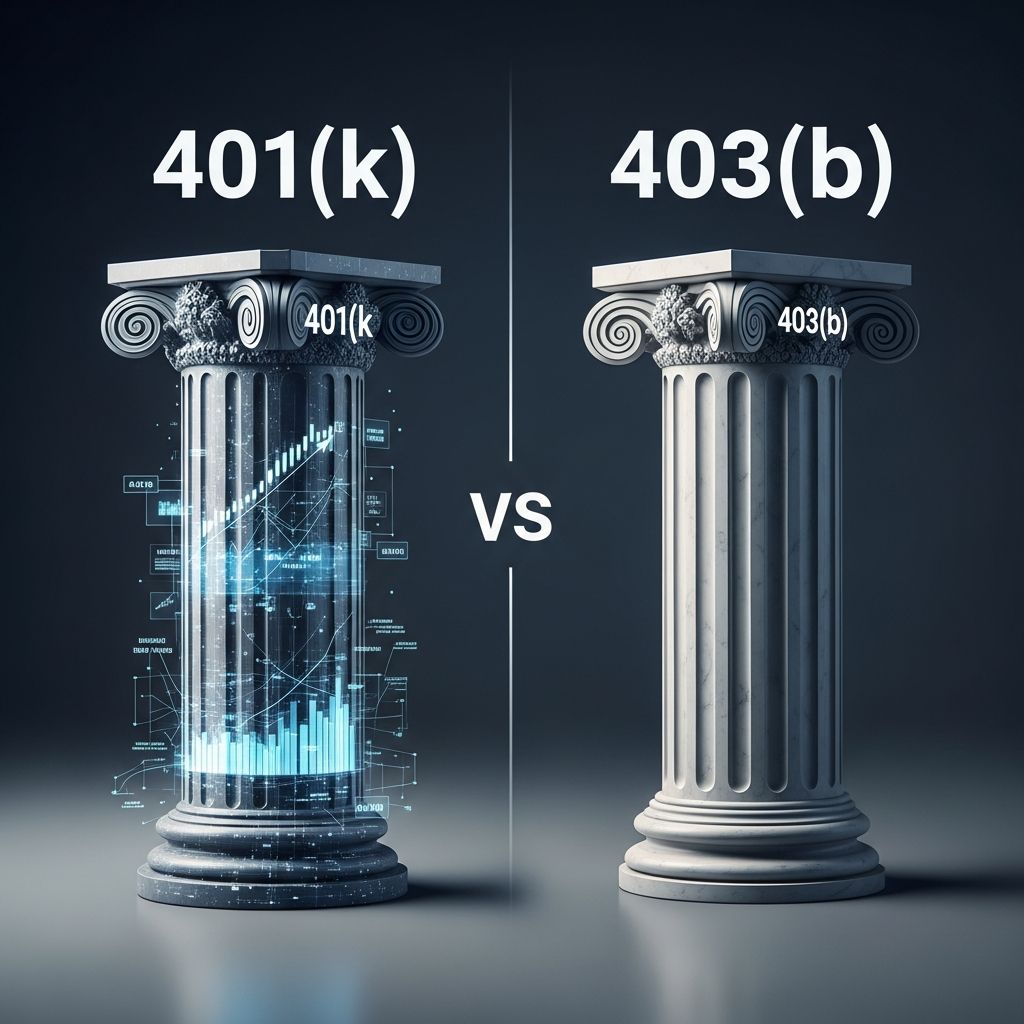
401(k) vs 403(b): Understanding the Differences
When it comes to saving for retirement through your employer, two of the most common workplace retirement plans are 401(k) and 403(b) plans. While both are tax-advantaged retirement savings vehicles designed to help employees build a secure financial future, they serve different populations and come with distinct characteristics. Understanding the differences between these two plans is crucial for maximizing your retirement savings and choosing the option that best suits your financial situation.
The primary distinction between these plans lies in who can access them and the organizations that offer them. A 401(k) plan is typically offered by private, for-profit companies, while a 403(b) plan is designed for employees of nonprofit organizations, public schools, churches, and certain government employers. Despite this fundamental difference in eligibility, both plans share several similarities, including tax-deferral benefits, the ability to make pre-tax or Roth contributions, and employer contribution options.
Who Can Participate: Eligibility Requirements
401(k) Plans are available to employees of private, for-profit companies and businesses of all sizes. If you work in the corporate sector or for a for-profit organization, your employer may offer a 401(k) plan as part of your employee benefits package. These plans are governed by the Employee Retirement Income Security Act (ERISA) and are subject to strict regulatory requirements.
403(b) Plans, formally known as tax-sheltered annuity plans, are specifically designed for employees of tax-exempt organizations. This includes:
- Public school teachers and administrators
- Employees of nonprofit hospitals and healthcare organizations
- Staff members of colleges and universities
- Church employees and religious organization staff
- Employees of certain federal, state, and local government agencies
If you work for any of these types of organizations, you may be eligible to participate in a 403(b) plan rather than a traditional 401(k).
Contribution Limits and Annual Maximums
One area where 401(k) and 403(b) plans align is in their standard contribution limits. For 2025, both plans allow employees under age 50 to contribute up to $23,500 annually through salary deferrals. This means you can reduce your taxable income by contributing this amount to either plan during the calendar year.
For employees aged 50 and older, both plans offer catch-up contributions of an additional $7,500 per year, bringing the total annual contribution to $30,500. Additionally, as of 2025, a new provision allows employees between ages 60 and 63 to make an additional catch-up contribution of $11,250 instead of the standard $7,500, enhancing retirement savings opportunities for those in their early sixties.
It’s important to note that if you participate in both a 401(k) and a 403(b) through different employers, your employee contribution limit applies to your combined deferrals across all plans. You cannot contribute the maximum to each plan separately in the same calendar year.
The Long-Service Employee Advantage in 403(b) Plans
One unique feature of 403(b) plans is the special catch-up provision available to long-service employees. If you have been with your nonprofit or government employer for at least 15 years and have not contributed more than $5,000 per year on average during your years of service, you may be eligible to make an additional catch-up contribution of up to $3,000 per year. This special provision can extend up to a lifetime limit of $15,000 in total additional contributions.
This long-service catch-up provision is exclusive to 403(b) plans and provides a significant advantage for employees who have dedicated many years to the same nonprofit or educational institution. However, it’s essential to verify with your plan administrator whether your specific plan offers this provision, as availability depends on individual plan rules.
Employer Matching: A Critical Difference
One of the most substantial differences between 401(k) and 403(b) plans relates to employer matching contributions. 401(k) Plans typically feature structured employer match programs as a standard component. Many employers offer matches such as 50% of the first 6% of your salary that you contribute, though the specific formula varies by employer. Employer matches in 401(k) plans are common and represent a significant source of retirement savings growth.
403(b) Plans present a different scenario regarding employer matches. While some nonprofit employers do offer matching contributions, many do not. The reason stems from regulatory testing requirements that apply to 403(b) plans. These nondiscrimination tests can be burdensome for nonprofit employers, creating disincentives for them to offer employer matching. When nonprofit employers do offer matches, they may use simplified structures or annuity-based contributions rather than traditional matching formulas.
For employees in 403(b) plans, it’s essential to review your Summary Plan Description (SPD) to understand whether your employer offers a match and, if so, what the specific terms are. Even without an employer match, maximizing your personal contributions to a 403(b) plan remains an excellent way to build retirement savings.
Investment Options and Diversification
401(k) Plans generally offer a broader range of investment options. Most 401(k)s provide access to mutual funds, and many plans include exchange-traded funds (ETFs), stocks, and bonds. Some plans even offer self-directed brokerage options, allowing employees to invest in a wider variety of securities. This diversity enables you to build a well-diversified portfolio tailored to your risk tolerance and investment objectives, potentially maximizing returns while managing market volatility.
403(b) Plans typically feature more limited investment options. Historically, 403(b) plans have been administered by insurance companies and primarily offer annuities and mutual funds. While these investments can provide stability and, in the case of annuities, guaranteed income streams during retirement, they may come with higher fees and expenses compared to other investment vehicles. The limited selection means less flexibility in diversifying your portfolio according to your specific financial goals.
The investment choice difference reflects the historical evolution of these plans—401(k)s have traditionally been managed by investment and fund companies, while 403(b)s emerged from the insurance industry. This distinction remains relevant today and should factor into your decision-making process if you have access to both types of plans.
Traditional vs. Roth Contribution Options
Both 401(k) and 403(b) plans typically offer two contribution approaches: traditional (pre-tax) and Roth (after-tax) options.
Traditional Contributions allow you to contribute pre-tax dollars, reducing your current taxable income. For example, if you earn $60,000 and contribute $6,000 to your 403(b) or 401(k), your taxable income for the year becomes $54,000. Your contributions grow tax-deferred, meaning you don’t pay taxes on investment gains until you withdraw money in retirement. At that point, both your original contributions and earnings are taxed as ordinary income.
Roth Contributions work differently. You contribute after-tax dollars, meaning your contributions do not reduce your current taxable income. However, once the money is in a Roth account, it grows tax-free, and qualified withdrawals in retirement are entirely tax-free. This option becomes advantageous if you expect to be in a higher tax bracket during retirement or if you anticipate significant investment growth.
The choice between traditional and Roth contributions depends on your current tax situation and expectations about your future tax bracket. Many employees benefit from contributing to both types of accounts to achieve tax diversification in retirement.
Administrative Costs and Fees
Another consideration when comparing these plans involves administrative costs and expenses. 401(k) Plans managed by investment companies may carry higher administrative costs due to the complexity of offering diverse investment options and managing numerous participant accounts. However, larger employers typically spread these costs more efficiently across their workforce.
403(b) Plans tend to have lower administrative costs and fees. Since these plans typically offer limited investment options—primarily annuities and mutual funds—and are historically managed by insurance companies, the operational structure is often simpler. However, individual investment options within 403(b) plans, particularly annuities, may carry higher internal expenses and fees than comparable mutual funds in 401(k) plans.
Withdrawal Rules and Early Distribution Penalties
Both 401(k) and 403(b) plans are subject to similar rules regarding withdrawals and early distributions. Generally, you cannot withdraw money from either plan before age 59½ without incurring a 10% early distribution penalty, plus ordinary income taxes on the amount withdrawn. However, both plans allow for certain exceptions to this penalty, such as for hardship distributions or loans against the plan balance.
Both plans require you to begin taking Required Minimum Distributions (RMDs) at age 73, as established by the SECURE 2.0 Act. The calculation methods for RMDs are identical across both plan types and based on your age and account balance.
Portability and Plan Changes
401(k) Plans offer relatively straightforward portability options. When you change employers, you can typically roll over your 401(k) balance into a new employer’s 401(k) plan or into an Individual Retirement Account (IRA), without triggering taxes or penalties, as long as you complete a direct rollover.
403(b) Plans also allow rollovers, but the process can be more complex depending on whether your plan has specific restrictions. Additionally, if you’re switching from a 403(b) to a 401(k) or vice versa, special attention should be paid to ensure the rollover is executed correctly and maintains its tax-advantaged status.
Comparison Table: 401(k) vs 403(b)
| Feature | 401(k) | 403(b) |
|---|---|---|
| Eligible Employers | Private, for-profit companies | Nonprofit organizations, schools, churches, government agencies |
| 2025 Contribution Limit | $23,500 (under 50); $30,500 (age 50+) | $23,500 (under 50); $30,500 (age 50+) |
| Special Catch-Up | Ages 60-63: $11,250 additional | 15+ years service: up to $3,000/year ($15,000 lifetime) |
| Employer Match | Commonly offered | Less common; varies by employer |
| Investment Options | Typically broader (mutual funds, ETFs, stocks, bonds) | Usually limited (annuities, mutual funds) |
| Administrative Costs | May be higher due to complexity | Typically lower |
| Tax Treatment Options | Traditional (pre-tax) and Roth (after-tax) | Traditional (pre-tax) and Roth (after-tax) |
Frequently Asked Questions About 401(k) and 403(b) Plans
Q: Can I contribute to both a 401(k) and a 403(b) in the same year?
A: You can contribute to both plans if you work for employers offering each type, but your total employee deferrals cannot exceed the annual limit ($23,500 in 2025 for those under 50). Any employer contributions are separate and in addition to this limit.
Q: Which plan should I choose if my employer offers both?
A: Prioritize the plan with the better employer match, as matching contributions represent free money for retirement. Additionally, consider which plan offers investment options that align with your financial goals. If the employer match is similar, evaluate the investment choices and fees associated with each plan.
Q: Are 403(b) plans safer than 401(k) plans?
A: Both plans offer similar legal protections under ERISA and IRS regulations. Safety depends more on the specific investments within each plan and your employer’s plan administration rather than the plan type itself.
Q: What happens to my 403(b) if I leave my nonprofit employer?
A: Your 403(b) balance remains yours. You can leave it with the current plan, roll it over to a new employer’s plan (if eligible), or roll it into an IRA. Consult with your plan administrator for specific rollover procedures.
Q: Do I have to pay taxes on 403(b) withdrawals?
A: With traditional 403(b) contributions, yes—you pay ordinary income taxes on the full withdrawal amount. With Roth 403(b) contributions, qualified withdrawals are tax-free. Early withdrawals before age 59½ may incur an additional 10% penalty.
Q: Can I make catch-up contributions to both types of plans?
A: Yes, if you meet the age requirements (50+) for standard catch-ups or the service requirements (15+ years) for the 403(b) special catch-up. However, your total contributions across all plans cannot exceed the annual limits.
Making Your Decision
Choosing between a 401(k) and a 403(b) depends on your employment situation, as eligibility is determined by your employer’s organizational status. However, if you work for an organization offering a 403(b) or if you have access to both plans through multiple employers, consider these factors when making your decision:
- Evaluate the employer match and prioritize the plan offering the most significant matching contributions
- Review investment options and fees in each plan to ensure alignment with your investment strategy
- Consider your timeline—if you have 15+ years with your nonprofit employer, the special 403(b) catch-up provision adds significant value
- Assess your current and expected future tax brackets to determine whether traditional or Roth contributions make more sense
- Consult your Summary Plan Description for specific details about your employer’s plan offerings
Both 401(k) and 403(b) plans represent powerful tools for building retirement security. By understanding their key differences and leveraging the features most advantageous to your situation, you can develop a comprehensive retirement savings strategy tailored to your financial goals.
References
- 403(b) vs 401(k): Understanding the Differences — Western & Southern Financial Group. 2025. https://www.westernsouthern.com/retirement/403b-vs-401k
- 401(k) vs 403(b): What’s the Difference? — Fidelity Investments. 2025. https://www.fidelity.com/learning-center/smart-money/401k-vs-403b
- What Is The Difference Between 401(k) and 403(b) Accounts? — Bankrate. 2025. https://www.bankrate.com/retirement/403b-vs-401k/
- 403(b) vs 401(k): What’s the Difference? — City National Bank. 2025. https://www.cnb.com/personal-banking/insights/403b-vs-401k.html
- 403(b) vs. 401(k) Plans: Benefits & Differences — MissionSquare. 2025. https://www.missionsq.org/products-and-services/403(b)-defined-contribution-plans/403(b)-vs-401(k)-plans.html
- What are the Differences Between 401(k) and 403(b) Plans? — National Council on Aging. 2025. https://www.ncoa.org/article/what-are-the-differences-between-401-k-and-403-b-plans/
- 401(k) vs. 403(b) Plans: Key Differences for Employers — J.P. Morgan. 2025. https://www.jpmorgan.com/insights/retirement/401k-vs-403b-plans-key-differences-for-employers
Similar Articles








Read full bio of medha deb