401(k) Student Loan Match In 2025: Explained And 5 Ways
Discover how employers can match your student loan payments with 401(k) contributions, helping balance debt repayment and retirement savings.
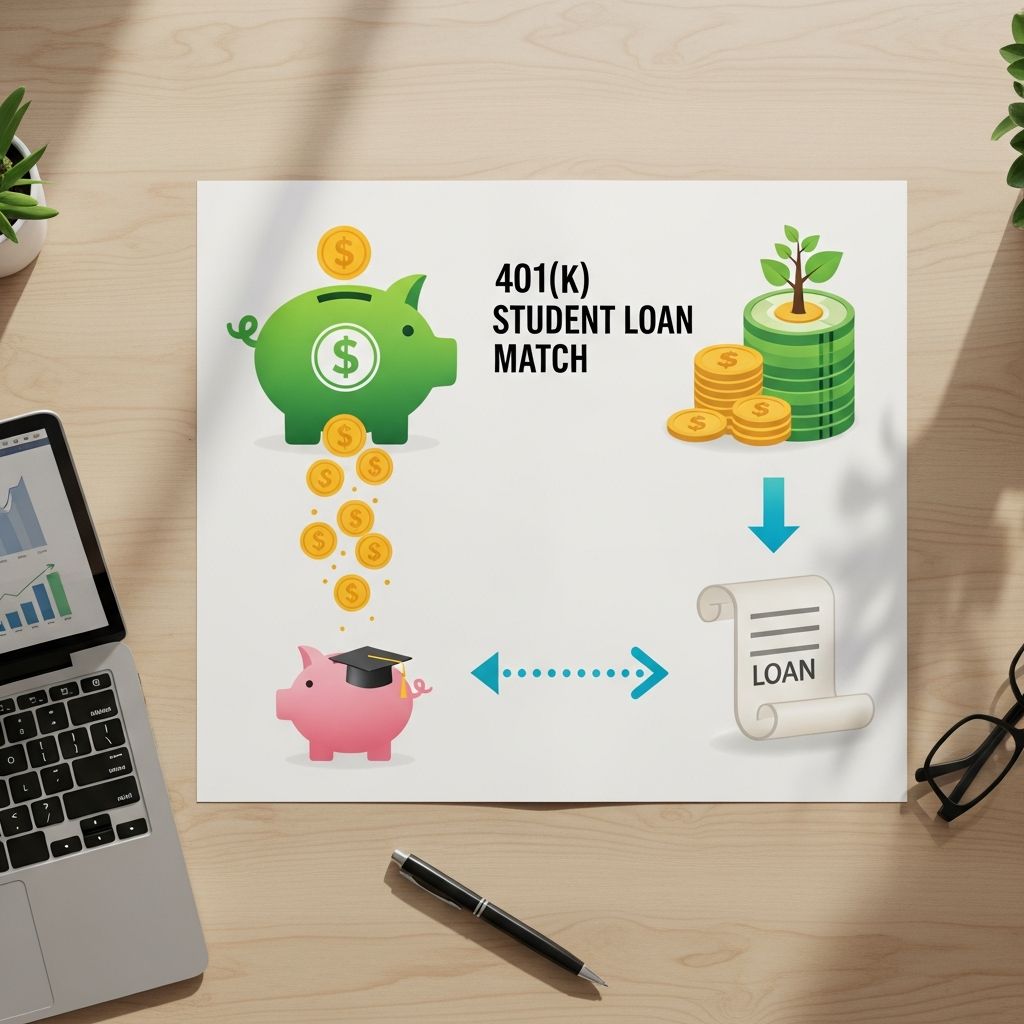
Balancing student debt repayment with retirement savings has long challenged young professionals. The 401(k) student loan match changes this dynamic by letting employers treat qualified student loan payments as if they were direct contributions to your retirement plan, unlocking matching funds.
The Rise of Student Loan Matching in Retirement Plans
Student debt totals over $1.7 trillion in the U.S., forcing many to prioritize loans over retirement accounts and forfeit employer matches—essentially free money. Enter the SECURE 2.0 Act of 2022, which introduced this provision effective for plan years after December 31, 2023. Section 110 specifically targets workers overwhelmed by education loans, enabling matches without requiring personal 401(k) deferrals.
This innovation applies to 401(k), 403(b), governmental 457(b), and SIMPLE IRA plans. It recognizes that monthly loan payments mimic the discipline of savings contributions, justifying employer rewards.
Core Mechanics: How Matching on Loan Payments Functions
At its heart, the program substitutes verified student loan repayments for traditional paycheck deferrals in match calculations. Here’s the step-by-step process:
- Make a Qualified Payment: Pay your eligible student loan, which must be for higher education expenses on loans you, your spouse, or dependent legally owe.
- Submit Proof: Provide your employer or plan administrator with documentation like payment statements, loan details, and confirmation of your obligation—typically annually or per plan deadlines.
- Receive the Match: Employer deposits the match into your retirement account, following the same formula as regular contributions (e.g., 50% up to 6% of salary).
- Observe Limits: Matches count toward annual caps, like $23,500 for 401(k)s in 2025, combining with any direct deferrals.
Matches must vest and allocate identically to standard ones, but frequency can vary—annually minimum, potentially quarterly. Employers verify payments to prevent abuse, ensuring only current-year disbursements qualify.
Eligibility Criteria for Employees and Loans
Not every loan payment triggers a match. Key qualifiers include:
| Category | Details |
|---|---|
| Eligible Plans | 401(k), 403(b), 457(b) governmental, SIMPLE IRA |
| Qualified Loans | Federal or private for post-secondary education; your/spouse/dependent’s, with your legal responsibility |
| Employee Status | Meets standard match eligibility; cosigners qualify only if primary payer |
| Payment Timing | Within the plan year; prior years ineligible |
Cosigners without primary borrower status typically miss out unless payments are theirs. Plans set claim windows, often one or more per year.
Employer Implementation: Setup and Responsibilities
Companies opt in voluntarily to attract talent amid talent shortages. Steps include:
- Amend plan documents with providers like Fidelity or Vanguard.
- Design verification systems for payment proofs.
- Communicate via open enrollment, detailing formulas and deadlines.
- Ensure nondiscrimination testing treats QSLPs (qualified student loan payments) like deferrals.
IRS interim guidance from 2024 clarifies operations, emphasizing uniform rules across match types.
Financial Advantages and Potential Drawbacks
Key Benefits
- Free Retirement Growth: Capture matches (e.g., $2,500 on $5,000 loans at 50% rate) without cutting take-home pay.
- Debt Progress: Repay loans faster while compounding savings via employer funds and market returns.
- Flexibility: Ideal for cash-strapped early-career workers; pairs with CARES Act loan repayment up to $5,250/year (expires 2025).
- Long-Term Wealth: Early matches amplify via decades of growth; missing them costs thousands.
Possible Limitations
- Availability: Employer discretion; not widespread yet.
- Documentation Hassle: Annual proofs required, risking missed matches.
- Caps Apply: Shares limits with personal contributions.
- No Double-Dipping: Can’t match both deferrals and loans beyond plan formulas.
Real-World Examples and Projections
Suppose you earn $60,000 with a 5% match on first 5% salary ($3,000/year potential). Paying $250/month ($3,000/year) on loans yields the full match deposited quarterly. Over 30 years at 7% return, that grows to ~$34,000. (Calculations assume standard assumptions; individual results vary.)
For a $80,000 earner with 100% match up to 4% ($3,200), equivalent loan payments secure identical boosts, easing the save-or-pay dilemma.
Strategies to Maximize Your Benefits
- Ask HR: During benefits season, confirm availability and details.
- Organize Records: Use loan servicer portals for instant proofs.
- Combine Perks: Pair with direct contributions post-debt payoff.
- Monitor Changes: Track IRS updates; 2024 guidance expanded access.
- Plan Ahead: Align payments with match windows.
Common Questions Answered
FAQ
Does this replace my regular 401(k) match?
No, it supplements; same percentage applies but triggered by loans instead.
Are private loans eligible?
Yes, if for qualified education.
What if I switch jobs?
Vesting rules mirror standard matches; prior proofs don’t carry over.
Can spouses benefit?
Yes, if you’re legally obligated on their loans.
Is proof submitted yearly?
Typically yes, per plan rules.
Future Outlook and Policy Context
As adoption grows, expect more firms—especially in tech and finance—to offer this amid competition for Gen Z/Millennial talent burdened by debt. IRS final rules could refine processes by 2026. Meanwhile, it bridges the retirement savings gap, where 40% of borrowers defer 401(k) contributions. Pairing with expiring CARES benefits underscores urgency.
This provision empowers proactive financial management, turning a liability into a dual-purpose strategy.
References
- Understanding the Student Loan Match Feature in 401(k) Plans — 401go.com. 2024. https://401go.com/understanding-the-student-loan-match-feature-in-401k-plans/
- 401(k) Student Loan Match – How It Works — Business Insider. 2024. https://www.businessinsider.com/personal-finance/investing/how-to-secure-2-0-student-loan-match-works
- What Is a 401(k) Student Loan Match? — Experian. 2024. https://www.experian.com/blogs/ask-experian/what-is-401k-student-loan-match/
- Secure Act 2.0 Student Loan Match: How It Works — Lord Abbett. 2024. https://www.lordabbett.com/en-us/financial-advisor/insights/retirement-planning/secure-act-2-0-student-loan-match–how-it-works.html
- Everything You Need to Know About the Student Loan Matching Guidance — PSCA. 2025-01. https://www.psca.org/news/psca-news/2025/1/everything-you-need-to-know-about-the-student-loan-matching-guidance/
Similar Articles








Read full bio of medha deb