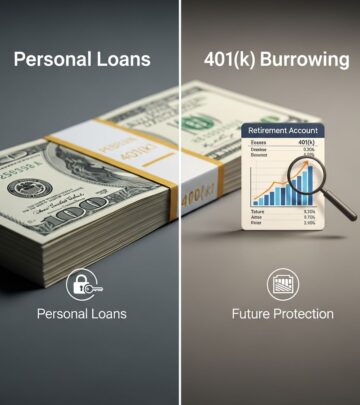
401(k) Loan vs. Personal Loan Guide
Discover which borrowing option suits your needs: tapping retirement savings or securing external funds without risking your future.

When unexpected expenses arise or major purchases loom, borrowing money becomes a practical solution. Two popular choices stand out: loans from your 401(k) retirement account and unsecured personal loans from financial institutions. Each offers distinct advantages and drawbacks, influencing your cash flow, credit profile, and long-term financial health. This guide breaks down the mechanics, costs, and scenarios for each to help you decide wisely.
Understanding 401(k) Loans
A 401(k) loan lets you access funds directly from your employer-sponsored retirement plan. Regulated by IRS rules, these loans allow borrowing up to $50,000 or 50% of your vested balance, whichever is lower. Approval depends on your plan’s policies, not your credit score, making them accessible even with poor credit.
Funds typically become available within weeks, with repayment spread over five years via payroll deductions. The interest rate, often prime plus 1-2%, goes back into your account, theoretically minimizing external costs. However, this borrowing pauses investment growth on the loaned amount and uses after-tax dollars for repayment, which are not tax-deductible.
Understanding Personal Loans
Personal loans come from banks, credit unions, or online lenders as lump-sum unsecured debt. Amounts range from $1,000 to $100,000+, based on creditworthiness, income, and debt-to-income ratio. Terms extend 1-7 years, with rates averaging 12% but varying widely from 8% to 36%.
Approval involves a hard credit inquiry, potentially dinging your score temporarily. Repayment flexibility shines here, with no ties to employment or retirement assets. Funds arrive quickly—often same-day after approval—ideal for urgent needs.
Key Feature Comparison
To evaluate these options side-by-side, consider this table highlighting core differences:
| Feature | 401(k) Loan | Personal Loan |
|---|---|---|
| Max Amount | $50,000 or 50% vested balance | $1,000-$100,000+ |
| Avg. Interest Rate | 9.5%-10.5% | 12%+ (credit-dependent) |
| Credit Check | None | Required (hard inquiry) |
| Repayment Term | Up to 5 years | 1-7 years |
| Tax Risks | Penalties if default/job loss | None |
| Retirement Impact | Misses compounding growth | None |
Data synthesized from multiple lender analyses as of 2024.
Advantages of 401(k) Loans
- No credit involvement: Bypasses credit checks, preserving your score for other needs.
- Competitive rates: Lower than most personal loans, with interest benefiting your account.
- Quick internal process: Often faster setup through employer plans.
- No new debt externally: You’re repaying yourself, avoiding outsider claims.
These perks make 401(k) loans appealing for short-term needs without credit hurdles.
Drawbacks of 401(k) Loans
- Job loss acceleration: Leaving employment triggers full repayment or default, incurring taxes plus 10% penalty if under 59½.
- Opportunity cost: Loaned funds don’t grow via market returns, potentially costing thousands in compound interest over decades.
- Double taxation: Repayments use after-tax money; withdrawals later are taxed again.
- Plan limitations: Not all employers permit loans, and multiple outstanding loans may be restricted.
These risks amplify during economic uncertainty.
Advantages of Personal Loans
- Higher limits: Access larger sums without raiding savings.
- Flexible terms: Customize duration and payments to fit budgets.
- No retirement risk: Preserve compounding in your 401(k) fully.
- Speedy funding: Many lenders disburse within days.
- Builds credit: On-time payments boost your score over time.
Ideal for those prioritizing retirement integrity.
Drawbacks of Personal Loans
- Higher rates: Especially for fair/poor credit, increasing total cost.
Credit impact: Initial inquiry and utilization affect scores. Approval barriers: Requires solid credit/income; denials common otherwise. Financial Scenarios for Each Option
Choose 401(k) loan when:
- Short-term need (under 5 years) with stable job.
- Poor credit blocks other loans.
- Plan allows it and balance suffices.
- Emergency requires no credit pull.
Choose personal loan when:
- Need exceeds $50k or longer repayment.
- Job instability heightens default risk.
- Strong credit secures low rates.
- Preserving retirement growth is priority.
Run projections: A $20k 401(k) loan at 9.5% over 5 years costs ~$5k interest (back to you), but misses ~$10k+ growth at 7% annual return. Personal loan at 12% costs ~$6k interest to lender.
Real-World Cost Examples
For a $30,000 loan:
Loan Type Rate Term Monthly Payment Total Interest 401(k) 9.5% 5 years $634 $8,040 Personal (Good Credit) 11% 5 years $659 $9,540 Personal (Fair Credit) 18% 5 years $750 $15,000 Assumes standard amortization; adjust for your rates.
Steps to Apply for 401(k) Loan
- Confirm plan eligibility with HR/administrator.
- Calculate max borrowable (min $1k typically).
- Submit request form; expect 1-4 weeks processing.
- Repay via payroll; track balance.
Steps to Get a Personal Loan
- Prequalify with soft checks at multiple lenders.
- Gather docs: ID, income proof, bank statements.
- Apply formally; review terms.
- Sign and receive funds promptly.
Shop rates via aggregators but finalize with direct lenders.
Frequently Asked Questions
Can I have both a 401(k) and personal loan?
Yes, but assess total debt load to avoid overextension.
Does a 401(k) loan show on my credit report?
No, unless default leads to taxable distribution reported.
What if I can’t repay a 401(k) loan?
Treated as distribution: income tax + 10% penalty under 59½.
Are personal loans better for debt consolidation?
Often yes, lower rates than cards and single payment simplify management.
How does inflation affect these choices?
Fixed-rate loans benefit from inflation eroding real debt value.
Alternatives to Consider
- Home equity loans: Lower rates if equity available, but home at risk.
- Balance transfer cards: 0% intro for debt payoff.
- 0% installment plans: Retailer financing for purchases.
- Emergency funds: Build 3-6 months expenses first.
Exhaust low/no-cost options before borrowing.
Long-Term Planning Tips
Prioritize retirement contributions post-borrowing. Use loans sparingly; high debt-to-income hampers future borrowing. Monitor credit via free annual reports from AnnualCreditReport.com (government site). Consult advisors for personalized math, especially near retirement.
Ultimately, personal loans edge out for flexibility sans retirement risk, per most analyses—unless credit barriers or plan perks dominate.
References
- 401(k) Loan vs. Personal Loan — Experian. 2024. https://www.experian.com/blogs/ask-experian/401k-loan-vs-personal-loan/
- 401(k) Loan vs Personal Loan: Which Option is Better? — BHG Financial. 2024. https://bhgfinancial.com/personal-loans/401k-loan-vs-personal-loan
- Taking a 401k loan or withdrawal — Fidelity. 2024. https://www.fidelity.com/viewpoints/financial-basics/taking-money-from-401k
- 401(k) Loans vs. Personal Loans: What’s The Difference — Discover. 2024. https://www.discover.com/personal-loans/resources/learn-about-personal-loans/personal-loan-vs-401k-loan/
- Borrowing From Your 401(k) vs Getting a Personal Loan — SoFi. 2024-08. https://www.sofi.com/learn/content/401k-loan-vs-personal-loan/








Read full bio of medha deb