401(k) Choices: 4 Smart Options After Leaving Your Job
Discover smart strategies for managing your 401(k) when changing jobs to protect and grow your retirement savings effectively.

When you switch jobs, your employer-sponsored 401(k) doesn’t vanish—it’s yours to manage strategically. Making informed decisions ensures your retirement nest egg continues growing without unnecessary taxes or losses. This guide outlines practical paths forward, from preserving balances to optimizing future growth.
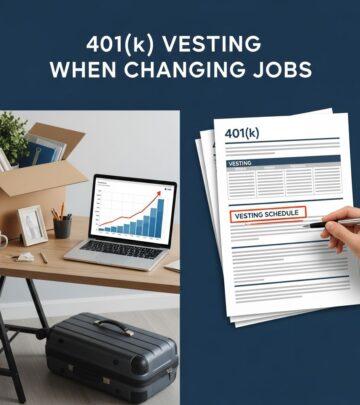
Understanding Vesting and Your Account Balance
Your
vested balance
determines control over funds. Employee contributions vest immediately at 100%, but employer matches follow schedules—often cliff (e.g., 100% after 3 years) or graded (e.g., 20% per year).- Less than $1,000: Employer may cash out automatically, sending a check minus 20% withholding.
- $1,000–$7,000: Possible automatic IRA rollover by employer.
- Over $7,000: Full control over four main options.
Check your plan documents or statement for exact vesting and thresholds, as they vary.
Main Options for Your 401(k)
You typically face four paths: retain with former employer, rollover to IRA, transfer to new employer’s plan, or withdraw. Each suits different needs based on fees, investments, and access.
Option 1: Retain Funds with Former Employer
If balance exceeds $7,000 and plan permits, leave money invested. Growth remains tax-deferred, and you retain management access.
| Pros | Cons |
|---|---|
| Low-cost institutional funds | Can’t add contributions |
| No immediate taxes | Limited new features post-employment |
| Familiar investments | Multiple accounts to track |
Ideal if satisfied with performance and fees; monitor annually for alignment with goals.
Option 2: Rollover to an Individual Retirement Account (IRA)
Transfer to a traditional or Roth IRA for broader choices. Direct trustee-to-trustee avoids taxes; indirect gives 60 days to complete.
IRAs offer thousands of funds, ETFs, and stocks beyond 401(k) limits. Roth conversion possible if paying taxes now for tax-free growth later.
- More flexibility for homebuying or education via exceptions.
- Potential for lower fees with self-directed brokers.
Average 401(k) fees: 0.5–1%; IRAs often under 0.1%.
Option 3: Transfer to New Employer’s 401(k)
If new plan accepts rollovers, consolidate for simplicity. Verify acceptance first—many do via direct rollover.
| Advantages | Drawbacks |
|---|---|
| Single account oversight | New plan fees/investments may not improve |
| Tax-deferred continuity | Possible vesting restart |
| Employer matches resume | Less investment variety |
Best for streamlined management if new plan excels.
Option 4: Cash Out (Not Recommended)
Withdraw as lump sum triggers income taxes plus 10% penalty if under 59½. For example, $50,000 withdrawal at 24% tax bracket yields ~$35,000 after penalties.
Only consider dire needs; long-term opportunity cost is massive—$50,000 at 7% annual return grows to $380,000 in 30 years.
Tax Rules and Rollover Mechanics
Opt for
direct rollovers
to skip withholding and penalties. 60-day indirect rule applies if receiving check.- Loans: Repay within 60–90 days or face taxes/penalties.
- Withholding: 20% mandatory on indirect distributions unless rolled over timely.
- Roth 401(k): Rolls to Roth IRA seamlessly.
IRS Form 1099-R reports distributions; rollovers aren’t taxable if done correctly.
Factors to Evaluate Before Deciding
Align choice with life stage and goals:
- Fees: Compare expense ratios—high fees erode 20–30% of returns over decades.
- Investments: Seek low-cost index funds, target-date funds.
- Access: IRAs offer more withdrawal flexibility.
- Creditor Protection: 401(k)s stronger than IRAs in bankruptcy.
- Future Plans: Consolidate if expecting more job changes.
Use online calculators to project growth scenarios.
Step-by-Step Rollover Guide
- Contact old plan administrator for forms.
- Open receiving account (IRA or new 401(k)).
- Request direct rollover, providing new account details.
- Confirm receipt (3–10 business days).
- Review investments and rebalance.
Avoid mixing funds until verified to prevent errors.
Special Scenarios
Multiple Old 401(k)s
Consolidate into one IRA for oversight. Fidelity notes many hold 5+ accounts averaging $112,000 total.
Under Age 59½ Needing Funds
IRAs allow substantially equal periodic payments (SEPP) penalty-free. 401(k)s may offer in-service withdrawals if still employed—but post-job, limited.
Company Stock Holdings
Net Unrealized Appreciation (NUA) strategy taxes stock at lower capital gains vs. ordinary income.
Common Mistakes to Avoid
- Missing 60-day window on indirect rollovers.
- Ignoring fees in new accounts.
- Cashing out prematurely—40% of leavers under 40 do so, per studies.
- Forgetting loans become due.
- Not updating beneficiaries.
Seeking Professional Guidance
Complex situations (e.g., large balances, stock options) warrant fiduciary advisors. Free consultations via rollover providers like Vanguard/Fidelity.
Frequently Asked Questions
Do I lose my 401(k) if I quit?
No—your contributions stay vested; employer matches depend on schedule. Check vested balance before leaving.
How long to rollover after job change?
No strict deadline unless receiving distribution (60 days). Act promptly to maintain momentum.
Can I roll 401(k) to Roth IRA?
Yes, but pay taxes on pre-tax amount upfront for future tax-free growth.
What if balance under $7,000?
Automatic cashout or IRA possible; monitor mail for checks.
Is IRA better than 401(k)?
Often yes for choices/fees, but 401(k)s offer better protection and matches.
Planning for Long-Term Success
Job changes average every 4 years—view as consolidation opportunity. Aim for diversified, low-fee portfolios targeting 4–7% annual returns. Regularly reassess as rules evolve (e.g., SECURE 2.0 expanded rollovers).
Proactive management turns transitions into growth accelerators.
References
- What happens to your 401(k) when you leave a job? — Fidelity Investments. 2025. https://www.fidelity.com/learning-center/smart-money/what-happens-to-your-401k-when-you-leave-a-job
- What Happens to Your 401(k) When You Quit a Job? — Vanguard. 2025. https://investor.vanguard.com/investor-resources-education/article/what-happens-401k-when-you-quit
- What to Do with a 401(k) When You Leave Your Employer — Mat Sorensen. 2024-10-15. https://matsorensen.com/what-to-do-with-a-401k-when-you-leave-your-employer/
- Understanding Your Retirement Plan Options When You Leave a Job — Morgan Stanley. 2025. https://www.morganstanley.com/articles/what-to-do-with-401k-after-leaving-job
- Rollover IRA: What to do with an old 401(k) — Fidelity Investments. 2025. https://www.fidelity.com/retirement-ira/401k-rollover-options
Similar Articles








Read full bio of medha deb