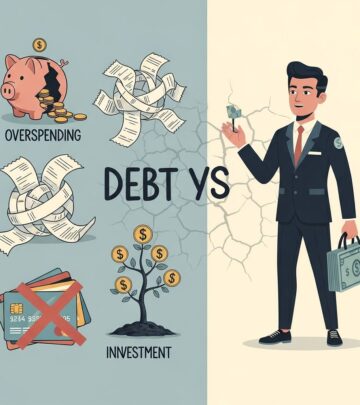
4 Reasons Why You Don’t Have Financial Common Sense
Discover the four key reasons you're missing financial common sense and practical steps to develop it for lasting money management success.

If you’re struggling with money, constantly in debt, or living paycheck to paycheck, it might not be a lack of knowledge but a missing piece of financial common sense. This foundational skill involves basic principles like spending less than you earn, avoiding unnecessary debt, and prioritizing savings. Yet, many people overlook these truths due to ingrained beliefs and behaviors. Drawing from personal finance insights, this article breaks down the four primary reasons why financial common sense eludes you and provides straightforward strategies to cultivate it.
1. We Believe That Things Will Make Us Happy
The pursuit of happiness through material possessions is one of the biggest barriers to financial common sense. Society bombards us with advertising that equates new gadgets, clothes, or luxury items with joy and fulfillment. This mindset leads to impulse buying and overspending, even when bank accounts scream otherwise. In reality, the thrill from purchases is fleeting, and studies show that experiences, not things, provide longer-lasting satisfaction.
Consider how retail therapy works: a cheap item can give the same dopamine hit as an expensive one, but habitual shoppers chase the high regardless of cost. This belief overrides basic logic like “if you can’t afford it, don’t buy it.” The result? Chronic debt cycles where credit cards fill the gap between wants and income.
- Identify triggers: Track purchases to see if they’re need-based or emotion-driven.
- Wait rule: Implement a 48-hour delay before non-essential buys to let impulses fade.
- Focus on experiences: Redirect spending toward free or low-cost activities like walks or hobbies.
Building financial common sense here means rewiring your brain to find joy in financial security rather than stuff. Over time, watching your savings grow provides a deeper, more sustainable happiness.
2. Old Habits Are Hard to Break
Habits formed in early adulthood—such as no budgeting, late bill payments, or excessive credit use—become deeply entrenched. You might intellectually know these are mistakes, but executing change feels impossible. Procrastination on bills leads to fees, damaged credit, and stress, yet the pattern persists because it’s familiar.
Financial common sense dictates simple actions: budget to track spending, pay bills on time, and live within means. But without addressing root causes like poor organization or lack of knowledge, old habits win. For instance, ignoring mail or forgetting due dates perpetuates the cycle.
| Bad Habit | Consequence | Fix |
|---|---|---|
| Late bill payments | Fees, credit damage | Set alerts, auto-pay |
| No budget | Overspending | Use apps or spreadsheets |
| Impulse credit use | Debt accumulation | Pre-approve purchases |
To break these, first diagnose why they exist. Procrastinators should open mail immediately and use visible reminders. Those lacking budgeting skills can seek free resources or apps. Consistency turns knowledge into action, fostering habits aligned with financial common sense.
3. We Learned Bad Money Habits from Our Parents
Much of our financial worldview is inherited. If parents didn’t save, maxed out credit cards, or paid bills late, you’re likely mirroring those behaviors. A T. Rowe Price survey found 97% of kids learn money habits from parents, embedding poor practices before independence.
This isn’t blame—it’s biology. Early observation shapes norms, making parental “normal” your default. If debt was a household staple, financial common sense like emergency funds or investing seems foreign. Erasing 18 years of modeling requires deliberate unlearning.
- Audit influences: List parental money traits and counter the negatives.
- Seek mentors: Learn from financially savvy friends or online communities.
- Educate yourself: Read books on basics like emergency funds, sized to 3-6 months of minimum expenses.
Financial common sense emerges by treating money anew: budget ruthlessly, save first, debt last. Parents’ ways worked for their era, but yours demands adaptation for stability.
4. We Worry About Fitting In and Keeping Up with the Joneses
Peer pressure fuels overspending to match others’ lifestyles. Social media amplifies this, showcasing vacations and gadgets, pressuring you to “keep up” despite your reality. Your brain prioritizes status over solvency, ignoring that true wealth is net worth, not appearances.
This meta-reason ties into others: things for status, habits reinforced socially, parental modeling of conspicuous consumption. Correction often needs crisis—like debt overload—to jolt sense back.
Counter it by:
- Curate feeds: Unfollow ostentatious influencers.
- Define success: Yours, not neighbors’—focus on debt freedom.
- Build buffers: A $1,000 starter emergency fund prevents credit reliance during debt payoff.
Financial common sense thrives in independence from comparison. Prioritize long-term security over short-term validation.
Building Your Emergency Fund: A Key to Common Sense
Central to financial resilience is an emergency fund, often sized to 3-6 months of minimum expenses—not income. Calculate by listing essentials: housing, food, utilities, transport, excluding luxuries or debt payments (post-payoff).
Examples:
- Family budget: $1,950 essentials + $900 debt = adjust post-debt to $11,700 for 6 months.
- Debt-heavy? Start with $1,000 to avoid new borrowing for repairs.
Once debt-free, aim for 6+ months in high-yield savings. Excess? Invest in index funds for better returns, balancing liquidity and growth.
Frequently Asked Questions (FAQs)
Q: How do I start building financial common sense?
A: Begin with basics—track spending, create a budget, and save $1,000 for emergencies while paying debt aggressively.
Q: What’s the right size for an emergency fund?
A: 3-6 months of minimum expenses (essentials only), adjustable for stability like reliable side income.
Q: Can I invest before maxing my emergency fund?
A: Debt-free? Yes, beyond 6 months—use low-cost index funds for superior long-term returns.
Q: How do I break parental bad money habits?
A: Audit influences, educate via books/apps, and build new routines like auto-savings.
Q: Why do I overspend to fit in?
A: Social pressure overrides logic; combat with personal goals and feed curation.
References
- Figuring the Size of Your Emergency Fund — Wise Bread. 2009-06-15. https://www.wisebread.com/figuring-the-size-of-your-emergency-fund
- 4 Reasons Why You Don’t Have Financial Common Sense (and How to Get It) — Wise Bread. N/A. https://www.wisebread.com/4-reasons-why-you-dont-have-financial-common-sense-and-how-to-get-it
- Book Review: The Little Book of Common Sense Investing — Wise Bread. N/A. https://www.wisebread.com/book-review-the-little-book-of-common-sense-investing
- Consumer Financial Protection Bureau: Emergency Funds — U.S. Government (CFPB.gov). 2024-03-12. https://www.consumerfinance.gov/consumer-tools/emergency-savings/
- Financial Habits Survey — T. Rowe Price (Official Report). 2023-05-10. https://www.troweprice.com/personal-investing/resources/insights/parents-kids-and-money-survey.html
- Index Funds and Asset Allocation — Federal Reserve Economic Data (FRED). 2025-01-05. https://fred.stlouisfed.org/series/INDEXFUNDS
Similar Articles








Read full bio of medha deb