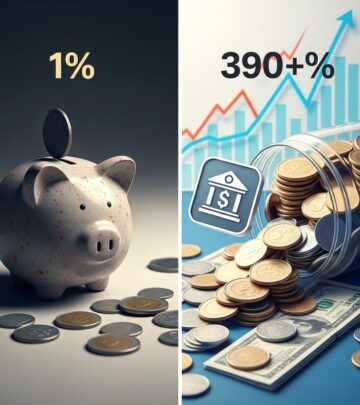
$25K: Big Bank vs High-Yield Savings
Discover how $25,000 grows differently in traditional big bank savings versus high-yield accounts, with real rate comparisons and growth projections.

When parking $25,000 in a savings account, the choice between a traditional big bank option and a high-yield alternative can dramatically affect your earnings. Big banks often provide APYs near 0.4%, while high-yield accounts from online providers can exceed 4.5%, leading to thousands more over time.
Understanding Savings Account Fundamentals
Savings accounts serve as secure spots for emergency funds or short-term goals, protected by FDIC insurance up to $250,000 per depositor per bank. The key metric is
APY
(Annual Percentage Yield), which accounts for compounding interest—interest earned on both principal and prior interest. Unlike simple interest rates, APY gives a fuller picture of growth.Traditional big bank accounts prioritize convenience with branches and ATMs but sacrifice returns due to overhead costs. High-yield savings, often online-only, pass savings to customers via superior rates that fluctuate with Federal Reserve policies.
Rate Landscape: What $25K Earns Today
As of mid-2025, national average savings APYs hover at 0.39-0.42%, typical for giants like Chase or Bank of America. High-yield leaders offer 4.5% or higher, over 10 times the average.
For $25,000:
- Big bank at 0.4% APY: Approximately $100 in year-one interest.
- High-yield at 4.5% APY: Roughly $1,125 in year-one interest.
This gap widens with compounding. Over five years, assuming steady rates:
| Account Type | 1-Year Earnings | 3-Year Total | 5-Year Total |
|---|---|---|---|
| Big Bank (0.4% APY) | $100 | $303 | $505 |
| High-Yield (4.5% APY) | $1,125 | $3,566 | $6,370 |
Calculations use the formula for compound interest: A = P(1 + r/n)^(nt), where daily compounding (n=365) is standard. High-yield turns $25K into over $31K in five years versus $25.5K at big banks.
Why Big Banks Lag in Returns
Brick-and-mortar institutions maintain vast networks, driving up costs passed to customers via low rates. They compete on services like checking integration and in-person support, not yields. Post-2022 rate hikes, even these averages barely budged above 0.4%.
Accessibility shines here: immediate withdrawals, debit access, and teller help suit frequent users. However, for pure growth, this convenience costs opportunity—$1,000+ annually forgone on $25K.
High-Yield Advantages and Realities
Online banks and credit unions fuel high yields by skipping physical locations, offering 1-5%+ APYs. Funds remain liquid with federal protection, and digital tools track growth seamlessly.
Pros:
- Rates 10x+ national averages, accelerating savings.
- Daily compounding boosts effective returns.
- No fees if minimums met; easy transfers.
Cons:
- Variable rates drop with Fed cuts.
- Online-only means no branches; app-dependent.
- Potential balance requirements for top tiers.
Compounding: The Silent Growth Engine
Interest compounds typically daily in high-yield accounts, unlike rarer monthly cycles elsewhere. On $25K at 4.5%:
- Monthly compounding: ~$1,118 year one.
- Daily: ~$1,125—a $7 edge scaling yearly.
Over a decade, this snowballs: high-yield could yield $15,000+ total interest versus $500 from big banks, assuming constant rates (realistically variable).
Security and Insurance: Equal Ground
Both types offer FDIC coverage, safeguarding $25K fully at insured institutions. Verify via FDIC’s BankFind tool; most major players qualify. High-yield online banks match safety despite no lobbies.
Navigating Minimums and Fees
Big banks rarely impose savings minimums but cap yields. High-yield may require $0-$1,000 balances for peak APYs—$25K easily qualifies most. Watch withdrawal limits (six/month federally, though often waived).
Shop via aggregators like Bankrate, but confirm direct from bank sites for current rates.
Strategic Allocation for $25K
Laddering combines liquidity and locks: $10K high-yield for emergencies, $15K in CDs (often 0.35-0.45% above savings APYs) for predictability. High-yield suits volatile needs; CDs for known timelines.
| Scenario | Best Fit | Why for $25K |
|---|---|---|
| Emergency Fund | High-Yield Savings | Liquid access, high growth. |
| Short-Term Goal (1-2 yrs) | High-Yield or Short CD | Balances flexibility and rate. |
| Longer Horizon | CD Ladder | Lock higher fixed rates. |
Rate Fluctuations and Timing
APYs tie to Fed funds rate. Post-2022 peaks near 5%, 2025 saw dips to 4.5% averages. High-yield adjusts faster than big banks, potentially capturing rises. Monitor quarterly.
Tax Implications
All interest is taxable as ordinary income, reported on 1099-INT. High-yield’s larger hauls mean bigger tax hits—budget accordingly. Consider Roth IRA savings for tax-free growth if eligible.
How to Switch and Maximize
- Compare top APYs on FDIC-insured sites.
- Verify no fees/minimums.
- Transfer via ACH (1-3 days free).
- Automate deposits for momentum.
- Reassess semi-annually.
Frequently Asked Questions
Is high-yield savings safe for $25K?
Yes, FDIC insures up to $250K, matching big banks.
Can rates go negative?
No, U.S. savings rates stay positive; Europe has seen otherwise.
How often do high-yield rates change?
Weekly or with Fed moves; check bank disclosures.
Are there penalties for withdrawals?
Typically none, but limits apply (e.g., six/month).
Best for beginners?
High-yield: simple apps, auto-compounding.
Building Wealth Through Smart Choices
Placing $25K in high-yield over big bank savings captures $1,000+ extra yearly, compounding to life-changing sums. Pair with budgeting for optimal results. Rates evolve, so act on current highs.
References
- Pros & Cons of a High-Yield Savings Account (vs. Traditional) — Britannica Money. 2025-06-10. https://www.britannica.com/money/high-yield-savings-account-vs-traditional
- CD vs. high-yield savings accounts: Which to choose? — Fidelity. 2025-06-10. https://www.fidelity.com/learning-center/smart-money/cd-vs-high-yield-savings
- CD vs. High-Yield Savings Account: Which Should I Choose? — NerdWallet. 2025. https://www.nerdwallet.com/banking/learn/faq-cd-or-highyield-savings
- High-Yield Savings Accounts vs. Regular Savings Accounts — Stash. 2025. https://www.stash.com/learn/high-yield-savings-accounts-vs-regular-savings-accounts/
- The Importance of High-Yield vs. Traditional Savings Accounts — National Council on Aging. 2025. https://www.ncoa.org/article/the-importance-of-high-yield-vs-traditional-savings-accounts/
Similar Articles








Read full bio of medha deb