2/1 Buydown Mortgage: Lower Rates for First Two Years
Understanding 2/1 buydowns: A temporary mortgage rate reduction strategy for homebuyers seeking initial payment relief.
What Is a 2/1 Buydown Mortgage?
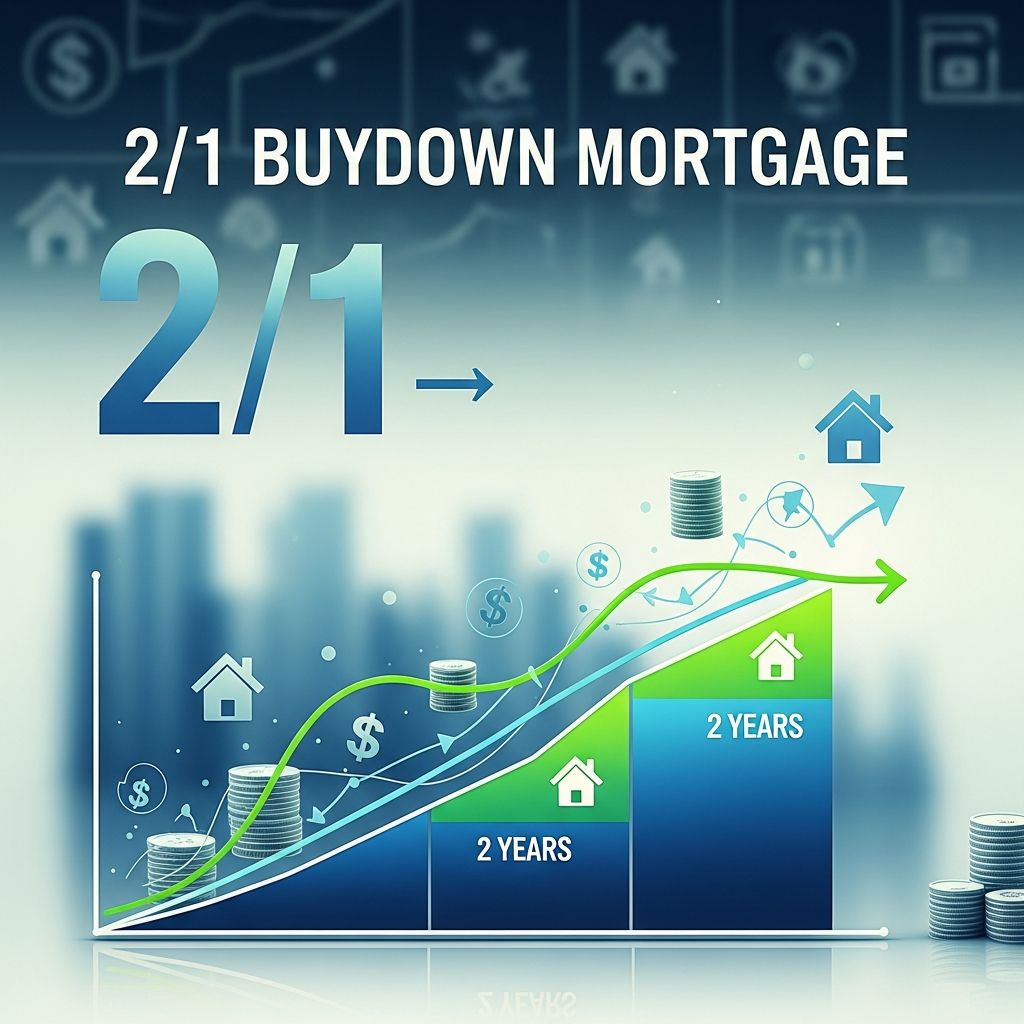
A 2/1 buydown mortgage is a financing strategy that temporarily reduces the interest rate on your home loan during the first two years of the mortgage. Specifically, borrowers receive a 2% interest rate reduction in the first year, followed by a 1% reduction in the second year, after which the loan reverts to its full note rate for the remainder of the term. This temporary rate reduction is designed to provide relief during the early years of homeownership when cash flow can be particularly tight.
The 2/1 buydown has gained significant popularity in recent years, particularly in high-interest-rate environments. This mortgage strategy offers a creative solution for buyers facing affordability challenges while maintaining the flexibility to refinance if market conditions improve.
How Does a 2/1 Buydown Work?
The Rate Structure
The mechanics of a 2/1 buydown are straightforward and predictable. During year one, your interest rate is reduced by 2 percentage points from your agreed-upon note rate. For example, if your loan’s full note rate is 7%, you would pay 5% during the first year. In year two, the rate increases by 1 percentage point, bringing it to 6%. Beginning in year three and continuing for the life of the loan, you pay the full note rate of 7%.
The Buydown Subsidy Account
The key mechanism that makes a 2/1 buydown function is the buydown subsidy account. Rather than the lender simply accepting a lower interest rate, a separate account is established that contains funds designated to subsidize the difference between your reduced payment and the full-rate payment. Each month, funds are drawn from this account to compensate the lender for the interest they are not receiving due to the reduced rate.
This structure is crucial because it allows lenders to maintain their expected yield on the loan while borrowers benefit from temporary payment relief. The subsidy account gradually depletes over the two-year period as monthly subsidies are withdrawn.
Who Pays for the 2/1 Buydown?
One of the most important aspects of understanding 2/1 buydowns is determining who bears the cost. Unlike traditional rate buydowns where the borrower pays points upfront, the 2/1 buydown is typically funded through one of these sources:
- The Seller: In the majority of cases, the home seller pays for the buydown as part of the purchase negotiation. This represents a seller concession and is a popular way for sellers to facilitate the sale in competitive markets or when buyers are struggling with affordability.
- The Lender: Some lenders may offer buydowns as part of their promotional offerings or to remain competitive in the market. In these cases, the lender builds the cost into their pricing structure.
- A Combination: Occasionally, both the seller and lender may contribute to the buydown subsidy account.
- The Buyer: While less common, buyers can technically pay for their own buydown, though this is rarely the optimal financial strategy.
The fact that the seller typically pays for the buydown makes it particularly attractive to buyers. From a negotiation standpoint, buyers can request that sellers fund the buydown as part of the purchase agreement, effectively reducing the buyer’s out-of-pocket costs while still making the deal attractive to the seller.
Key Advantages of a 2/1 Buydown
Immediate Payment Relief
The primary advantage of a 2/1 buydown is the substantial reduction in monthly mortgage payments during the critical first two years of homeownership. For a buyer making a monthly payment of $900 on a full-rate loan, the 2% reduction in year one could save approximately $150-200 per month, depending on the loan amount. This cash flow relief can be invaluable for new homeowners who are adjusting to property taxes, maintenance costs, insurance, and other housing-related expenses.
Qualification Benefits
Another significant advantage relates to mortgage qualification. Lenders typically calculate debt-to-income ratios based on the current interest rate environment. With a 2/1 buydown, borrowers may qualify for larger loans or more favorable terms because their initial payment obligations are lower. This can enable buyers to afford homes they might not qualify for under standard financing.
Protection Against Rate Increases
While not a guarantee, many industry analysts project that interest rates will decline over the coming years. A 2/1 buydown positions borrowers to benefit from rate decreases through refinancing while protecting them against further rate increases during the first two years.
Flexibility and Refinancing Opportunity
If interest rates decline significantly during the first two years, borrowers have the flexibility to refinance into a lower rate without penalty. This allows them to lock in gains from the rate environment improving while avoiding the scenario where they would be stuck with a higher rate in year three.
Refundable Nature
A compelling but often overlooked advantage is that 2/1 buydowns are partially refundable. If the loan is paid off before the subsidy account is fully depleted (through sale, refinancing, or early payoff), any remaining funds in the subsidy account may be returned to the party who funded it, typically the seller.
Disadvantages and Considerations
Payment Shock
The most significant drawback of a 2/1 buydown is the payment increase that occurs in years two and three. After enjoying the reduced payments in year one, borrowers experience a 1% rate increase in year two, followed by another increase to the full rate in year three. This creates a situation known as “payment shock,” where monthly payments can increase by $200-400 or more. Borrowers must be prepared financially for these increases.
Does Not Solve Affordability Issues Long-Term
While a 2/1 buydown provides temporary relief, it is important to recognize that it does not fundamentally address whether a borrower can truly afford a home. If a borrower cannot afford the full note rate payment after year two, the buydown merely delays the affordability problem rather than solving it.
Rates May Not Decline
The strategy assumes that interest rates will decline, making refinancing attractive. However, if rates increase or remain stable, refinancing may not be possible or advisable. Borrowers relying on the expectation of rate declines could find themselves locked into a higher rate in year three with no refinancing option.
Limited Availability
While 2/1 buydowns have become more common, they are not available through all lenders or for all loan types. Availability may also depend on market conditions and the lender’s appetite for seller concessions.
Qualification Complications
Some borrowers misunderstand how their mortgage qualifies them. Lenders typically base qualification on the full note rate, not the reduced initial rate, to ensure borrowers can handle the full payment when the rate adjusts. This means the affordability advantage at qualification time may be limited.
2/1 Buydown vs. Other Mortgage Options
| Feature | 2/1 Buydown | Traditional Fixed-Rate Mortgage | ARM (Adjustable-Rate Mortgage) |
|---|---|---|---|
| Year 1 Payment | Lowest | Consistent | Variable/Often Low |
| Year 2 Payment | Middle | Consistent | Variable |
| Year 3+ Payment | Full Rate | Consistent | Adjusts Periodically |
| Predictability | Moderate | High | Low |
| Initial Cost to Buyer | Often Zero | Points (Optional) | Usually None |
| Best For | Short-term owners, Refi candidates | Long-term stability | Risk-tolerant buyers |
Is a 2/1 Buydown Right for You?
Determining whether a 2/1 buydown makes sense depends on your individual circumstances. Consider these factors:
- Your Timeline: If you plan to remain in the home for only five to seven years, a 2/1 buydown combined with anticipated refinancing could provide significant benefits.
- Income Trajectory: If you expect your income to increase substantially, the payment shock in year three may be manageable.
- Rate Outlook: Your confidence in interest rate declines should influence your decision. If you believe rates will decline, a buydown positions you well for refinancing.
- Financial Cushion: Ensure you have reserves to handle the payment increase in year two and especially year three.
- Seller Negotiations: If the seller is willing to fund the buydown, the decision becomes easier since you have little downside.
Frequently Asked Questions
Q: How much can a 2/1 buydown save me in the first year?
A: Savings depend on your loan amount. On a $300,000 loan at 7%, a 2% rate reduction saves approximately $400-500 per month in year one.
Q: Can I refinance out of a 2/1 buydown?
A: Yes, refinancing is one of the primary benefits. You can refinance into a lower rate if market conditions improve, potentially keeping your payment lower long-term.
Q: What happens to the subsidy account if I refinance?
A: If you refinance before the subsidy account is depleted, any remaining funds may be returned to the party who funded it, typically the seller.
Q: Does a 2/1 buydown affect my credit score?
A: No, a 2/1 buydown does not impact your credit score. It is simply a different rate structure and does not change your creditworthiness or payment history.
Q: Can I negotiate a 2/1 buydown in any market?
A: Availability depends on market conditions and lender policies. In buyer’s markets, sellers are more likely to agree to fund buydowns. In seller’s markets, they may be less willing.
Q: What if rates go up after year three?
A: Your rate is fixed at the full note rate for the life of the loan, so subsequent rate increases in the market do not affect your mortgage rate. However, refinancing would not be advantageous.
References
- How Mortgage Rates Are Determined — Federal Reserve Board. Updated 2024. https://www.federalreserve.gov
- Understanding Mortgage Options and Costs — Consumer Financial Protection Bureau. Updated 2025. https://www.consumerfinance.gov
- Mortgage Buydowns Explained — National Association of Realtors. 2024. https://www.nar.realtor
- Interest Rate Projections and Economic Outlook — Federal Open Market Committee (FOMC). 2025. https://www.federalreserve.gov/monetarypolicy/fomcmin.htm
- Debt-to-Income Ratios and Loan Qualification Standards — Office of the Comptroller of the Currency. Updated 2024. https://www.occ.treas.gov
Similar Articles








Read full bio of medha deb