12b-1 Fees: Understanding Mutual Fund Distribution Costs
Learn how 12b-1 fees impact mutual fund investments and what they mean for your portfolio returns.
What Are 12b-1 Fees?
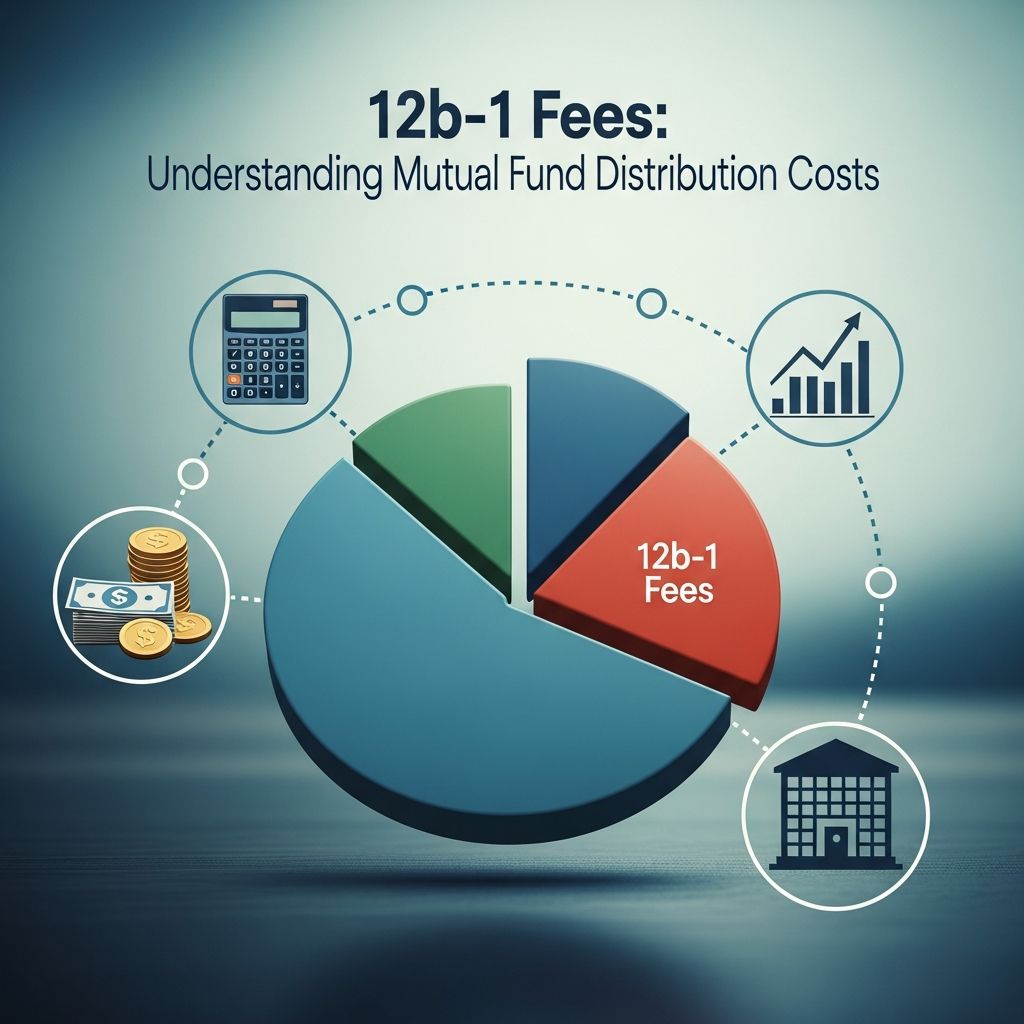
12b-1 fees are charges paid by mutual funds from their assets to cover distribution and marketing expenses, as well as shareholder service costs. These fees derive their name from Rule 12b-1 of the Investment Company Act of 1940, which authorizes mutual funds to assess these charges directly against fund assets rather than billing investors separately. This mechanism effectively transforms sales and marketing expenses into operating costs that are shared among all fund investors, including existing shareholders who have already purchased the fund.
The fundamental structure of 12b-1 fees combines two distinct components. The distribution and marketing fee can reach up to 0.75% per year, while the service fee is capped at 0.25% annually, resulting in a combined maximum of 1.0% per year. However, most funds do not charge the maximum allowable amount, and the actual fees vary considerably depending on the fund’s share class and distribution strategy.
Understanding the Origin and Purpose of 12b-1 Fees
When Rule 12b-1 was established, regulators intended to allow mutual funds to use fund assets to pay for legitimate distribution expenses. The theory behind this approach was that by using fund assets for marketing and distribution, funds could grow their asset bases, achieve economies of scale, and ultimately reduce per-shareholder costs. Theoretically, as a fund grows larger through marketing efforts funded by 12b-1 fees, the fund’s expense ratio should decline as fixed operating costs are spread across a larger investor base.
However, this theoretical benefit has not consistently materialized in practice. Research, including studies conducted by the Securities and Exchange Commission, has demonstrated that mutual funds charging 12b-1 fees tend to grow larger without becoming proportionally cheaper. Instead, existing investors continue to pay the marketing costs to attract new investors, effectively subsidizing new investor acquisition without receiving corresponding benefits in the form of reduced expenses or improved returns.
How 12b-1 Fees Differ by Share Class
The structure and amount of 12b-1 fees vary significantly depending on a fund’s share class, each designed to serve different investor profiles and distribution channels.
Class A Shares
Class A shares typically charge an upfront sales load (commission) that is paid at the time of purchase. Because the upfront commission compensates brokers and financial advisors for distribution and marketing, Class A mutual funds usually impose only a modest 12b-1 service fee, typically around 0.25% annually. This structure makes Class A shares more suitable for investors making larger initial investments, as the upfront load is diluted across a bigger purchase amount.
Class C Shares
Class C shares, also known as level-load shares, do not charge an upfront sales commission. Instead, they rely heavily on 12b-1 fees to compensate brokers and maintain distribution channels. Class C funds typically charge the maximum allowable 12b-1 fee structure: 0.75% for distribution and marketing plus 0.25% for shareholder services, totaling 1.0% annually. Class C shares are generally marketed to investors making smaller or medium-sized investments, or those who want to avoid large upfront commissions.
Class B Shares
Class B shares represent a middle ground, typically featuring a contingent deferred sales load (back-end charge) that decreases over time. These shares often use 12b-1 fees to bridge the gap between upfront and back-end charges, making them a compromise option for certain investor situations.
Components of 12b-1 Fees
Distribution and Marketing Fees
The distribution portion of 12b-1 fees, capped at 0.75% annually, covers expenses directly related to promoting and selling the mutual fund. These costs include advertising, preparing prospectuses and marketing materials, compensating brokers for making the fund available through no-transaction-fee (NTF) platforms, and other promotional activities. This component essentially allows mutual fund companies to treat marketing expenses as fund operating costs rather than corporate expenses.
Shareholder Service Fees
Capped at 0.25% annually, shareholder service fees cover the costs of responding to investor inquiries, providing account information, and delivering investor communications. When included as part of a 12b-1 plan, these fees appear in the fund prospectus under the ”Distribution and/or Service (12b-1) Fees” category. If a fund offers shareholder services outside of a formal 12b-1 plan, those expenses are listed separately under ”Other Expenses.” This distinction is important for investors reviewing fee disclosures.
Where to Find 12b-1 Fee Information
Before investing in a mutual fund, locate the fee table in the fund’s prospectus, typically found near the beginning of the document. The fee table is divided into two main sections: ”Shareholder Fees” and ”Annual Fund Operating Expenses.” 12b-1 fees appear under ”Annual Fund Operating Expenses” in a row labeled ”Distribution [and/or Service] (12b-1) Fees.” This table format enables investors to compare fees across different funds and understand the complete cost structure before making investment decisions.
Impact of 12b-1 Fees on Investment Returns
Even seemingly modest 12b-1 fees can significantly impact long-term investment returns due to the power of compounding. Consider a concrete example: if an investor places $10,000 in a fund generating a 5% annual return before expenses, with annual operating expenses of 1.5% (which may include 12b-1 fees), the investment would grow to approximately $19,612 after 20 years. By contrast, the same investment in a fund with 1.0% in expenses would grow to approximately $23,162—a difference of more than $3,550, or 18%, due solely to the additional 0.5% annual cost.
This mathematical reality underscores why careful attention to fund fees is crucial. Over a 20-year investment horizon, differences of just a few tenths of a percent in annual fees compound into substantial wealth differences. For long-term investors, minimizing 12b-1 fees and other fund expenses should be a priority consideration in fund selection.
Comparing Mutual Fund Fee Structures
| Share Class | Upfront Sales Load | 12b-1 Fee | Back-End Load | Best For |
|---|---|---|---|---|
| Class A | 3-6% typical | 0.25% annual | None typically | Larger investments; long-term holds |
| Class B | None | 0.50-1.00% annual | 5-6% declining | Medium-sized investments |
| Class C | None | 1.00% annual | 1% for first year | Smaller investments; shorter horizons |
| Index/No-Load Funds | None | None or minimal | None | Cost-conscious, passive investors |
The Controversy Surrounding 12b-1 Fees
Since their inception, 12b-1 fees have sparked debate among investors, financial advisors, and regulators. Critics argue that these fees create a fundamental conflict of interest: existing fund investors pay to attract new investors, without necessarily receiving any benefit from the fund’s growth. This arrangement effectively means that current shareholders subsidize the acquisition costs of new shareholders.
Proponents of 12b-1 fees counter that these charges enable smaller investors to access professional mutual fund management that might otherwise require higher minimum investments or account fees. They also argue that by funding distribution efforts, 12b-1 fees allow funds to achieve critical mass and benefit from economies of scale. However, empirical evidence suggests this scaling benefit rarely materializes as theoretical models predict.
Strategies for Minimizing 12b-1 Fee Impact
Choose Low-Cost Fund Alternatives
Investors seeking to avoid 12b-1 fees altogether have several options. Index funds, exchange-traded funds (ETFs), and no-load mutual funds typically charge minimal or no 12b-1 fees. These alternatives offer passive investment strategies that require minimal marketing, allowing them to maintain significantly lower overall expense ratios than actively managed funds.
Evaluate Total Cost of Ownership
When comparing mutual funds, calculate the total annual costs across all fee categories, not just 12b-1 fees. A fund with a low 12b-1 fee but high management fees may ultimately be more expensive than a fund with higher 12b-1 fees but lower management fees. Always review the complete fee table in the prospectus to make comprehensive cost comparisons.
Consider Direct Investment
Investing directly with mutual fund families rather than through brokers or intermediaries can sometimes eliminate or reduce 12b-1 fees. Direct investment avoids distribution costs that brokers charge, potentially lowering overall expenses.
Opt for Class A Shares for Large Investments
For substantial investments (typically $50,000 or more), Class A shares with their higher upfront loads but lower annual 12b-1 fees often prove less expensive over time than Class C shares. This is because the fixed upfront load doesn’t recur annually, whereas 12b-1 fees persist for the entire holding period.
Key Takeaways About 12b-1 Fees
- 12b-1 fees are annual charges paid from mutual fund assets to cover distribution, marketing, and shareholder service expenses
- These fees can range from 0.25% to 1.0% annually, depending on the fund’s share class and structure
- 12b-1 fees compound over time, potentially reducing returns by tens of thousands of dollars over a 20+ year investment horizon
- Current fund investors effectively subsidize the marketing costs to attract new investors
- Different share classes structure 12b-1 fees differently; Class A uses higher upfront loads with lower annual fees, while Class C uses higher annual 12b-1 fees
- No-load funds, ETFs, and index funds offer alternatives with minimal or no 12b-1 fees
Frequently Asked Questions About 12b-1 Fees
Q: Can mutual funds charge the maximum 1% 12b-1 fee?
A: Yes, mutual funds are legally permitted to charge up to 1.0% annually in 12b-1 fees (0.75% for distribution plus 0.25% for shareholder services), but not all funds charge the maximum. Most funds charge less, depending on their distribution strategy and share class.
Q: Are 12b-1 fees included in the expense ratio I see quoted for a fund?
A: Yes, 12b-1 fees are included in the fund’s total expense ratio. When you see a fund’s expense ratio quoted, it includes management fees, 12b-1 fees, and other operating expenses combined.
Q: Do I have to pay 12b-1 fees if I buy mutual funds directly from the fund company?
A: You may still encounter 12b-1 fees when buying directly from fund companies, as these fees are part of the fund’s structure rather than tied to distribution channel. However, some direct-purchase funds charge lower or no 12b-1 fees.
Q: Why haven’t mutual funds eliminated 12b-1 fees if they don’t reduce expenses?
A: Mutual fund companies and brokers benefit financially from 12b-1 fees, as they receive compensation from fund assets. This creates limited financial incentive to eliminate these fees, despite their questionable benefit to existing investors.
Q: How can I find a fund’s 12b-1 fee?
A: Locate the mutual fund’s prospectus, then find the fee table typically near the front of the document. Look in the ”Annual Fund Operating Expenses” section under ”Distribution [and/or Service] (12b-1) Fees” to find the specific 12b-1 fee percentage.
Q: Are 12b-1 fees different from sales loads?
A: Yes. Sales loads are one-time upfront or back-end charges, while 12b-1 fees are recurring annual charges paid from fund assets. A fund may have both sales loads and 12b-1 fees, or either one independently.
References
- Mutual Fund Fees and Expenses — U.S. Securities and Exchange Commission, Investor.gov. 2024. https://www.investor.gov/introduction-investing/investing-basics/glossary/mutual-fund-fees-and-expenses
- Investment Company Act of 1940, Rule 12b-1 — U.S. Securities and Exchange Commission. https://www.sec.gov/cgi-bin/browse-edgar
- Mutual Fund Expense Study — SEC Division of Investment Management. https://www.sec.gov/divisions/investment/about/digest.shtml
Similar Articles








Read full bio of Sneha Tete