The 10 Greatest Entrepreneurs Who Changed Business
Discover the visionary entrepreneurs who revolutionized industries and shaped modern business.
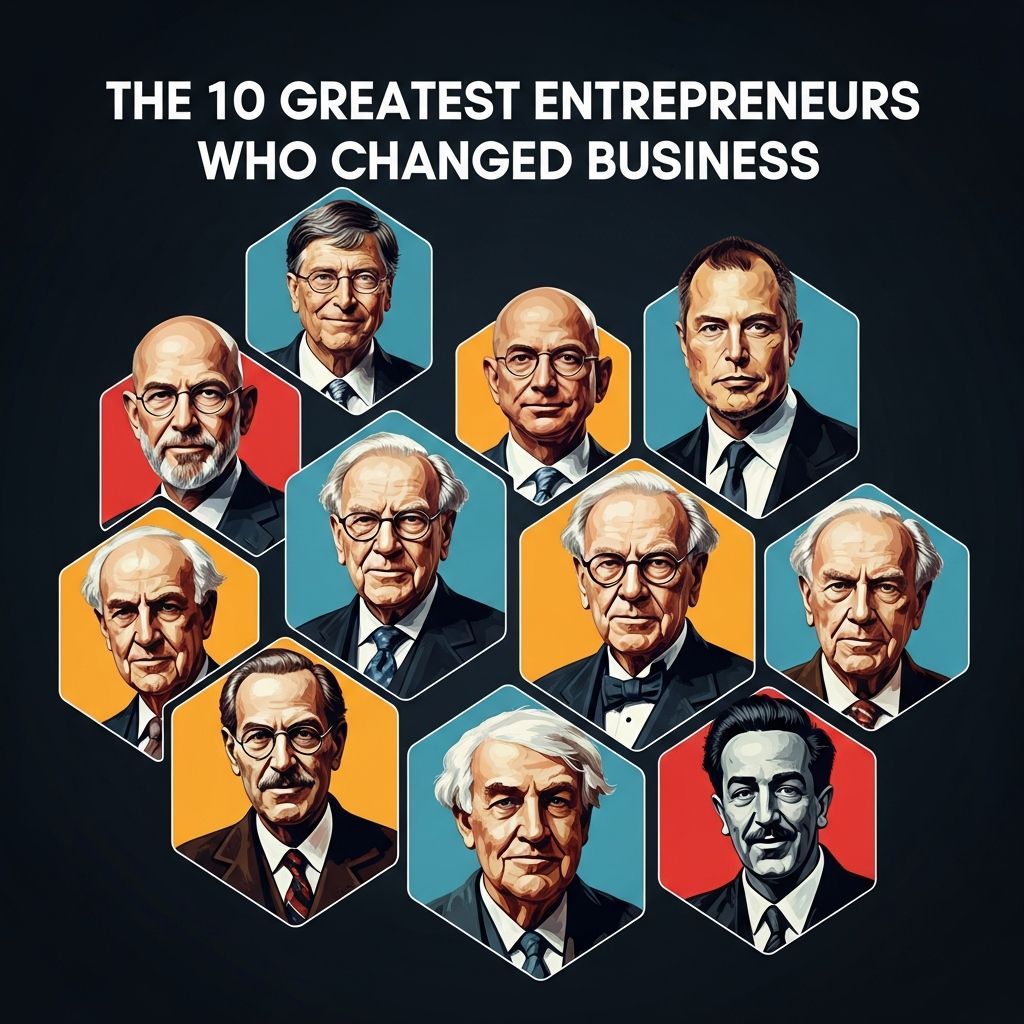
Throughout history, certain individuals have demonstrated exceptional vision, determination, and business acumen that has fundamentally transformed entire industries and reshaped the global economy. These entrepreneurs did not merely build successful companies; they created business models, technologies, and systems that revolutionized how commerce operates and how society functions. Their legacies extend far beyond profit margins and market share, influencing everything from daily consumer habits to technological advancement and social progress.
The definition of a great entrepreneur extends beyond simply achieving financial success. True entrepreneurial greatness involves identifying unmet market needs, developing innovative solutions, taking calculated risks, and building organizations that outlast their founders. The entrepreneurs featured in this analysis have each contributed uniquely to business history, whether through pioneering new industries, democratizing products and services, or fundamentally changing business practices.
1. John D. Rockefeller – The Oil Magnate Who Shaped Modern Industry
John D. Rockefeller stands as one of the most influential figures in business history, building Standard Oil into the world’s dominant petroleum company during the late 19th and early 20th centuries. Rockefeller’s entrepreneurial genius lay not just in his ability to extract and refine oil, but in his revolutionary approach to business consolidation and operational efficiency.
Beginning with a single refinery in Cleveland, Ohio, Rockefeller methodically consolidated the fragmented oil refining industry through a combination of competitive advantages and strategic acquisitions. He understood that controlling the distribution and refining of oil was more profitable than oil extraction alone. By implementing vertical integration—controlling every stage from production to distribution—Rockefeller created unprecedented economies of scale.
Rockefeller’s impact on business practice proved transformative. He established standardized business processes, invested heavily in research and development, and created a corporate structure that became a model for large-scale enterprises. While his monopolistic practices eventually led to antitrust action under the Sherman Act, his business methods became the foundation for modern corporate organization.
2. Andrew Carnegie – The Steel Industry Pioneer
Andrew Carnegie revolutionized the American steel industry by implementing new production technologies and business strategies that dramatically reduced manufacturing costs. A Scottish immigrant who arrived in America with minimal resources, Carnegie built U.S. Steel into the world’s largest steel manufacturer, personally accumulating one of history’s greatest fortunes.
Carnegie’s entrepreneurial approach focused on operational excellence and continuous improvement. He embraced the latest technologies, including the Bessemer process, which significantly improved steel production efficiency. More importantly, Carnegie understood that vertical integration and economies of scale were essential to competitive advantage. He acquired raw material sources, transportation infrastructure, and manufacturing facilities to create an integrated steel production system.
Beyond his business achievements, Carnegie’s transformation from industrial magnate to philanthropist established a model for wealth redistribution and social responsibility. His libraries, universities, and cultural institutions demonstrated that entrepreneurial success could serve broader societal purposes, influencing subsequent generations of wealthy entrepreneurs toward charitable giving.
3. Henry Ford – Democratizing Transportation Through Mass Production
Henry Ford fundamentally transformed manufacturing and transportation by developing the assembly line production system and making automobiles affordable for average Americans. Ford’s vision extended beyond building cars; he sought to create products that ordinary working people could purchase, not merely luxury items for the wealthy.
The Model T, introduced in 1908, represented a revolutionary approach to automobile design and manufacturing. Ford standardized components, simplified production processes, and implemented the moving assembly line, which reduced production time and costs dramatically. By focusing on a single model and achieving massive production volumes, Ford achieved unprecedented economies of scale, reducing the Model T’s price from $850 to $290 within a decade.
Ford’s innovation extended to employee relations and compensation. He implemented the five-dollar day, nearly double the prevailing wage, recognizing that well-paid workers represented both a moral imperative and good business sense. These workers formed a stable, productive labor force while also serving as customers who could afford his automobiles, creating a virtuous economic cycle.
4. Thomas Edison – Inventing the Modern Age
Thomas Edison exemplified the entrepreneur-inventor who combined technological innovation with business development. Though not the sole inventor of many technologies he patented, Edison possessed exceptional ability to recognize commercially viable inventions, develop them into marketable products, and build businesses around them.
Edison’s greatest entrepreneurial achievement involved electrification rather than any single invention. He developed not just the incandescent light bulb but also the infrastructure, distribution systems, and business models necessary to bring electric power to homes and businesses. His creation of the electrical utility industry established entirely new markets and transformed modern civilization.
Edison’s approach combined laboratory innovation with shrewd business practice. He understood patent strategy, brand development, and the importance of controlling both technology and distribution channels. His establishment of General Electric created a corporate structure capable of managing complex technological systems and large-scale operations.
5. Walt Disney – Creating Entertainment as a Business Empire
Walt Disney represented a different entrepreneurial model—one based on creative vision combined with business acumen. Rather than manufacturing physical products or extracting raw materials, Disney built an empire on imagination, animation, storytelling, and entertainment innovation.
Disney’s entrepreneurial genius lay in recognizing that animation could become a major entertainment medium and that family entertainment represented an enormous untapped market. He pioneered full-length animated features, revolutionized animation technology, and created a studio system that produced consistent, high-quality content. Beyond animation, Disney expanded into theme parks, television, and consumer products, creating an integrated entertainment ecosystem.
Disney demonstrated that entrepreneurs need not limit themselves to a single product or service. Instead, he showed how to build coherent entertainment experiences across multiple platforms and delivery mechanisms. His theme parks particularly represented innovative entrepreneurship, creating entirely new categories of entertainment and tourism.
6. Steve Jobs – Revolutionizing Personal Computing and Digital Entertainment
Steve Jobs transformed multiple industries—personal computing, animated motion pictures, digital music, and mobile communications—through relentless focus on user experience and design excellence. Jobs understood that technology served human needs and that great products required seamless integration of hardware, software, and user interface design.
Jobs’ founding of Apple Computer challenged IBM’s dominance by making computers accessible and intuitive for ordinary users. The Macintosh introduced graphical user interfaces to mainstream computing, fundamentally changing how people interacted with technology. Later, the iPod, iTunes, and iPhone demonstrated Jobs’ repeated ability to identify emerging markets, envision how technology could serve human desires, and execute product development with exceptional precision.
Jobs proved that entrepreneurs could prioritize aesthetic design and user experience without sacrificing profitability or market dominance. His insistence on simplicity, elegance, and functionality created products that people loved using, generating fierce customer loyalty and premium pricing power. This approach influenced entire industries, from consumer electronics to software design.
7. Oprah Winfrey – Building a Media Empire Through Personal Brand
Oprah Winfrey represents a modern entrepreneurial model based on personal brand, media ownership, and diversified business interests. Starting as a local television news anchor, Winfrey built a talk show that became a global phenomenon, then leveraged that platform into ownership of television networks, magazines, production companies, and various business ventures.
Winfrey’s entrepreneurial achievement laid in recognizing her own value as a brand and building a business ecosystem around that brand. She transitioned from being an employee to owning her production company, negotiating favorable terms with broadcasters, and ultimately becoming majority owner of her television network. Her business empire demonstrates how entrepreneurs can build companies in the media and entertainment sectors through personal equity and brand development.
8. Bill Gates – Software Revolution and Philanthropic Innovation
Bill Gates co-founded Microsoft and built it into the world’s largest software company by recognizing the enormous commercial potential of personal computer operating systems. Gates understood that software represented the true value in computing, not hardware, and that licensing operating systems to multiple manufacturers would create unprecedented market dominance.
Gates’ entrepreneurial strategy involved aggressive competition, strategic licensing, and relentless focus on market share. He recognized early that personal computers would proliferate globally and that whoever controlled the operating system software would achieve enormous competitive advantage and profitability. Microsoft’s operating system, initially developed to meet immediate market needs, became the standard platform upon which the personal computing industry developed.
Like Carnegie before him, Gates transitioned into philanthropy, establishing the Bill & Melinda Gates Foundation and committing his wealth toward addressing global health, education, and poverty challenges. His entrepreneurial innovations in business extended into innovation in charitable giving, demonstrating how business success could fund attempts to solve humanity’s most pressing problems.
9. Jeff Bezos – Revolutionizing Retail Through E-Commerce
Jeff Bezos founded Amazon with a vision to become an “everything store” that leveraged the internet to transform retail fundamentally. Rather than building physical retail locations, Bezos recognized that the internet enabled companies to maintain vast inventories, reduce overhead costs, and reach customers globally with efficient distribution networks.
Bezos’ entrepreneurial approach emphasized long-term value creation over short-term profitability, investing heavily in infrastructure, technology, and logistics capabilities. Amazon Web Services represented additional entrepreneurial innovation, recognizing that the infrastructure built to serve Amazon’s retail operations could serve other businesses, creating an entirely new computing service category.
Bezos demonstrated that modern entrepreneurs could build global commercial empires through digital technology and logistics innovation. His relentless focus on customer experience, operational efficiency, and technological advancement transformed consumer expectations and forced traditional retailers to adapt or decline.
10. Elon Musk – Pushing Boundaries Across Multiple Industries
Elon Musk represents a contemporary entrepreneurial model characterized by bold vision, technological ambition, and willingness to challenge established industries. Through companies including PayPal, Tesla, SpaceX, and others, Musk has pursued transformative projects in electric vehicles, sustainable energy, and space exploration.
Musk’s entrepreneurial approach combines technical expertise with visionary ambition. Rather than optimizing existing business models, Musk starts with ambitious goals—sustainable energy, Mars colonization, advanced transportation—then builds companies and acquires necessary technology to achieve these objectives. This approach differs from many entrepreneurs who identify market opportunities and build businesses to fill them.
Tesla transformed the automotive industry by proving that electric vehicles could achieve performance, luxury, and desirability equal to or exceeding internal combustion vehicles. SpaceX reduced space launch costs dramatically through technological innovation and vertical integration, enabling new space-based applications and commerce.
Common Characteristics of Great Entrepreneurs
Analyzing these ten remarkable entrepreneurs reveals common characteristics that appear across different industries and historical periods:
Vision and Innovation
Each entrepreneur possessed the ability to envision possibilities others could not perceive. They identified underserved markets, recognized technological opportunities, or saw how existing products could be fundamentally improved or reimagined. Their vision extended beyond immediate profit to creating new categories of commerce or dramatically transforming existing industries.
Operational Excellence
Beyond vision, great entrepreneurs demonstrated exceptional ability to execute their ideas. They built organizations, hired talented people, implemented effective systems, and maintained relentless focus on operational efficiency. Many achieved competitive advantage not through a single innovation but through superior execution across all business functions.
Risk Taking and Resilience
Entrepreneurship inherently involves risk and uncertainty. These individuals demonstrated willingness to invest substantial resources in ventures with uncertain outcomes. Equally important, they showed resilience when facing setbacks, learning from failures, and adjusting strategies without abandoning core visions.
Customer Focus
Great entrepreneurs maintained deep understanding of customer needs and preferences. Rather than simply producing what they could manufacture, they focused on creating value for customers, whether through lower prices, improved quality, greater convenience, or entirely new experiences.
Frequently Asked Questions
Q: What defines an entrepreneur?
An entrepreneur is someone who identifies business opportunities, assembles necessary resources, takes substantial risk, and builds organizations to create value. Entrepreneurs combine vision, risk-taking, and operational execution to create new businesses or transform existing industries.
Q: Can anyone become an entrepreneur?
While specific circumstances and resources facilitate entrepreneurship, many individuals across diverse backgrounds have achieved entrepreneurial success. Key requirements include identifying genuine market opportunities, acquiring necessary skills or surrounding yourself with skilled people, securing adequate capital or resources, and maintaining persistent effort despite obstacles.
Q: What distinguishes great entrepreneurs from merely successful business owners?
Great entrepreneurs typically build organizations that outlast their founders, create new industries or categories, fundamentally transform how commerce operates, and achieve impact extending beyond financial profit. Many also contribute significantly to society through philanthropy or addressing major social challenges.
Q: How important is timing to entrepreneurial success?
Timing proves critically important but not determinative. Great entrepreneurs recognize when technological, social, or economic conditions create opportunities for their ventures. However, many successful entrepreneurs also create timing advantages through superior execution and market education, bringing viable products to markets before they recognize demand.
Q: What role does failure play in entrepreneurial development?
Most great entrepreneurs experienced significant failures before major successes. These failures provided valuable learning experiences, revealing what approaches don’t work, which customers truly value, and how markets respond to different strategies. Resilience and learning from failure distinguish entrepreneurs who ultimately succeed from those who quit prematurely.
References
- The History of Standard Oil Company — U.S. Department of Justice, Antitrust Division. Historical records. https://www.justice.gov/atr/history
- Henry Ford and the Assembly Line Revolution — The Henry Ford Museum. Educational resources. https://www.thehenryford.org
- Edison’s Contributions to the Electric Power Industry — National Geographic History Archives. 2024. https://www.nationalgeographic.com
- Disney Innovation and Theme Park Development — The Walt Disney Company Archives. Historical documentation. https://thewaltdisneystudios.com
- Apple Inc. Product Innovation and Market Strategy — Universum Global Business Research. 2024. https://universumglobal.com
- E-Commerce Revolution and Market Transformation — Statista Digital Market Research. 2024. https://www.statista.com
Similar Articles








Read full bio of medha deb