10/1 ARM vs 30-Year Fixed: Key Differences
Discover how a 10/1 ARM stacks up against a 30-year fixed mortgage, from rates to payments and long-term costs.
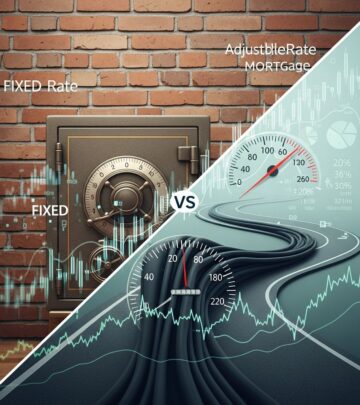
Choosing between a 10/1 adjustable-rate mortgage (ARM) and a 30-year fixed-rate mortgage involves weighing initial savings against long-term predictability. A 10/1 ARM locks in a lower rate for the first decade before annual adjustments, while a 30-year fixed offers unchanging payments over three decades.
Understanding Mortgage Fundamentals
Mortgages finance home purchases by allowing borrowers to pay over time with interest. Fixed-rate loans maintain the same rate throughout, providing budget certainty. ARMs start with a fixed period before rates shift based on market indexes plus a lender margin.
The 10/1 ARM specifically features 10 years of stability followed by yearly changes, appealing to those planning short-term ownership. In contrast, 90% of buyers opt for 30-year fixed loans for their reliability.
Core Structural Differences
| Feature | 10/1 ARM | 30-Year Fixed |
|---|---|---|
| Initial Rate | Typically lower, e.g., around 6.75% in 2025 samples | Higher but stable, averaging 6.83% then |
| Rate Lock Period | 10 years | Full 30 years |
| Adjustments | Annual after year 10 | None |
| Rate Caps | Periodic, lifetime limits on increases | Not applicable |
| Payment Predictability | Fixed first 10 years, then variable | Consistent throughout |
| Common Term | 30 years total | 30 years |
This table highlights how ARMs prioritize early affordability, while fixed loans emphasize consistency.
Rate Dynamics and Introductory Periods
10/1 ARMs attract with teaser rates below fixed options, reducing early payments. For instance, historical data shows ARMs at 2.895% APR versus 3.575% for 30-year fixed on similar loans. Current 2026 rates place 30-year fixed VA at 5.93% APR and 10-year fixed around 5.86%, suggesting ARMs remain competitive initially.
Post-introductory, ARM rates tie to indexes like SOFR plus margins, with caps limiting jumps—often 2% per year and 5-6% lifetime. Fixed rates avoid this volatility entirely.
Payment Implications Over Time
Monthly payments on a 10/1 ARM stay low initially but can rise post-adjustment. A $350,000 loan at 6.49% ARM versus 6.99% fixed shows lower outlays in the first decade for the ARM, though later hikes depend on rates. Fixed payments include principal, interest, taxes, and insurance (PITI) without rate surprises.
Shorter fixed terms like 10-year amplify payments but slash interest. For $250,000 at 3%, a 10-year fixed demands $2,414 monthly versus $1,054 for 30-year, totaling $289,680 interest paid versus $379,440.
Equity Accumulation and Loan Payoff
ARMs build equity steadily in the fixed phase akin to fixed loans but risk slower progress if rates climb. After 5 years on a $250,000 loan, a 10-year fixed builds $142,784 equity versus $70,375 for 30-year. By year 10, the shorter loan is paid off, maximizing ownership.
- 10-year fixed: Zero balance after 120 payments, full equity plus appreciation.
- 30-year fixed: Balance drops gradually, e.g., $155,268 after 10 years.
- 10/1 ARM: Equity mirrors fixed initially, then varies with adjustments.
Financial Scenarios and Cost Projections
For a $300,000 loan:
| Loan Type | APR | Monthly P&I | Total Interest (Full Term) |
|---|---|---|---|
| 10-Year Fixed | 3.90% | $3,225 | $66,959 |
| 15-Year Fixed | 4.75% | $2,489 | $128,031 |
| 30-Year Fixed | 5.00% | $1,718 | $298,419 |
Shorter terms demand higher payments but save massively on interest. ARMs fit mid-term plans, potentially saving if sold before adjustments.
Ideal Candidates for Each Option
Opt for 10/1 ARM If:
- You anticipate moving within 10 years.
- Current rates are elevated, favoring low intro periods.
- Your income supports potential future increases.
- You seek maximum early affordability.
Choose 30-Year Fixed If:
- This is your long-term residence.
- Budget stability is paramount.
- Rates are historically low at purchase.
- You prefer avoiding market risks.
ARMs suit transient buyers or rate optimists; fixed loans favor settlers.
Risks and Mitigation Strategies
ARM risks include payment shock if rates surge—mitigated by caps and shopping margins. Fixed loans risk locking in high rates, addressable via refinancing. Both require strong credit; ARMs demand rate adjustment planning.
Hybrid strategies: Start with ARM, refinance to fixed pre-adjustment if rates drop.
Current Market Insights for 2026
As of March 2026, 30-year fixed rates hover around 5.93-6.32% APR, with shorter terms slightly lower. ARMs continue offering intro edges, but monitor Treasury yields influencing adjustments. Shop multiple lenders for best terms.
Frequently Asked Questions
What happens after the 10-year fixed period in a 10/1 ARM?
The rate adjusts annually based on an index plus margin, capped to prevent extreme jumps.
Are 10/1 ARMs cheaper overall than 30-year fixed?
Often yes in the first 10 years due to lower rates, but total costs depend on adjustment paths and sell timing.
Can I refinance from an ARM to fixed?
Yes, typically after the intro period or anytime, subject to credit and market rates.
How do credit scores impact these loans?
Higher scores unlock best rates; ARMs may scrutinize debt-to-income more for adjustment risks.
Is a 10-year fixed mortgage the same as 10/1 ARM?
No—a 10-year fixed pays off in 10 years with higher payments; 10/1 ARM extends to 30 years post-adjustment.
Steps to Decide Your Mortgage
- Assess homeownership timeline.
- Run affordability calculators for scenarios.
- Compare current rates from lenders.
- Consult a mortgage advisor.
- Factor taxes, insurance, and closing costs.
Align choice with financial goals for optimal outcomes.
References
- Compare 10 & 30 Year Fixed Rate Mortgages — MortgageCalculator.org. 2017-04-17. https://www.mortgagecalculator.org/calcs/10-vs-30-year-mortgage.php
- 10/1 ARM vs. 30-Year Fixed Mortgage: What’s the Difference? — Experian. 2025-04. https://www.experian.com/blogs/ask-experian/10-1-arm-vs-30-year-fixed-mortgage/
- 10/1 Or 10/6 ARM Vs. 30-Year Fixed-Rate Mortgage — Bankrate. N/A. https://www.bankrate.com/mortgages/101-arm-vs-30-year-fixed-mortgage/
- 10 vs 20 vs 30 Year Fixed Mortgages: Which to Choose? — White River Credit Union. N/A. https://whiterivercu.com/news/fixed-mortgages-which-to-choose/
- Today’s Mortgage Rates — NerdWallet. 2026-03-31. https://www.nerdwallet.com/mortgages/mortgage-rates
- Comparing a 10, 15 and 30 Year Mortgage — First Tech Federal Credit Union. N/A. https://www.firsttechfed.com/articles/mortgage/comparing-a-10-15-and-30-year-mortgage
Similar Articles








Read full bio of medha deb